. 2002 Oct;5(10):1010-5.
doi: 10.1038/nn914.

What constitutes an efficient reference frame for vision?

Affiliations

What constitutes an efficient reference frame for vision?

Duje Tadin et al. Nat Neurosci. 2002 Oct.

Abstract

Vision requires a reference frame. To what extent does this reference frame depend on the structure of the visual input, rather than just on retinal landmarks? This question is particularly relevant to the perception of dynamic scenes, when keeping track of external motion relative to the retina is difficult. We tested human subjects' ability to discriminate the motion and temporal coherence of changing elements that were embedded in global patterns and whose perceptual organization was manipulated in a way that caused only minor changes to the retinal image. Coherence discriminations were always better when local elements were perceived to be organized as a global moving form than when they were perceived to be unorganized, individually moving entities. Our results indicate that perceived form influences the neural representation of its component features, and from this, we propose a new method for studying perceptual organization.


Conflict of interest statement

Competing interests statement

The authors declare that they have no competing financial interests.

Figures
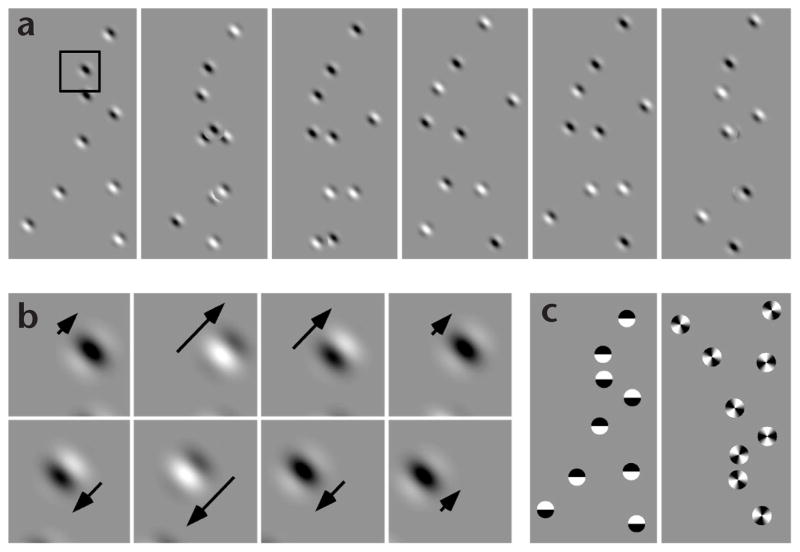
Fig. 1
Fig. 1
Point-light walker animations. (a) Six frames illustrating the 60-frame point-light walker (PLW) animation defined by Gabor patches. Animation duration was ~1.4 s. Each frame in isolation appears as a random pattern of Gabor patches, but when the animation is set into motion, human form is readily perceived. Sequentially shifting the gaze from frame to frame may give a weak impression of biological motion. In actual experiments, however, observers did not visually pursue the PLW, but fixated at the fixation cross in the center of the screen. (b) Eight frames showing a full cycle of 2-Hz oscillatory motion of the grating within the Gabor patch that defines the shoulder of the PLW. The first frame corresponds to the outlined region in panel (a). Arrows indicate motion direction and speed of the grating. Note that the position of the entire Gabor patch changes from frame to frame. The magnitude of this position change depends on the Gabor location, with the ‘wrist Gabors’ undergoing the largest position changes. (c) First frames from biological motion animations defined by counter-phasing black/white disks (left) and rotationally oscillating windmills (right, illustrating the inverted condition).
Fig. 2
Fig. 2
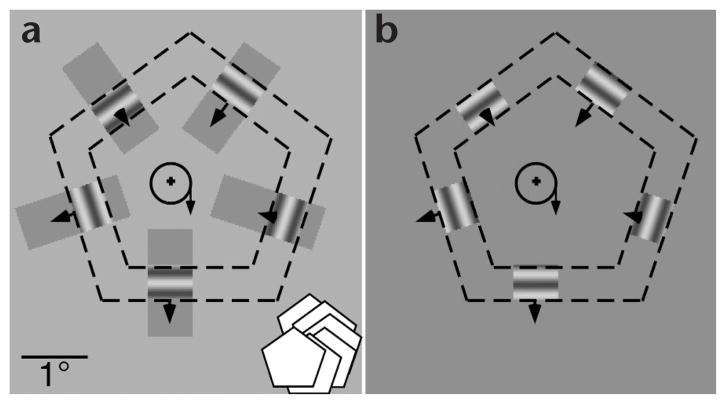
Translating pentagon animations. (a) A translating pentagon was presented behind five apertures (dashed outline is for illustration only). The pentagon translated clockwise along the circular path (as illustrated by the schematic in the bottom right corner). The circle inside the pentagon represents the path taken. The arrow on the circle marks the current position along the path and the direction of translation. The motion of the pentagon results in the back and forth motion of the line segments within apertures. Arrows mark the locations where the line segments would shift as the pentagon moves from the 3 o’clock to the 6 o’clock position. Note that direction and speed vary among different line segments, as depicted by the variable lengths of the arrows. When the apertures were visible (as shown), observers perceived a translating pentagon shape. Independent of the pentagon translation, five gratings oscillated either coherently or incoherently within the limits of pentagon sides. (b) Same display except that the luminance of the aperture mask is the same as the background, rendering the apertures invisible. In this condition, observers saw only back and forth motion of the line segments, with no global form information.
Fig. 3
Fig. 3
Results from PLW experiments. (ac) Psychometric functions for upright and inverted PLW conditions for observer BF—oscillating Gabor patches (a), counterphasing black/white disks (b), and rotationally oscillating windmills (c). Vertical error bars show s.e.m. for each data point. Horizontal error bars (placed on the 82% point on the psychometric functions) show 95% confidence intervals around threshold estimates. (d, e) Phase range thresholds (82% correct) for two other observers. Thresholds larger than 1 indicate that observers’ accuracy was below the 82% criterion at the maximum possible phase range (360°). Error bars show 95% confidence intervals around threshold estimates. (f) Phase range thresholds for oscillating Gabor patches embedded in stationary PLW displays for two observers. Note the reduced range of the y-axis, indicating that the thresholds were significantly lower when the Gabor patches were embedded in a stationary pattern. Error bars follow the same convention as (d) and (e).
Fig. 4
Fig. 4
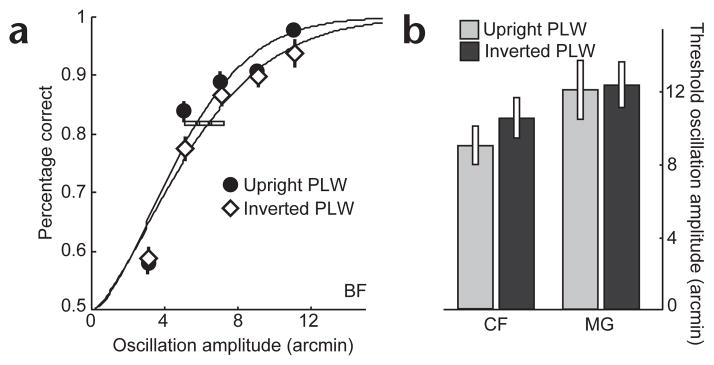
Results from the motion detection task. (a) Psychometric functions for upright and inverted PLW conditions for observer BF. (b) Oscillation amplitude thresholds (82% correct) for two other observers. Vertical and horizontal error bars follow the same convention as Fig. 3.
Fig. 5
Fig. 5
Results from MP experiments. Psychometric functions for visible and invisible aperture conditions in a motion coherence task for observers DT and EG in the translating (a, b) and stationary (c, d) pentagon experiments. Note the reduced range of the x-axis in (c) and (d), indicating that when the pentagon was stationary, motion coherence thresholds were significantly reduced. Vertical and horizontal error bars follow the same convention as Fig. 3.

References

    1. Boussaoud D, Bremmer F. Gaze effects in the cerebral cortex: reference frames for space coding and action. Exp Brain Res. 1999;128:170–180. - PubMed
    1. Buneo CA, Jarvis MR, Batista AP, Andersen RA. Direct visuomotor transformations for reaching. Nature. 2002;416:632–636. - PubMed
    1. Soechting JF, Flanders M. Moving in three-dimensional space: frames of reference, vectors, and coordinate systems. Annu Rev Neurosci. 1992;15:167–191. - PubMed
    1. Felleman DJ, Van Essen DC. Distributed hierarchical processing in the primate cerebral cortex. Cereb Cortex. 1991;1:1–47. - PubMed
    1. Bradley DC, Maxwell M, Andersen RA, Banks MS, Shenoy KV. Mechanisms of heading perception in primate visual cortex. Science. 1996;273:1544–1547. - PubMed

Publication types

MeSH terms