. 2002 Sep;13(9):3294-302.
doi: 10.1091/mbc.e02-02-0095.

Membrane trafficking of heterotrimeric G proteins via the endoplasmic reticulum and Golgi

Affiliations

Membrane trafficking of heterotrimeric G proteins via the endoplasmic reticulum and Golgi

David Michaelson et al. Mol Biol Cell. 2002 Sep.

Abstract

Membrane targeting of G-protein alphabetagamma heterotrimers was investigated in live cells by use of Galpha and Ggamma subunits tagged with spectral mutants of green fluorescent protein. Unlike Ras proteins, Gbetagamma contains a single targeting signal, the CAAX motif, which directed the dimer to the endoplasmic reticulum. Endomembrane localization of farnesylated Ggamma(1), but not geranylgeranylated Ggamma(2), required carboxyl methylation. Targeting of the heterotrimer to the plasma membrane (PM) required coexpression of all three subunits, combining the CAAX motif of Ggamma with the fatty acyl modifications of Galpha. Galpha associated with Gbetagamma on the Golgi and palmitoylation of Galpha was required for translocation of the heterotrimer to the PM. Thus, two separate signals, analogous to the dual-signal targeting mechanism of Ras proteins, cooperate to target heterotrimeric G proteins to the PM via the endomembrane.


Figures
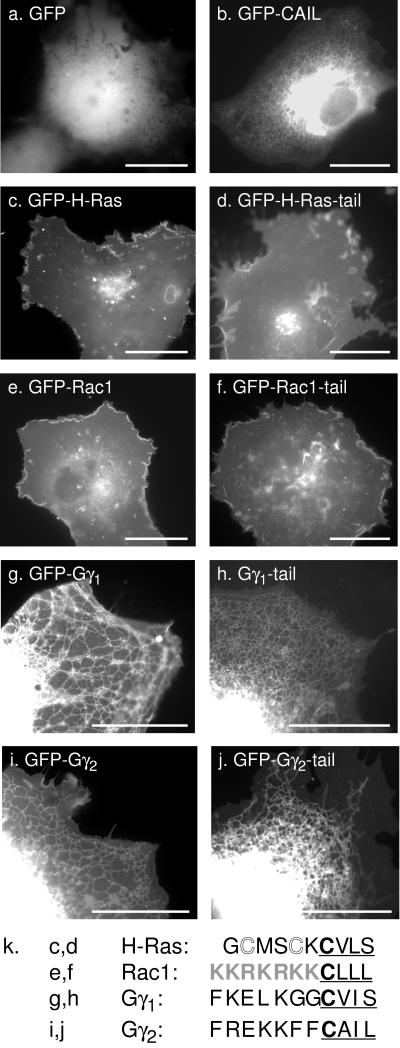
Figure 1
Figure 1
Gγ subunits are targeted by their CAAX sequence to endomembrane but lack intrinsic secondary PM targeting signals. COS-1 cells were transfected with plasmids directing expression of GFP alone (a), GFP fused to the Gγ2 CAAX sequence, CAIL (b), GFP-H-Ras (c), GFP-H-Ras tail (d), GFP-Rac1 (e), GFP-Rac1 tail (f), GFP-Gγ1 (g), GFP-Gγ1 tail (h), GFP-Gγ2 (i), or GFP-Gγ2 tail (j) and imaged 24 h later alive by digital epifluorescence microscopy using a high-resolution cooled CCD camera. Bars, 10 μm. Amino acid sequence comparison of the C-terminal hypervariable regions of H-Ras, Rac1, Gγ1, and Gγ2 (k). The CAAX motif is underlined, the palmitoylation sites of H-Ras are shown in outline font, and the polybasic region of Rac1 is shaded.
Figure 2
Figure 2
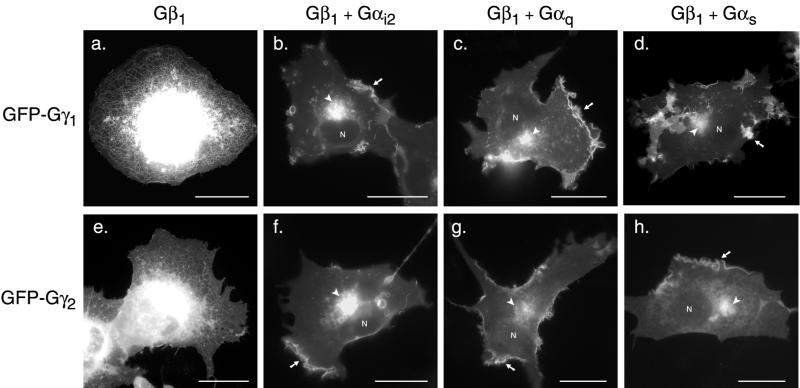
Gα subunits provide a PM-targeting second signal for Gβγ. COS-1 cells were transfected with GFP-Gγ1 (a–d) or GFP-Gγ2 (e–h) and cotransfected with Gβ1 alone (a, e), Gβ1 and Gαi2 (b, f), Gβ1 and Gαq (c, g), or Gβ1 and Gαs (d, h) and imaged as in Figure 1. Arrows indicate PM, arrowheads indicate Golgi, and the positions of nuclei are marked (N). a and e, The nuclear envelope and Golgi are purposely overexposed to reveal the peripheral reticulum of the ER. Bars, 10 μm.
Figure 3
Figure 3
Gα palmitoylation acts as a second signal for PM targeting of GFP-Gγ. COS-1 cells were transfected with GFP-H-Ras (a, b), GFP-H-Ras with mutated palmitoylation sites (c), GFP-Gγ2 (d–f), or GFP-Gγ1 (g–i). The Gβ1 subunit was coexpressed with GFP-Gγ2 or GFP-Gγ1 as indicated (d–i) along with either Gαi2 (d, e, g, h) or palmitoylation-deficient Gαi2C3S (f, i). An inhibitor of palmitoylation, 2-BP, was added in b, e, and h. Bars, 10 μm.
Figure 4
Figure 4
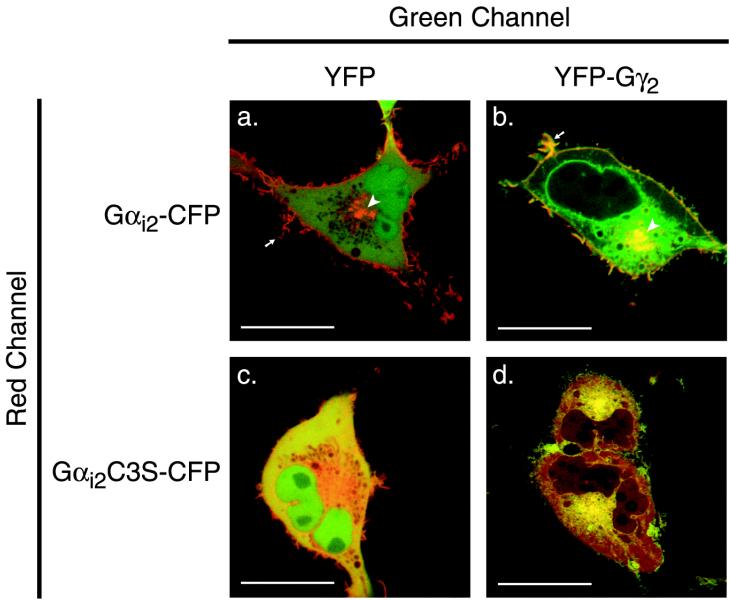
Gα and Gβγ colocalize on Golgi. COS-1 cells were cotransfected with Gαi2-CFP (a and b) or Gαi2C3S-CFP (c and d) and either YFP plus Gβ1 (a and c) or YFP-Gγ2 plus Gβ1 (b and d). Dual color images of living cells were imaged 24 h after transfection with a Zeiss 510 LSM. The CFP channel is assigned red, the YFP channel is assigned green, and colocalization is indicated by yellow pseudocolor. Arrows indicate PM ruffles, and the arrowhead indicates Golgi. Bars, 10 μm.
Figure 5
Figure 5
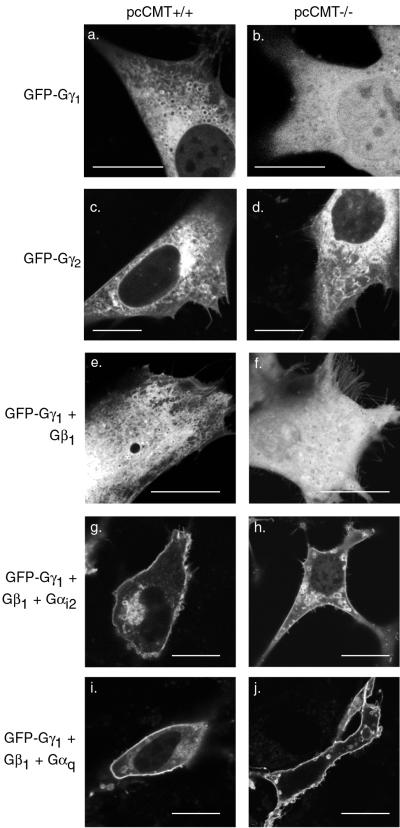
Endomembrane targeting of farnesylated GFP-Gγ1, but not geranylgeranylated GFP-Gγ2, requires pcCMT. GFP-Gγ1 (a, b, e–j) or GFP-Gγ2 (c and d) were transfected into CMT+/+ (a, c, e, g, and i) or CMT−/− (b, d, f, h, and j) MEFs alone (a–d) or with either Gβ1 only (e and f), or Gβ1 and Gαi2 (g and h), or Gβ1 and Gαq (i and j) and imaged alive 24 h later by LSM. GFP-Gγ1 remained in the cytosol and nucleoplasm in CMT−/− cells when expressed alone or coexpressed only with Gβ1 but was localized to PM when coexpressed with Gβ1 and either Gα subunit. Bars, 10 μm.
Figure 6
Figure 6
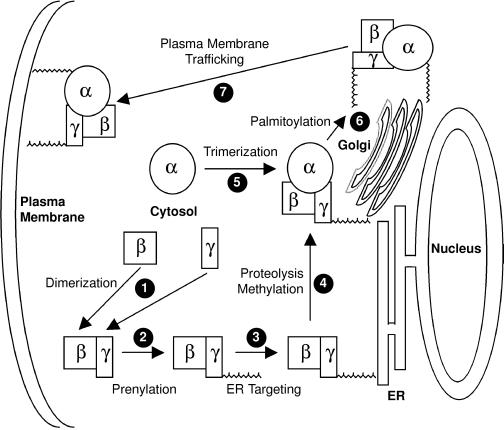
Model of G-protein trafficking to the PM. All three G protein subunits are synthesized in the cytosol on free polysomes. Gβ and Gγ immediately dimerize on the basis of their high affinity for each other (1). Whether this occurs before or after Gγ prenylation is uncertain. Prenylation of Gγ (2) drives Gβγ to the cytosolic face of the ER (3), where it encounters the CAAX protease and carboxyl methyltransferase (4). Fully processed Gβγ is then delivered to the cytosolic face of the Golgi, where it recruits Gα (5), which is then acylated by a Golgi resident acyl transferase (6). Acylation then allows the G protein heterotrimer to be transported as a holoenzyme to the PM via a route (7) that may be the classic secretory pathway.

References

    1. Apolloni A, Prior IA, Lindsay M, Parton RG, Hancock JF. H-ras but not K-ras traffics to the plasma membrane through the exocytic pathway. Mol Cell Biol. 2000;20:2475–2487. - PMC - PubMed
    1. Bergo MO, Leung GK, Ambroziak P, Otto JC, Casey PJ, Gomes AQ, Seabra MC, Young SG. Isoprenylcysteine carboxyl methyltransferase deficiency in mice. J Biol Chem. 2001;276:5841–5845. - PubMed
    1. Bergo MO, Leung GK, Ambroziak P, Otto JC, Casey PJ, Young SG. Targeted inactivation of the isoprenylcysteine carboxyl methyltransferase gene causes mislocalization of K-Ras in mammalian cells. J Biol Chem. 2000;275:17605–17610. - PubMed
    1. Choy E, Chiu VK, Silletti J, Feoktistov M, Morimoto T, Michaelson D, Ivanov IE, Philips MR. Endomembrane trafficking of ras: the CAAX motif targets proteins to the ER and Golgi. Cell. 1999;98:69–80. - PubMed
    1. Clarke S. Protein isoprenylation and methylation at carboxyl terminal cysteine residues. Annu Rev Biochem. 1992;61:355–386. - PubMed

Publication types

MeSH terms

LinkOut - more resources