Contrast-enhanced 2D cine phase MR angiography for measurement of basilar artery blood flow in posterior circulation ischemia
- PMID: 12223376
- PMCID: PMC7976251
Contrast-enhanced 2D cine phase MR angiography for measurement of basilar artery blood flow in posterior circulation ischemia
Abstract
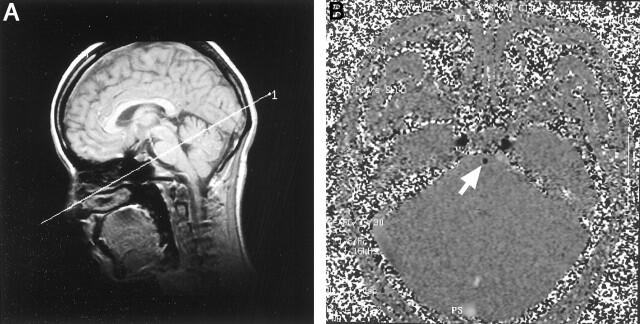
Background and purpose: Dizziness is a symptom that develops with internal ear disturbances and with dysfunctions of the brain stem and cerebellum, in particular with blood flow disturbances of the brain stem and cerebellum (posterior circulation ischemia [PCI]). Patients with PCI often present with various neurologic signs and symptoms. To examine the usefulness of contrast-enhanced 2D cine phase MR angiography in the diagnosis of PCI, we examined quantitative blood flow of the basilar artery in patients with PCI who had primarily complained of dizziness.
Methods: We quantitatively measured the blood flow volume rate of the basilar artery by using a contrast-enhanced 2D cine phase MR angiographic technique in 21 patients diagnosed with PCI and in 16 age- and sex-matched control participants.
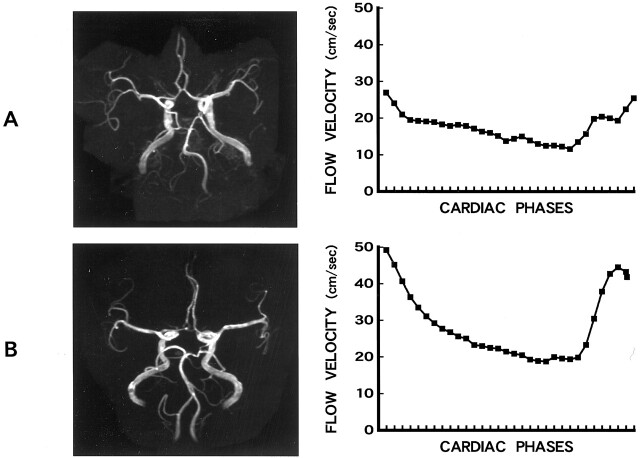
Results: Maximum and mean average flow velocities of the basilar artery in the PCI group were significantly lower than those of the control group (29.2 +/- 9.2 cm/s versus 38.5 +/- 8.2 cm/s [P <.005] and 18.0 +/- 5.6 cm/s versus 22.6 +/- 5.0 cm/s [P <.01], respectively). The flow volume rates of the basilar arteries were also significantly lower in the PCI group (103.3 +/- 37.3 mL/min versus 148.8 +/- 40.0 mL/min [P <.001]).
Conclusion: The flow volume rate of the basilar artery in patients with PCI during intermittent ischemic attacks with dizziness was chronically reduced compared with that in the control participants. This suggests that flow volume rates may influence the development of the clinical signs and symptoms of PCI. We think that contrast-enhanced 2D cine phase MR angiography is a valuable method for the diagnosis of PCI.
Figures
References
-
- Kubik CS, Adams RD. Occlusion of the basilar artery: a clinical and pathological study. Brain 1946;69:73–121 - PubMed
-
- Caplan L. Posterior circulation ischemia: then, now, and tomorrow: The Tomas Willis Lecture—2000. Stroke 2000;31:2011–2023 - PubMed
-
- Williams D, Wilson TG. The diagnosis of the major and minor syndromes of basilar insufficiency. Brain 1962;85:741–774 - PubMed
-
- Corvera J, Benitez LD, Lopez-Rios G, Rabiela MT. Vestibular and oculomotor abnormalities in vertebrobasilar insufficiency. Ann Otol Rhinol Laryngol 1980;89:370–376 - PubMed
-
- Troost BT. Dizziness and vertigo in vertebrobasilar disease: part II. central causes and vertebrobasilar disease. Stroke 1980;11:413–415 - PubMed
Publication types
MeSH terms
Substances
LinkOut - more resources
Full Text Sources
Other Literature Sources
Miscellaneous