Keeping a good pathway down: transcriptional repression of Notch pathway target genes by CSL proteins
- PMID: 12223465
- PMCID: PMC1084223
- DOI: 10.1093/embo-reports/kvf170
Keeping a good pathway down: transcriptional repression of Notch pathway target genes by CSL proteins
Abstract
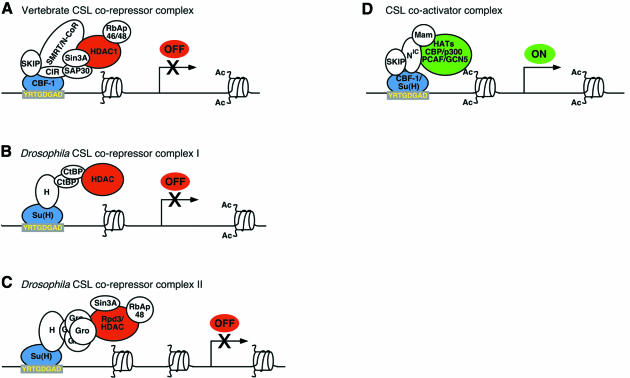
CSL [CBF-1, Su(H), Lag-1]-type transcription factors are the primary effectors of the Notch pathway, a signal transduction cascade that is essential for the development of all metazoan organisms. Interestingly, CSL proteins were originally classified as transcriptional repressors in vertebrates, but as transcriptional activators in model invertebrate organisms. Resolution of this paradox came with the realization that repression and activation by CSL proteins occurs in both systems and that the switch involves recruitment of distinct co-repressor and co-activator complexes. Although CSL proteins appear to utilize a common co-activator complex of largely similar constitution, recent studies have demonstrated that vertebrate and Drosophila CSL interact with a variety of distinct co-repressor complexes. This review highlights differences in composition and similarities in function of different CSL co-repressor complexes, which actively repress Notch pathway target genes in the absence of Notch pathway activity.
Figures
References
-
- Artavanis-Tsakonas S., Rand, M.D. and Lake, R.J. (1999) Notch signaling: cell fate control and signal integration in development. Science, 284, 770–776. - PubMed
-
- Bailey A.M. and Posakony, J.W. (1995) Suppressor of Hairless directly activates transcription of Enhancer of split Complex genes in response to Notch receptor activity. Genes Dev., 9, 2609–2622. - PubMed
-
- Bang A.G., Bailey, A.M. and Posakony, J.W. (1995) Hairless promotes stable commitment to the sensory organ precursor cell fate by negatively regulating the activity of the Notch signaling pathway. Dev. Biol., 172, 479–494. - PubMed
-
- Barolo S., Walker, R., Polyanovsky, A., Freschi, G., Keil, T. and Posakony, J.W. (2000) A Notch-independent activity of Suppressor of Hairless is required for normal mechanoreceptor physiology. Cell, 103, 957–969. - PubMed
Publication types
MeSH terms
Substances
LinkOut - more resources
Full Text Sources
Other Literature Sources
Molecular Biology Databases