. 2002 Sep;130(1):68-77.
doi: 10.1104/pp.002428.

VFL, the grapevine FLORICAULA/LEAFY ortholog, is expressed in meristematic regions independently of their fate

Affiliations

VFL, the grapevine FLORICAULA/LEAFY ortholog, is expressed in meristematic regions independently of their fate

María José Carmona et al. Plant Physiol. 2002 Sep.

Abstract

The flowering process in grapevine (Vitis vinifera) takes place in buds and extends for two consecutive growing seasons. To understand the genetic and molecular mechanisms underlying this process, we have characterized grapevine bud development, cloned the grapevine FLORICAULA/LEAFY (FLO/LFY) ortholog, VFL, and analyzed its expression patterns during vegetative and reproductive development. Flowering induction takes place during the first season. Upon induction, the shoot apical meristem begins to produce lateral meristems that will give rise to either inflorescences or tendrils. During the second season, after a winter dormancy period, buds reactivate and inflorescence meristems give rise to flower meristems. VFL is expressed in lateral meristems that give rise to inflorescence and flower meristems, consistent with a role in reproductive development. Furthermore, VFL is also detected in other meristematic regions such as the vegetative shoot apical meristem and the lateral meristems that will give rise to tendrils. VFL is also expressed in leaf primordia and in growing leaf margins until later stages of development. Accumulation of VFL transcripts in cell-proliferating regions suggests a role for VFL not only in flower meristem specification, but also in the maintenance of indeterminacy before the differentiation of derivatives of the apical meristem: flowers, leaves, or tendrils.


Figures
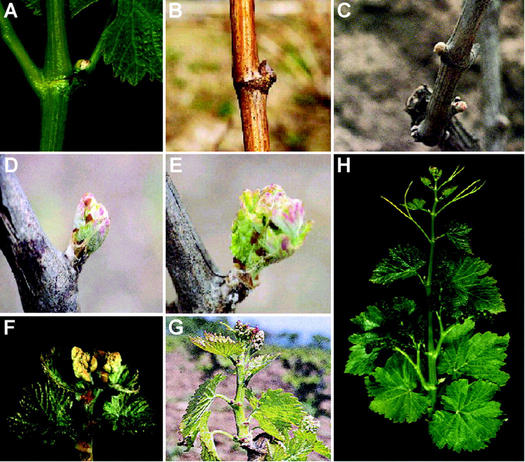
Figure 1
Figure 1
Stages of development in grapevine. A, Newly formed latent bud in the axil of a young leaf. B, Winter bud; phenological stage A according to Baggiolini (1952). C, Swelling bud; phenological stage B. D, Sprouting bud; phenological stage C. E, Phenological stage D. F, Outgrowing shoot; phenological stage E. G, The inflorescences are clearly visible and separated; phenological stage G. H, General view of a growing cane bearing inflorescences with developing flowers at phenological stage H.
Figure 2
Figure 2
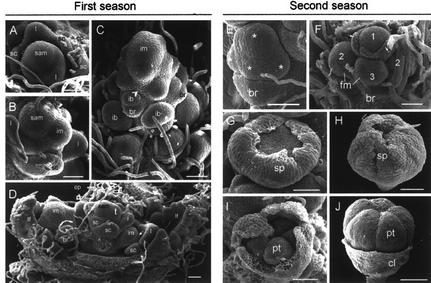
Development of a grapevine var Tempranillo bud and its derivatives as revealed by SEM. A through D, First season; E through J, second season. A, Detail of an April latent bud. The vegetative shoot apical meristem is forming leaf primordia flanked by scales (sc) in spiral phyllotaxis. B, Detail of a June bud. The shoot apical meristem has undergone flowering transition and begins to form lateral inflorescence meristem (im) opposite to leaf primordia. C, Inflorescence meristem in August, around the end of the first season. Notice the spiral phyllotaxis of inflorescence branch meristem (ib). One bract (br) subtends each branch. Only some of the ib and br are indicated. D, General view of a July bud showing the derivatives formed by the SAM (sam) during the 1st year. At this stage, the bud encloses developing leaves (lf), inflorescence meristems (im), newly formed leaf primordia (l), and tendril primordia (t). E, Detail of an inflorescence branch in a bud of phenological stage B–C (second season). The inflorescence branch meristem has divided into three to four flower meristems (asterisks). F, Flower meristems derived from an inflorescence branch in a bud of phenological stage C–D. The terminal flower meristem, labeled as 1, is more advanced in development than flanking 2 and 3. G, Developing flower in a bud of phenological stage E. The sepals (sp) grow to enclose the inner part of the flower. H and I, Developing flower at the end of stage E. In I, sepal primordia have been partially removed to show the petal primordia (pt). J, Flower from phenological stage G shoots. The petals have overgrown the calyx (cl). ep, Epidermal hair. All bars represent 50 μm.
Figure 3
Figure 3
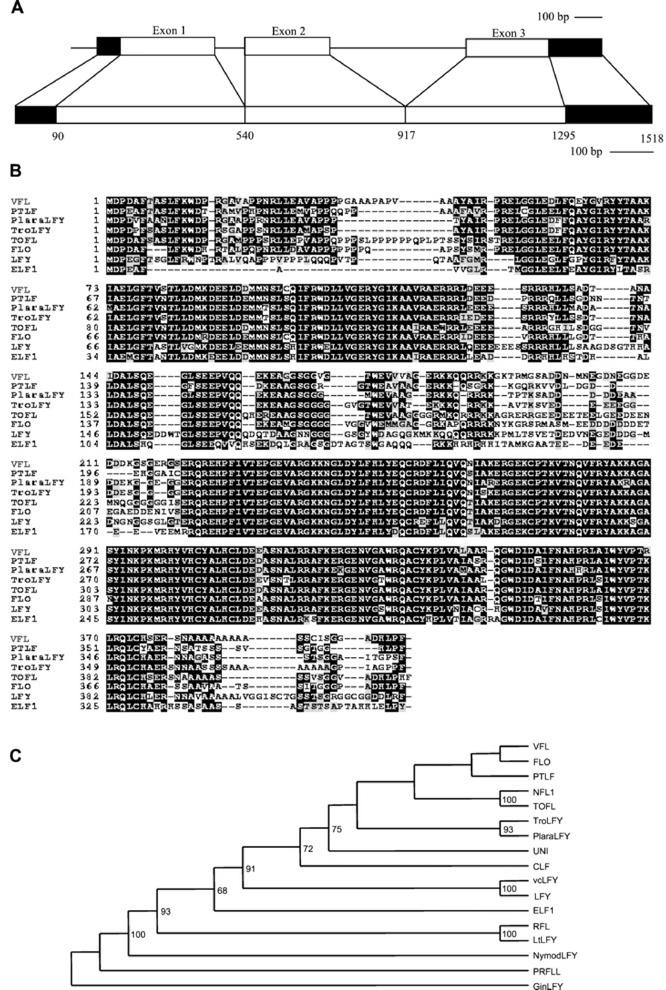
The VFL gene and sequence comparison to FLO/LFY-like proteins. A, Genomic organization of VFL (top) and VFL cDNA (bottom). B, The deduced amino acid sequence of VFL was compared with (accession nos. in parentheses): PTLF from Populus balsamifera (U93196); PlaraLFY from Platanus racemosa (AF106842); TroLFY from Trochodendron aralioides (AF230078); TOFL from tomato (AF197934); FLO from snapdragon (M55525); LFY from Arabidopsis (M91208); and ELF1 from eucalyptus (AF34806). Black boxes indicate identical amino acids, shaded boxes similar residues, and dashed lines gaps introduced to optimize the alignment. Sequences were aligned using the ClustalW program. C, Phylogenetic relationship among FLO/LFY-like proteins. The protein sequences shown in B are included, together with: GinLFY from ginkgo (Ginkgo biloba; AF108228); PRFLL from Monterey pine (U92008); NymodLFY from Nymphaea odorata (AF105110); LtLFY from L. temulentum (AF321273); RFL from rice (AB005620); vcLFY from violet cress (Jonopsidium acaule; AF184589); CFL from cucumber (Cucumis sativus; AF059320); UNI from pea (AF010190); and NFL1 from tobacco (U16172). Bootstrap support values are indicated when over 50.
Figure 4
Figure 4
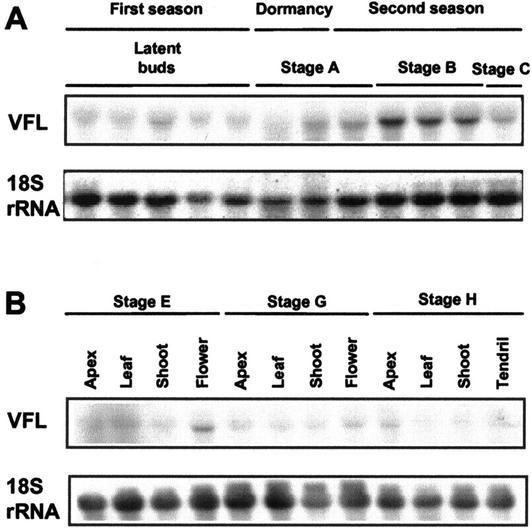
Expression of VFL during grapevine development. A, VFL expression in latent buds (from June to August) in the first growing season, in winter buds (phenological stage A) and in buds from phenological stages B and C during the spring of the second growing season (see “Materials and Methods” for further details). B, VFL expression in different tissues during cane development (phenological stages E, G, and H). For each lane, 25 μg of total RNA was loaded, blotted, and hybridized with a VFL probe. Filters were also hybridized with 18S rRNA as a quantitative control of loading and blotting.
Figure 5
Figure 5
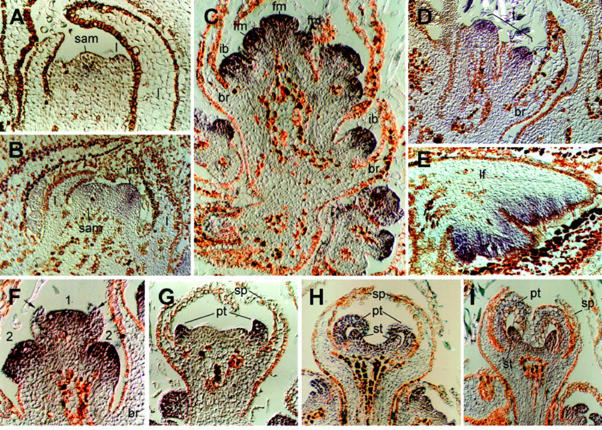
VFL expression patterns during bud development. A, Vegetative bud comparable with that in Figure 2A. VFL accumulates in the inner layers of the SAM and in leaf primordia. B, June bud during floral transition similar to that in Figure 2B. VFL is expressed in the SAM and in the lateral meristem that will develop an inflorescence. C, Inflorescence of a bud of phenological stage B-C, second season, showing accumulation of VFL in inflorescence branches and in newly formed flower meristems. D, Tendril primordia during the second season. VFL accumulates in the apical region of the tendril that is likely to have meristematic activity. E, Developing leaf. VFL accumulates at the growing tips of the leaf. F, Close up of an inflorescence branch comparable with that in Figure 2F where flower meristems have just formed. VFL is strongly expressed in newly formed flower meristems and begins to disappear at the regions where sepal primordia form (arrows). G, Flower comparable with that in Figure 2G. VFL is not detected in sepal primordia but accumulates in the inner part of the flower preferentially in petal primordia. H, Flower comparable with those in Figure 2, H and I. I, Flower corresponding to a stage slightly earlier than the one shown in Figure 2J. VFL is detected at very low levels in petals and at higher levels in stamens. VFL mRNA is absent from the bracts throughout development. Nomenclature is the same as in Figure 2.
Figure 6
Figure 6
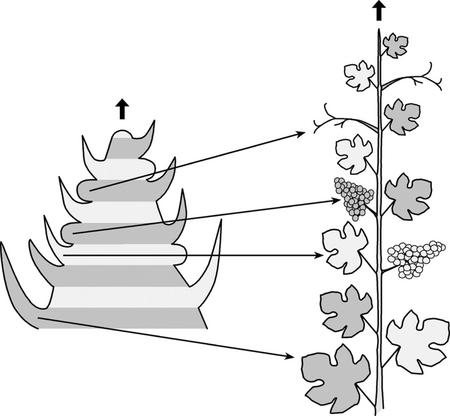
Bud derivatives in grapevine. Left, Schematic representation of a latent bud during the first season showing the phyllotaxis of meristems and primordia at this stage. Right, derivatives formed from those meristems and primordia during the second season. Lateral meristems giving rise to inflorescences or tendrils are indistinguishable in morphology and position at the time they are formed.

References

    1. Araki T. Transition from vegetative to reproductive phase. Curr Opin Plant Biol. 2001;4:63–68. - PubMed
    1. Baggiolini M. Les stades repères dans le developpement annuel de la vigne et leur utilisation pratique. Rev Romande Agric Vitic Arbor. 1952;8:4–6.
    1. Blázquez MA, Soowal LN, Lee I, Weigel D. LEAFY expression and flower initiation in Arabidopsis. Development. 1997;124:3835–3844. - PubMed
    1. Boss PK, Thomas MR. Association of dwarfism and floral induction with a grape “green revolution” mutation. Nature. 2002;416:847–850. - PubMed
    1. Bradley D, Ratcliffe O, Vincent C, Carpenter R, Coen E. Inflorescence commitment and architecture in Arabidopsis. Science. 1997;275:80–83. - PubMed

Publication types

Associated data

LinkOut - more resources