Observational study of vaccine efficacy 14 years after trial of hepatitis B vaccination in Gambian children
- PMID: 12228132
- PMCID: PMC124550
- DOI: 10.1136/bmj.325.7364.569
Observational study of vaccine efficacy 14 years after trial of hepatitis B vaccination in Gambian children
Abstract
Objective: To determine the duration of protection from hepatitis B vaccine given in infancy and early childhood.
Design: Cross sectional serological study of hepatitis B virus infection in children of various ages 14 years after the start of a trial of vaccination regimens.
Setting: Two villages in the Gambia.
Participants: Children and adolescents given hepatitis B vaccine in infancy or early childhood: 232 were aged 1-5 years, 225 aged 5-9 years, 220 aged 10-14 years, and 175 aged 15-19 years.
Main outcome measures: Vaccine efficacy against infection and against chronic infection in the different age groups.
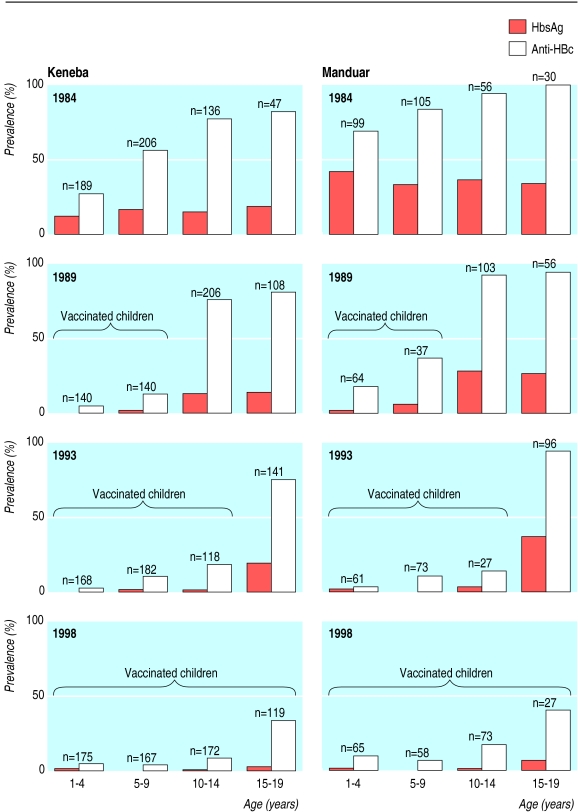
Results: Vaccine efficacy against chronic carriage of hepatitis B virus was 94% (95% confidence interval 89% to 97%), which did not vary significantly between the age groups. Efficacy against infection was 80% (76% to 84%). This was significantly lower in the oldest age group (65%, 56 to 73). Of the uninfected participants in this age group, 36% had no detectable hepatitis B virus surface antibody. Time since vaccination and a low peak antibody response were the most powerful risk factors for breakthrough infection (P<0.001 in each case). Low peak antibody response was also a risk factor for chronic carriage (odds ratio 95, 19 to 466).
Conclusions: Children vaccinated in infancy are at increased risk of hepatitis B virus infection in the late teens. The risk of chronic carriage after sexual exposure needs further assessment to determine if booster vaccines are necessary.
Figures
Comment in
-
Vaccine induced protection against hepatitis B.BMJ. 2003 Jan 11;326(7380):105. doi: 10.1136/bmj.326.7380.105. BMJ. 2003. PMID: 12521983 Free PMC article. No abstract available.
References
-
- World Health Organization. Prevention of primary liver cell cancer. Report on a meeting of a WHO scientific group. Lancet. 1983;i:463–465. - PubMed
-
- Kane MA, Clements J, Hu D. Hepatitis B. In: Jamison OT, Mosley WH, Measham AR, Bobadilla J, editors. Disease control priorities in developing countries. A World Bank Book. New York: Oxford University Press; 1993. pp. 321–330.
-
- Gambia Hepatitis Study Group. The Gambia hepatitis intervention study. Cancer Res. 1987;47:5782–5787. - PubMed
-
- Whittle HC, Bradley AK, McLauchlen K, Ajdukiewicz AB, Howard CR, Zuckerman AJ, et al. Hepatitis B infection in two Gambian villages. Lancet. 1983;i:1203–1206. - PubMed
-
- Whittle H, Inskip H, Bradley AK, McLaughlan K, Shenton F, Lamb W, et al. The pattern of childhood hepatitis B infection in two Gambian villages. J Infect Dis. 1990;161:1112–1115. - PubMed
MeSH terms
Substances
LinkOut - more resources
Full Text Sources