The mental health of UK Gulf war veterans: phase 2 of a two phase cohort study
- PMID: 12228134
- PMCID: PMC124552
- DOI: 10.1136/bmj.325.7364.576
The mental health of UK Gulf war veterans: phase 2 of a two phase cohort study
Abstract
Objectives: To examine the prevalence of psychiatric disorders in veterans of the Gulf war with or without unexplained physical disability (a proxy measure of ill health) and in similarly disabled veterans who had not been deployed to the Gulf war (non-Gulf veterans).
Design: Two phase cohort study.
Setting: Current and ex-service UK military personnel.
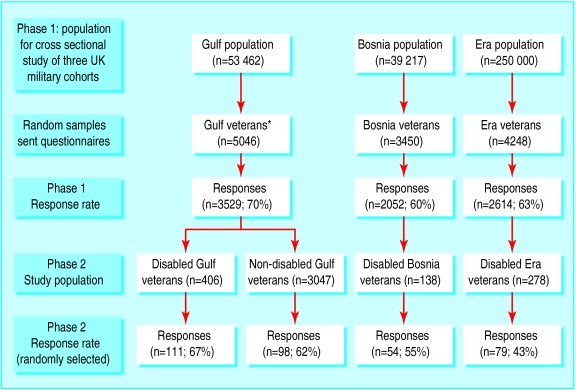
Participants: Phase 1 consisted of three randomly selected samples of Gulf veterans, veterans of the 1992-7 Bosnia peacekeeping mission, and UK military personnel not deployed to the Gulf war (Era veterans) who had completed a postal health questionnaire. Phase 2 consisted of randomly selected subsamples from phase 1 of Gulf veterans who reported physical disability (n=111) or who did not report disability (n=98) and of Bosnia (n=54) and Era (n=79) veterans who reported physical disability.
Main outcome measure: Psychiatric disorders assessed by the schedule for clinical assessment in neuropsychiatry and classified by the Diagnostic and Statistical Manual of Mental Disorders, fourth edition.
Results: Only 24% (n=27) of the disabled Gulf veterans had a formal psychiatric disorder (depression, anxiety, or alcohol related disorder). The prevalence of psychiatric disorders in non-disabled Gulf veterans was 12%. Disability and psychiatric disorders were weakly associated in the Gulf group when confounding was adjusted for (adjusted odds ratio 2.4, 99% confidence interval 0.8 to 7.2, P=0.04). The prevalence of psychiatric disorders was similar in disabled non-Gulf veterans and disabled Gulf veterans ( 19% v 24%; 1.3, 0.5 to 3.4). All groups had rates for post-traumatic stress disorder of between 1% and 3%.
Conclusions: Most disabled Gulf veterans do not have a formal psychiatric disorder. Post-traumatic stress disorder is not higher in Gulf veterans than in other veterans. Psychiatric disorders do not fully explain self reported ill health in Gulf veterans; alternative explanations for persistent ill health in Gulf veterans are needed.
Figures
References
-
- The Iowa Persian Gulf Study Group. Self-reported illnesses and health status among Gulf war veterans. A population based study. JAMA. 1997;277:238–245. - PubMed
-
- Kang H, Mahan C, Lee K, Magee C, Murphy F. Illnesses among United States veterans of the Gulf war: a population-based survey of 30,000 veterans. J Occup Environ Med. 2000;42:491–501. - PubMed
-
- Gray G, Smith T, Kang H, Knoke J. Are Gulf veterans suffering from war-related illnesses? Federal and civilian hospitalizations examined, June 1991 to December 1994. Am J Epidemiol. 2000;151:63–67. - PubMed
-
- Macfarlane G, Thomas E, Cherry N. Mortality among UK Gulf war veterans. Lancet. 2000;356:17–21. - PubMed
-
- Doebbeling B, Clarke W, Watson D, Torner J, Woolson R, Voelker M, et al. Is there a Persian Gulf war syndrome? Evidence from a large population-based survey of veterans and nondeployed controls. Am J Med. 2000;108:695–704. - PubMed
Publication types
MeSH terms
LinkOut - more resources
Full Text Sources
Medical