. 2002 Oct;70(10):5346-54.
doi: 10.1128/IAI.70.10.5346-5354.2002.

The class A macrophage scavenger receptor is a major pattern recognition receptor for Neisseria meningitidis which is independent of lipopolysaccharide and not required for secretory responses

Affiliations

The class A macrophage scavenger receptor is a major pattern recognition receptor for Neisseria meningitidis which is independent of lipopolysaccharide and not required for secretory responses

Leanne Peiser et al. Infect Immun. 2002 Oct.

Abstract

Macrophages (Mphi) play a key role in the pathogenesis of invasive meningococcal infections. The roles of two pattern recognition molecules, the Mphi scavenger receptor (SR-A) and Toll-like receptor 4 (TLR-4), have been investigated using bone marrow culture-derived Mphi (BMMphi). Surprisingly, a comparison of BMMphi from wild-type and SR-A knockout (SR-A(-/-)) mice showed that nonopsonic phagocytosis of meningococci was mediated almost exclusively via SR-A. Previous studies have demonstrated only a partial involvement of the receptor in the uptake of other bacteria, such as Escherichia coli. Interestingly, we also show that lipopolysaccharide (LPS) was not the ligand for the receptor on these organisms. Further study of the downstream events of SR-A-mediated ingestion of Neisseria meningitidis demonstrated that SR-A was not required for cytokine production. To determine the bacterial and host factors required to stimulate Mphi activation, we examined TLR-4-deficient Mphi from C3H/HeJ mice and LPS-deficient meningococci. TLR-4-deficient cells elaborated reduced amounts of tumor necrosis factor alpha, interleukin-12 (IL-12), and IL-10, even though ingestion via SR-A was unaffected in these cells. Similarly, although there was no change in SR-A-mediated ingestion of LPS-deficient meningococci, the mutant failed to stimulate a Mphi-dependent cytokine response. Thus, we show that Mphi SR-A mediates opsonin-independent uptake of N. meningitidis independently of lipid A and that this activity is uncoupled from the Mphi secretion of proinflammatory cytokines, which provides a basis for further investigation of the role of this receptor in meningococcal disease in humans.


Figures
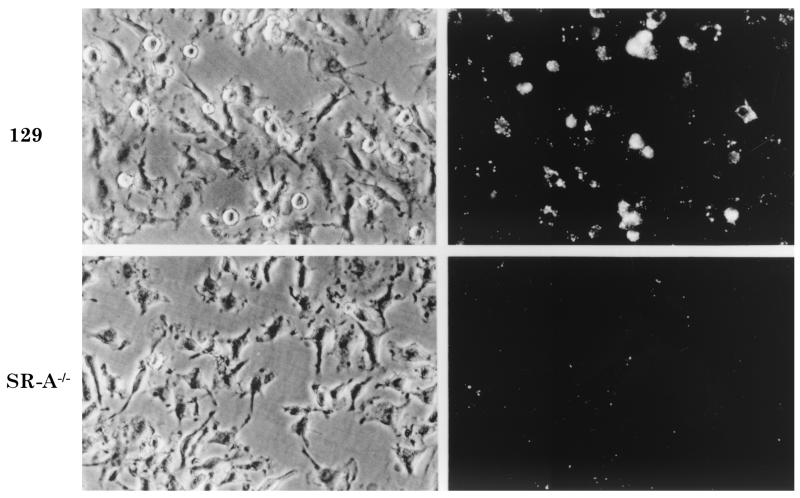
FIG. 1.
FIG. 1.
SR-A−/− Mφ show greatly reduced ability to ingest N. meningitidis. BMMφ from WT or SR-A−/− mice were incubated with ethanol-fixed RdGnX-F8238 (20 bacteria per Mφ) for 2 h at 37°C and analyzed by fluorescence microscopy. Each field depicted is representative of the whole population, and representative fields derived by fluorescence and phase microscopy are shown. Magnification, ×600.
FIG. 2.
FIG. 2.
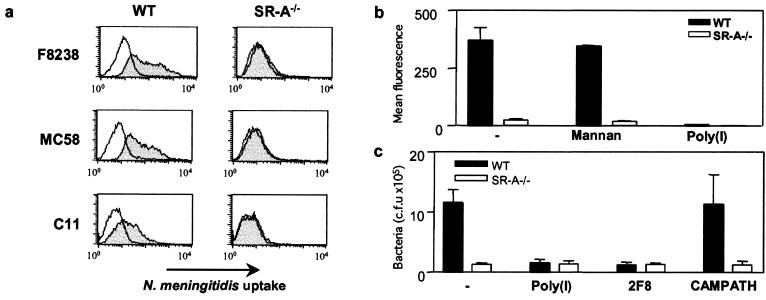
Characterization of SR-A-dependent uptake of N. meningitidis by Mφ. (a) Flow cytometry of WT or SR-A−/− Mφ ingestion of ethanol-fixed, RdGnX-F8238, -MC58, or -C11. The shaded line represents Mφ incubated with bacteria, and the open line represents control cells. (b) BMMφ were incubated with 20 ethanol-fixed RdGnX-MC58 bacteria per cell in the presence or absence of inhibitors at 37°C, and the mean fluorescence for each population was determined by flow cytometry. The average mean fluorescence for each condition is shown. (c) BMMφ were incubated with 50 live MC58 bacteria per cell in the presence or absence of SR-A inhibitors at 37°C. The number of bacteria associated with the Mφ was determined by colony assay. The average number of colonies obtained for each condition is shown. The error bars indicate standard deviations.
FIG. 3.
FIG. 3.
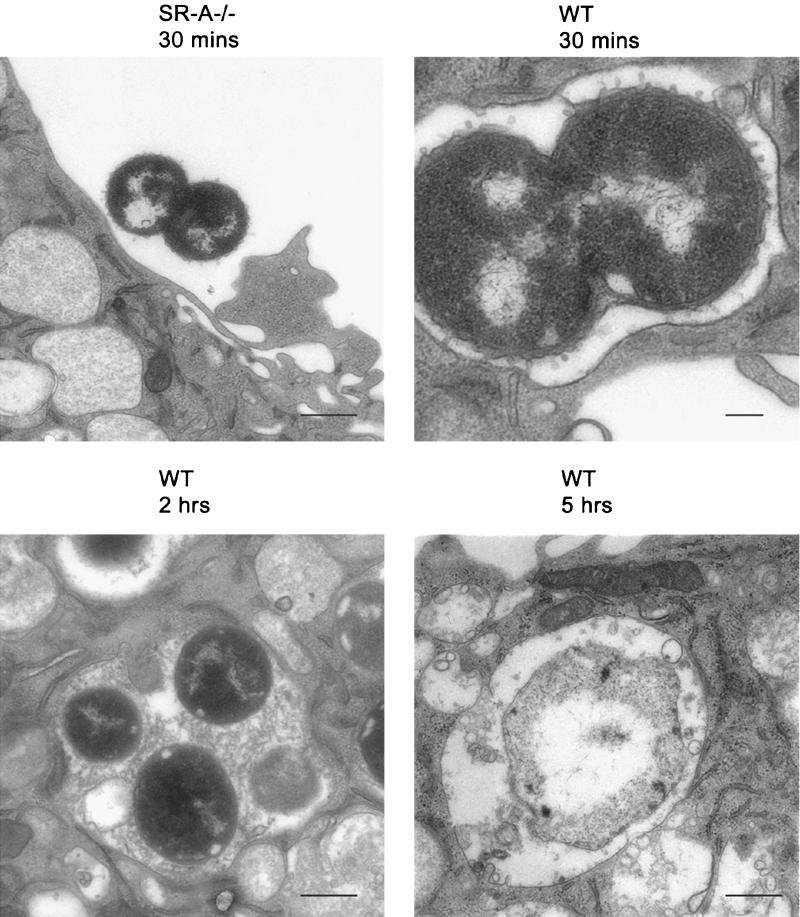
EM of N. meningitidis uptake. WT and SR-A−/− BMMφ were incubated for various times with 150 live MC58 bacteria per cell at 37°C. At various intervals, the cells were washed to remove extracellular bacteria before being processed and analyzed by EM. The fields chosen are representative of the whole Mφ population. Bar = 400 nm; upper right panel, bar = 200 nm.
FIG. 4.
FIG. 4.
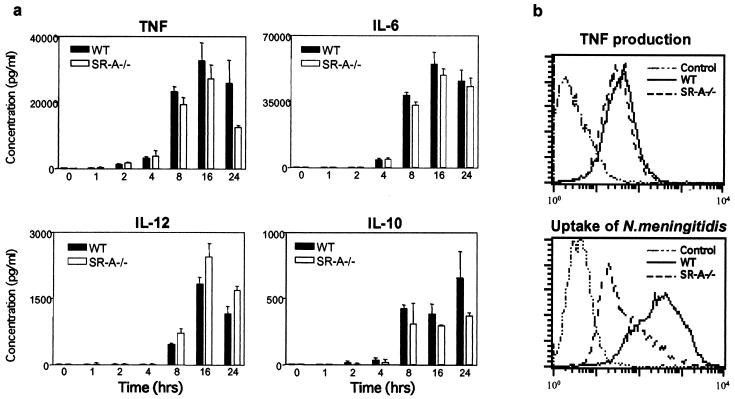
Mφ proinflammatory cytokine secretion following challenge with N. meningitidis. (a) WT and SR-A−/− BMMφ were incubated with ethanol-fixed MC58 bacteria at 37°C. At different times, the culture supernatant was harvested and analyzed by cytokine ELISA for production of TNF-α, IL-6, IL-10, and IL-12. The results are representative of at least two similar experiments, and the average of triplicate conditions is plotted. (b) BMMφ were incubated with ethanol-fixed RdGnX-MC58 (40 bacteria per cell) in the presence of brefeldin A. After incubation, the Mφ were fixed with 4% paraformaldehyde, stained with a phycoerythrin (PE)-labeled anti-TNF-α antibody, and analyzed by flow cytometry. The results are representative of at least two similar experiments. Note that preincubation of the anti-TNF-α antibody with recombinant mouse TNF-α or of the cells with an unlabeled anti-TNF-α antibody blocked the binding of the PE-labeled anti-TNF-α (not shown), confirming specificity. The error bars indicate standard deviations.
FIG. 5.
FIG. 5.
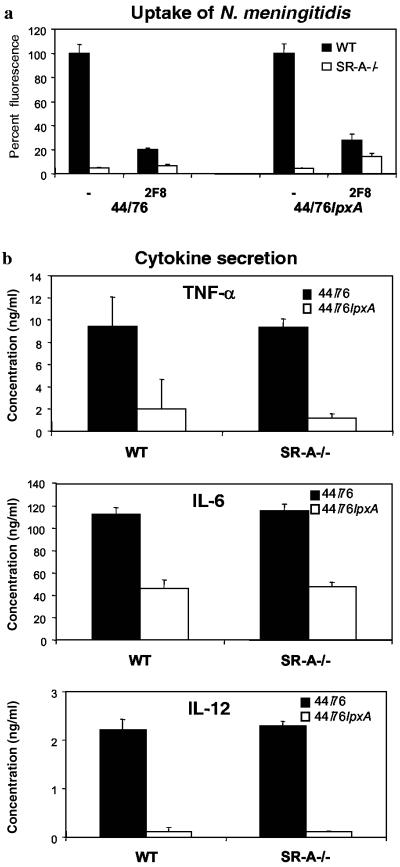
Lipid A mutants of N. meningitidis do not induce TNF-α, IL-12, and IL-6 production by WT and SR-A−/− Mφ. (a) WT and SR-A−/− Mφ were incubated with 44/76 or the lipid A mutant (44/76lpxA) in the presence or absence of 2F8 (15 μg/ml). SR-A-mediated ingestion is expressed as a percentage of WT fluorescence. The average fluorescence values for WT and SR-A−/− Mφ incubated with 44/76, 44/76 plus 2F8, lpxA, and lpxA plus 2F8 were (459, 22); (93, 30); (1,050, 44); and (293, 155), respectively. (b) WT and SR-A−/− Mφ were incubated with ethanol-fixed 44/76 or 44/76lpxA bacteria at 37°C. After 24 h, the culture supernatant was removed and centrifuged to remove particulate matter before cytokine ELISA. The average concentration of triplicate conditions is plotted; the results are from a single experiment but are representative of at least three similar assays. Note that cells incubated with culture medium containing PBS or culture medium alone did not stimulate the Mφ to secrete cytokines (not shown). The error bars indicate standard deviations.
FIG. 6.
FIG. 6.
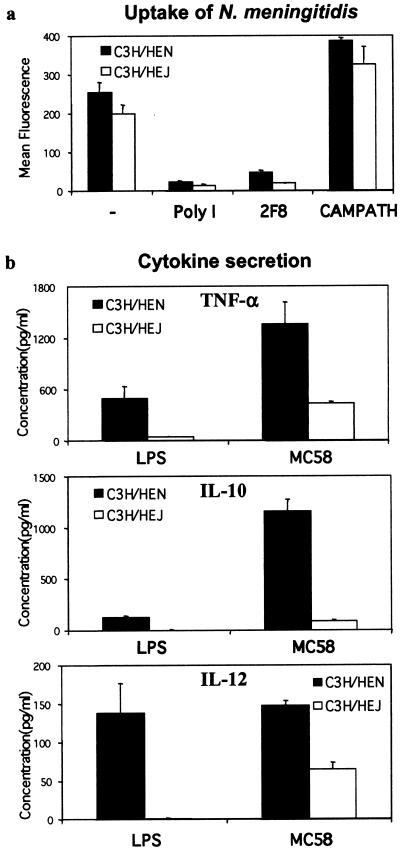
CH3/HeJ BMMφ produce less cytokine than C3H/HeJ cells following N. meningitidis uptake. (a) BMMφ were incubated with 20 ethanol-fixed RdGnX-MC58 bacteria per Mφ in the presence or absence of poly(I) (50 μg/ml), 2F8 (15 mg/ml), or CAMPATH IG (15 μg/ml) at 37°C for 2 h. The Mφ were then analyzed by flow cytometry, and the average fluorescence for each condition is shown. (b) C3H/HeN and C3H/HeJ Mφ were incubated with E. coli LPS (1 μg/ml) or ethanol-fixed MC58 bacteria at 37°C. After 24 h, the culture supernatant was removed and centrifuged to remove particulate matter before cytokine ELISA. The average concentration of triplicate conditions is plotted; the results are from a single experiment but are representative of at least three similar assays. Note that cells incubated with culture medium alone did not stimulate the Mφ to secrete cytokines (not shown). The error bars indicate standard deviations.

References

    1. Brandtzaeg, P. 1995. Pathogenesis of meningococcal infections, p. 71-114. In K. Cartwright (ed.), Meningococcal disease. John Wiley, Chichester, United Kingdom.
    1. Brandtzaeg, P., L. Osnes, R. Ovstebo, G. B. Joo, A. B. Westvik, and P. Kierulf. 1996. Net inflammatory capacity of human septic shock plasma evaluated by a monocyte-based target cell assay: identification of interleukin-10 as a major functional deactivator of human monocytes. J. Exp Med. 184:51-60. (Erratum, 184:2075.) - PMC - PubMed
    1. Cartwright, K. 1995. Introduction and historical aspects, p. 1-20. In K. Cartwright (ed.), Meningococcal disease. John Wiley and Sons, Chichester, United Kingdom.
    1. Elomaa, O., M. Kangas, C. Sahlberg, J. Tuukkanen, R. Sormunen, A. Liakka, I. Thesleff, G. Kraal, and K. Tryggvason. 1995. Cloning of a novel bacteria-binding receptor structurally related to scavenger receptors and expressed in a subset of macrophages. Cell 80:603-609. - PubMed
    1. Fitzgerald, K. A., and L. A. J. O'Neill. 2000. The role of the interleukin-1/Toll-like receptor family in inflammation and host defence. Microb. Infect. 2:933-943. - PubMed

Publication types

MeSH terms