. 2002 Oct;70(10):5547-55.
doi: 10.1128/IAI.70.10.5547-5555.2002.

Genetic immunization elicits antigen-specific protective immune responses and decreases disease severity in Trypanosoma cruzi infection

Affiliations

Genetic immunization elicits antigen-specific protective immune responses and decreases disease severity in Trypanosoma cruzi infection

Nisha Garg et al. Infect Immun. 2002 Oct.

Abstract

Immunity to Trypanosoma cruzi requires elicitation of humoral and cell-mediated immune responses to extracellular trypomastigotes and intracellular amastigotes. In this study, the effectiveness of the T. cruzi trans-sialidase family (ts) genes ASP-1, ASP-2, and TSA-1 as genetic vaccines was assessed. Immunization of mice with plasmids encoding ASP-1, ASP-2, or TSA-1 elicited poor antigen-specific cytotoxic-T-lymphocyte (CTL) activity and T. cruzi-specific antibody responses. Codelivery of interleukin-12 and granulocyte-macrophage colony-stimulating factor plasmids with antigen-encoding plasmids resulted in a substantial increase in CTL activity and antibody production and in increased resistance to T. cruzi infection. In pooled results from two to four experiments, 30 to 60% of mice immunized with antigen-encoding plasmids and 60 to 80% of mice immunized with antigen-encoding plasmids plus cytokine adjuvants survived a lethal challenge with T. cruzi. In comparison, 90% of control mice injected with empty plasmid DNA died during the acute phase of infection. However, the pool of three ts genes provided no greater protection than the most effective single gene (ASP-2) either with or without coadministration of cytokine plasmids. Importantly, the extent of tissue parasitism, inflammation, and associated tissue damage in skeletal muscles during the chronic phase of T. cruzi infection in mice immunized with antigen-encoding plasmids plus cytokine adjuvants was remarkably reduced compared to mice immunized with only cytokine adjuvants or empty plasmid DNA. These results identify new vaccine candidates and establish some of the methodologies that might be needed to develop effective vaccine-mediated control of T. cruzi infection. In addition, this work provides the first evidence that prophylactic genetic immunization can prevent the development of Chagas' disease.


Figures

FIG. 1.
FIG. 1.
Transient expression of T. cruzi proteins in COS7 cells. cDNAs encoding the T. cruzi proteins ASP-1 (27 to 641 amino acids), ASP-2 (61 to 705 amino acids), or TSA-1 (78 to 652 amino acids) were cloned in eukaryotic expression plasmid CMVI.UBF3/2 at the indicated restriction sites. COS7 cells were transfected with 5 μg of CMVI.UBF3/2 containing TSA-1 (E and F), ASP-1 (A and B), or ASP-2 (C and D) cDNA by using Lipofectin. Cells were incubated for 48 h, fixed and permeabilized with ice-cold methanol, and incubated with serum from mice in the acute (F) or chronic (B) phase of T. cruzi infection or with rabbit anti-ASP-2 polyclonal antiserum (D). Fluorescein isothiocyanate-labeled goat anti-mouse or anti-rabbit IgG was used as a secondary antibody, and cells were visualized by confocal microscopy. Cells incubated with normal mouse (A and E) or rabbit (C) serum as primary antibody were used as negative controls. Magnification, ×100.
FIG. 2.
FIG. 2.
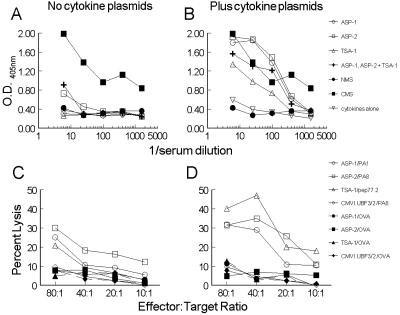
Antibody production and cytolytic responses induced by intramuscular immunization with T. cruzi antigen-encoding plasmids C57BL/6 female mice were immunized with CMVI.UBF3/2 empty plasmid or CMVI.UBF3/2 containing ASP-1, ASP-2, and/or TSA-1 cDNA, with (B and D) or without (A and C) cytokine-encoding plasmids, twice at an interval of 6 weeks. The presence of parasite-specific antibodies in sera (A and B) and peptide-specific CTL responses (C and D) was assessed 2 weeks after the second immunization. Sera from normal mice (NMS) and mice chronically infected with T. cruzi (CMS) were used as negative and positive controls, respectively (A and B). For cytolytic assays (C and D), splenocytes from one mouse in each group were stimulated in vitro with ASP-1-, ASP-2-, or TSA-1-derived H-2Kb-restricted CTL epitope peptides (PA14, PA8, and pep77.2, respectively, at 1 μM). Cytolytic activity was measured in a 5-h 51Cr release assay against RMA-S target cells (H-2Kb) sensitized with specific (PA14, PA8, or pep77.2; open symbols) or nonspecific (SIINFEKL, OVA257-264, solid symbols) peptides. The background lytic activity of splenocytes obtained from CMVI.UBF3/2-immunized mice and stimulated in vitro with ASP-2-specific peptide (PA8) against targets pulsed with the homologous peptide or heterologous peptide (SIINFEKL; solid symbols) is shown.
FIG. 3.
FIG. 3.
Elicitation of cytolytic responses by a multicomponent nucleic acid vaccine can be augmented by cytokines. C57BL/6 mice were immunized with ASP-1-, ASP-2-, and TSA-1-encoding plasmids with or without cytokine-expressing plasmids. Mice injected with empty CMVI.UBF3/2 plasmid or cytokine-encoding plasmids only were used as controls. At 2 weeks after the second immunization, splenocytes from immunized mice were stimulated in vitro with peptides PA8 (A), PA14 (B), pep77.2 (C), or a PA8-PA14-pep77.2 mixture (D). Effectors generated from these splenocytes were then tested in a 5-h 51Cr release assay against RMA-S target cells sensitized with either the homologous peptide (PA14, PA8, or pep77.2; open symbols) or pulsed with the control peptide (SIINFEKL, OVA257-264; filled symbols).
FIG. 4.
FIG. 4.
Parasitemia and mortality in genetically immunized mice. C57BL/6 mice were injected with CMVI.UBF3/2 encoding ASP-1, ASP-2, or TSA-1, with (C and D) or without (A and B) cytokine adjuvants, twice at an interval of 6 weeks. Mice injected with the empty CMVI.UBF3/2 plasmid were used as controls. Two weeks after the second immunization, mice were challenged with a lethal dose of T. cruzi (105 BFT/mouse). Blood parasite levels (A and C) were monitored at weekly intervals, and survival (B and D) was recorded daily.
FIG. 5.
FIG. 5.
Parasitemia and mortality in mice immunized with a multicompent genetic vaccine. C57BL/6 mice were injected with plasmids encoding ASP-1, ASP-2, and TSA-1, with or without cytokine adjuvants, twice at an interval of 6 weeks. Mice injected with the empty CMVI.UBF3/2 plasmid or cytokine genes alone were used as controls. Immunization of mice (as in Fig. 4) was followed 2 weeks later by intraperitoneal infection with T. cruzi (105 BFT/mouse). Blood parasitemia (A) and survival (B) were observed and determined as described in the legend to Fig. 4.
FIG. 6.
FIG. 6.
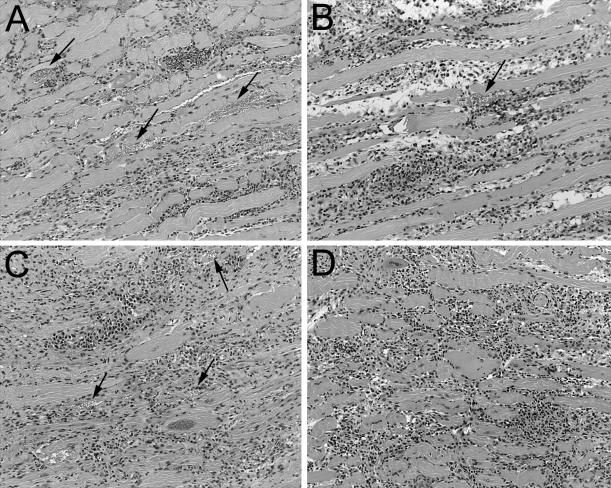
Inflammation and tissue parasitemia in immunized and challenged mice. C57BL/6 mice were immunized with empty CMVI.UBF3/2 (A), with cytokine plasmids (B), with ASP-1-, ASP-2-, TSA-1-encoding plasmids (C), or with a mixture of antigen-encoding plasmids plus cytokine-expressing plasmids (D) twice at 6-week intervals. Mice were infected 2 weeks after their second immunization with a lethal dose of T. cruzi BFT (105/mouse). Skeletal muscle sections for histologic analysis were obtained at 45 days postinfection. Parasite-infected cells are indicated by arrows. Magnification, ×20.
FIG. 7.
FIG. 7.
Control of tissue inflammation and parasite burden by DNA immunization. Histologic analysis of skeletal muscles of mice immunized with empty CMVI.UBF3/2 plasmid alone (A), with cytokine-expressing plasmids (B), with ASP-1-, ASP-2-, and TSA-1-encoding plasmids (C), or with a mixture of antigen-encoding plasmids plus cytokine-expressing plasmids (D). Mice were infected 2 weeks after the second immunization with T. cruzi BFT (105/mouse), and tissues were collected at 150 days postinfection.

References

    1. Alberti, E., A. Acosta, M. E. Sarmiento, C. Hidalgo, T. Vidal, A. Fachado, L. Fonte, L. Izquierdo, J. F. Infante, C. M. Finlay, and G. Sierra. 1998. Specific cellular and humoral immune response in BALB/c mice immunized with an expression genomic library of Trypanosoma cruzi. Vaccine 16:608-612. - PubMed
    1. Bliss, J., V. Van Cleave, K. Murray, A. Wiencis, M. Ketchum, R. Maylor, T. Haire, C. Resmini, A. K. Abbas, and S. F. Wolf. 1996. IL-12, as an adjuvant, promotes a T helper 1 cell, but does not suppress a T helper 2 cell recall response. J. Immunol. 156:887-894. - PubMed
    1. Brener, Z., and R. T. Gazzinelli. 1997. Immunological control of Trypanosoma cruzi infection and pathogenesis of Chagas' disease. Int. Arch. Allergy Immunol. 114:103-110. - PubMed
    1. Costa, F., G. Franchin, V. L. Pereira-Chioccola, M. Ribeirao, S. Schenkman, and M. M. Rodrigues. 1998. Immunization with a plasmid DNA containing the gene of trans-sialidase reduces Trypanosoma cruzi infection in mice. Vaccine 16:768-774. - PubMed
    1. Cox, F. E. 1997. Designer vaccines for parasitic diseases. Int. J. Parasitol. 27:1147-1157. - PubMed

Publication types

MeSH terms