


doi: 10.1128/IAI.70.10.5877-5881.2002.
Two predicted chemoreceptors of Helicobacter pylori promote stomach infection
Affiliations
- PMID: 12228322
- PMCID: PMC128301
- DOI: 10.1128/IAI.70.10.5877-5881.2002
Item in Clipboard
Two predicted chemoreceptors of Helicobacter pylori promote stomach infection
Infect Immun.
2002 Oct.
Abstract
Helicobacter pylori must be motile or display chemotaxis to be able to fully infect mammals, but it is not known how this chemotaxis is directed. We disrupted two genes encoding predicted chemoreceptors, tlpA and tlpC. H. pylori mutants lacking either of these genes are fully motile and chemotactic in vitro and are as able as the wild type to infect mice when they are the sole infecting strains. In contrast, when mice are coinfected with the H. pylori SS1 tlpA or tlpC mutant and the wild type, we find more wild type than mutant after 2 weeks of colonization. Neither strain has an in vitro growth defect. These results suggest that the tlpA- and tlpC-encoded proteins assist colonization of the stomach environment.
Figures
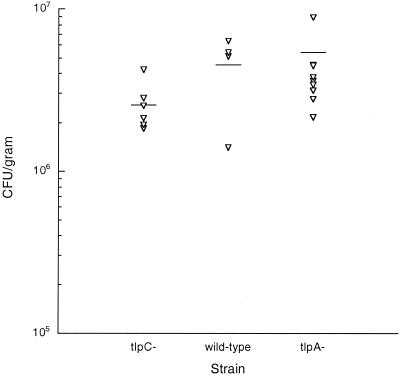
The numbers of H. pylori recovered from mice infected with mutants lacking tlpA or tlpC do not differ from those from mice infected with the wild type. Each point represents the bacterial numbers per gram of stomach in mice infected for 2 weeks with SS1 ΔtlpC::cat-1 mutant (left), wild-type SS1 (middle), or SS1 ΔtlpA::cat-1 mutant (right). Mice infected by wild-type SS1 were given 1 × 10⁸ CFU (n = 4), mice receiving SS1 ΔtlpA::cat (n = 9) were inoculated with 4 × 10⁷ to 13 × 107 CFU, and mice receiving SS1 ΔtlpC::cat (n = 6) were given 1 × 10⁷ to 6 × 10⁷ CFU. Two different isolates of ΔtlpA::cat-1 were used but their colonization levels did not differ, so their data are shown together in one column. The short horizontal lines represent the geometric mean CFUs per gram. The levels of colonization do not differ significantly from each other (P > 0.05).
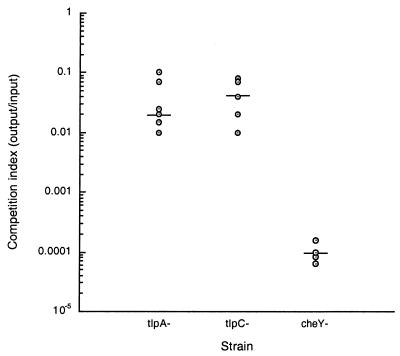
Number of bacteria in the stomachs of mice infected with mixtures of wild-type and mutant H. pylori after 2 weeks. Each point represents one mouse. The competitive index (CI) is the mutant/wild-type ratio for output divided by the same ratio for input. The short horizontal lines represent the geometric means. The number of mice (n) used follows: for ΔtlpA::cat mutant (left), n = 10; for ΔtlpC::cat mutant (middle), n = 8; and for cheY::aphA3 mutant (right), n = 4. We were unable to detect any cheY mutants in the output and used 250 CFU/g (the estimated detection limit) for these calculations. Statistical analysis using the Wilcoxon matched-pair signed-rank test (available at http://www.fon.hum.uva.nl/Service/Statistics/Signed_Rank_Test.html ) showed that all strains are significantly different from a strain with no competition defect (CI = 1) (P < 0.01). On the basis of observations with other mutants and wild-type strains, two strains with equal abilities yield a CI of 1 (data not shown).
References
-
- Alm, R. A., L.-S. L. Ling, D. T. Moir, B. L. King, E. D. Brown, P. C. Doig, D. R. Smith, B. Noonan, B. C. Guild, B. L. Dejonge, G. Carmel, P. J. Tummino, A. Caruso, M. Uria-Nickelsen, D. M. Mills, C. Ives, R. Gibson, D. Merber, S. D. Mills, Q. Jiang, D. E. Taylor, G. F. Vovis, and T. J. Trast. 1999. Genomic-sequence comparison of two unrelated isolates of the human gastric pathogen Helicobacter pylori. Nature 397:176-180. - PubMed
-
- Armitage, J. P. 1999. Bacterial tactic responses. Adv. Microb. Physiol. 41:229-289. - PubMed
-
- Blaser, M. J. 1999. Where does Helicobacter pylori come from and why is it going away? JAMA 282:2260-2262. - PubMed
Publication types
MeSH terms
Substances
LinkOut - more resources
Full Text Sources
Other Literature Sources
Medical
