


The role of adenosine in regulation of cerebral blood flow during hypoxia in the near-term fetal sheep
- PMID: 12231655
- PMCID: PMC2290527
- DOI: 10.1113/jphysiol.2002.023077
The role of adenosine in regulation of cerebral blood flow during hypoxia in the near-term fetal sheep
Abstract
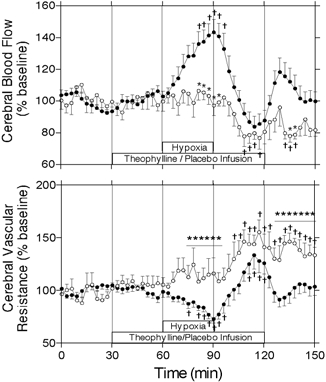
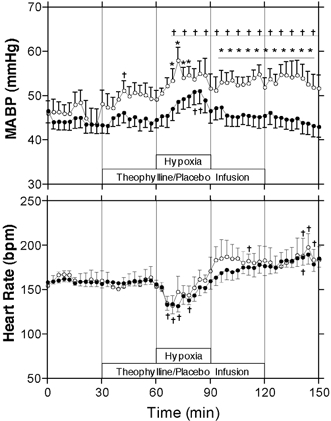
The aim of this study was to determine in the near-term ovine fetus the role of adenosine in the basal regulation of cerebral blood flow and in the increases in cerebral blood flow in response to acute hypoxic insult. We measured cerebral blood flow in chronically instrumented fetal sheep (127-135 days gestation, term approximately 145 days) using laser Doppler flowmetry probes implanted in the parietal cortices. Hypoxia was administered for 30 min by lowering the ewe's inspired oxygen to 10-12 % during an infusion of either saline or theophylline, a non-specific adenosine receptor antagonist. The theophylline infusion was begun 30 min prior to and ended 30 min after the completion of the hypoxic insult. The administration of theophylline had no significant effect on cerebral blood flow during the baseline period. During control hypoxic periods, cerebral blood flow increased by approximately 45 %. During theophylline experiments, however, there was no significant increase in cerebral blood flow during hypoxia. In the control experiments, cerebral blood flow returned to baseline levels during the recovery period, while in the theophylline experiments cerebral blood flow fell below baseline levels. We conclude that, in the near-term ovine fetus, adenosine plays a minimal role in the regulation of basal cerebral blood flow. However, these data are strong evidence for the involvement of adenosine in increased fetal cerebral blood flow during an acute hypoxic insult. Finally, adenosine may also play an important role in the maintenance of fetal cerebral blood flow immediately following hypoxic insult.
Figures
References
-
- Ball KT, Gunn TR, Gluckman PD, Power GG. Suppressive action of endogenous adenosine on ovine fetal nonshivering thermogenesis. Journal of Applied Physiology. 1996;81:R2393–2398. - PubMed
-
- Bari F, Louis TM, Busija DW. Effects of ischemia on cerebral arteriolar dilation to arterial hypoxia in piglets. Stroke. 1998a;29:222–227. - PubMed
-
- Bari F, Thore CR, Louis TM, Busija DW. Inhibitory effects of hypoxia and adenosine on N-methyl-d-aspartate-induced pial arteriolar dilation in piglets. Brain Research. 1998b;780:237–244. - PubMed
-
- Cohen WR, Piasecki GJ, Jackson BT. Plasma catecholamines during hypoxemia in fetal lamb. American Journal of Physiology. 1982;243:R520–525. - PubMed
Publication types
MeSH terms
Substances
Grants and funding
LinkOut - more resources
Full Text Sources
