. 2002 Oct 1;99(20):13020-5.
doi: 10.1073/pnas.192251199. Epub 2002 Sep 13.

A push-pull approach to maximize vaccine efficacy: abrogating suppression with an IL-13 inhibitor while augmenting help with granulocyte/macrophage colony-stimulating factor and CD40L

Affiliations

A push-pull approach to maximize vaccine efficacy: abrogating suppression with an IL-13 inhibitor while augmenting help with granulocyte/macrophage colony-stimulating factor and CD40L

Jeffrey D Ahlers et al. Proc Natl Acad Sci U S A. .

Abstract

Although a role for CD4(+) helper cells in CD8(+) cytotoxic T lymphocyte (CTL) induction by vaccines is widely recognized, much less is known about a counterbalancing role of CD4(+) T cells in down-modulating this response, or about ways to optimize vaccine responses through abrogation of this negative regulatory mechanism. Here, we discovered a synergistic enhancement of vaccine-mediated CTL induction and protection by the relief of suppression through depletion of regulatory CD4(+) cells, including CD4(+) NKT cells, or blockade of IL-13 made by these cells, combined with the cytokine granulocyte/macrophage colony-stimulating factor and the costimulatory molecule CD40L. Indeed, in the absence of helper epitopes, granulocyte/macrophage colony-stimulating factor and the helper-mimetic molecule CD40L are not sufficient to replace help to induce CTL without abrogation of CD4(+) T cell-mediated suppression, suggesting a role for T cell help in overcoming suppression. The increased CTL induction translated to striking protection against viral infection by a vaccine by using this synergistic combined approach. These results argue for a push-pull approach to maximize vaccine efficacy, especially for HIV and cancer.


Figures
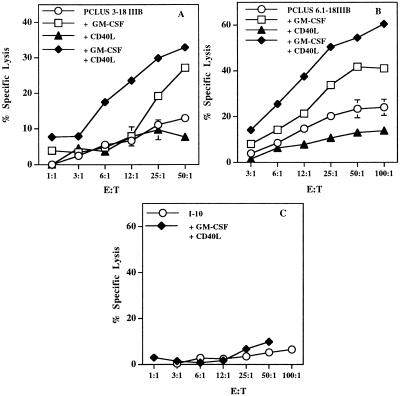
Figure 1
Figure 1
GM-CSF and CD40L trimer synergize for induction of CD8+CTL. (A) Specific lysis of P18IIIB (0.5 μM) coated target cells by splenic effectors from BALB/c mice immunized s.c. with 20 nmol (17 μg CTL epitope P18IIIB) HIV-1 Th-CTL vaccine construct, PCLUS 3–18IIIB, with or without individual or a combination of factors GM-CSF (5 μg/mouse), and CD40L (15 μg/mouse), incorporated in adjuvant montanide-ISA 51. Spleen cells are pooled from two mice. Error bars < the symbols are not shown. (B) CTL response is significantly (P < 0.05) enhanced by GM-CSF and CD40L after boosting with HIV Th-CTL vaccine construct, PCLUS 6.1–18IIIB. Similar results were obtained in four additional experiments. (C) Mice immunized with the minimum CTL epitope, I-10, plus GM-CSF and CD40L failed to elicit a CTL response, even after boosting and with a 4-fold higher peptide dose (80 nmol/mouse) (≈80 μg).
Figure 2
Figure 2
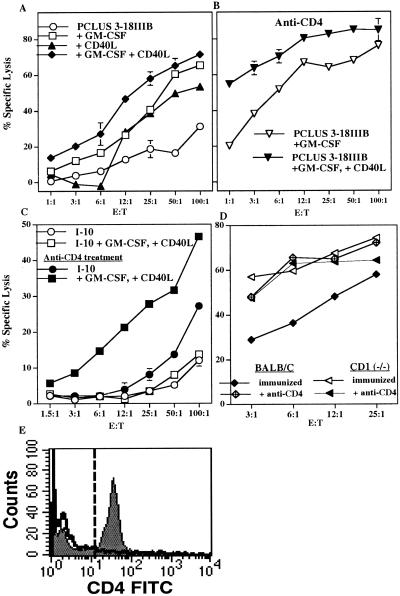
CD4+ cell depletion enhances CD8+ CTL response to HIV-1 Th-CTL vaccine and minimum CTL epitope. (A) Specific lysis of P18IIIB (0.5 μM) coated targets by splenic effectors after 7 days in vitro restimulation with P18IIIB and IL-2 after two s.c. immunizations with PCLUS 3–18IIIB alone, or plus individual or a combination of factors GM-CSF (5 μg/dose) and CD40L (10 μg/dose) 2 weeks apart. (B) Two additional groups of animals from the experiment in A were treated with anti-CD4 (GK1.5, 0.5 mg/day per mouse) 1 day before immunization and for 2 additional days and spleen cells harvested 15 days later, restimulated in vitro, and assayed for CTL. (C) Specific lysis by splenic effectors from mice immunized with minimum CTL epitope I-10 (60 nmol/mouse), alone, or I-10 plus GM-CSF and CD40L, restimulated in vitro with P18IIIB (0.5 μM) plus IL-2 and assayed for CTL 7 days later. Filled symbols represent mice treated with anti-CD4. Error bars < the symbols are not shown. This experiment was performed four times with comparable results. (D) CTL response of BALB/c and CD1-deficient mice after two immunizations with PCLUS 6.1–18IIIB plus GM-CSF (5 μg/dose) and CD40L (10 μg/dose). One group from each strain of mice also received anti-CD4 (GK1.5, 0.5 mg/day i.p.) 1 day before and 3 days after immunization. BALB/c and CD1(−/−) mice were significantly different (P < 0.05) without but not with CD4 depletion. Error bars < symbols are not shown. This experiment was performed two additional times with comparable results. (E) Animals treated or not with anti-CD4 were immunized with PCLUS 6.1–18IIIB, plus GM-CSF and CD40L and 15 days later spleen cells pooled from two mice each were examined for CD4+ cells, gated on CD3+ cells. Total CD4+ cells in untreated mice (gray) or mice treated 4 days with anti-CD4, 0.5 mg/day (solid line) are shown.
Figure 3
Figure 3
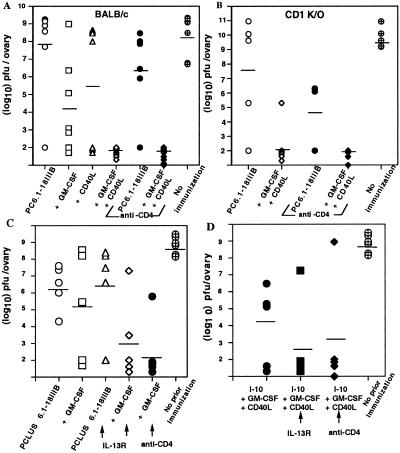
The combination of GM-CSF and CD40L is essential for vaccine-mediated protection from viral challenge. Female BALB/c (A) and CD1(−/−) (B) mice were immunized s.c. with 20 nmol HIV-1 vaccine PCLUS 6.1–18IIIB in ISA-51 plus indicated cytokines and costimulatory molecules and boosted i.p. Two groups immunized with PCLUS 6.1–18IIIB alone or with the combination GM-CSF and CD40L were depleted of CD4+ cells by treating with GK1.5 antibody (0.5 μg/dose i.p.) 1 day before and 3 consecutive days after immunization. Mice were challenged i.p. 5 days later with 1 × 10⁷ pfu recombinant vaccinia expressing the HIV-1 IIIB gp160. Ovaries from individual mice were harvested 5 days after challenge, and titered on BSC-1 cells as described (25). (C) Female BALB/c mice were immunized twice with PCLUS 6.1–18IIIB with or without GM-CSF and challenged with recombinant vaccinia as in A. Mice immunized with PCLUS 6.1–18IIIB alone (open triangles), or plus GM-CSF (open diamonds), received five treatments (250 μg/mouse i.p. on day 0, 1, 2, 4, and 6 after immunization) with IL-13Rα2-Fc, an inhibitor of IL-13. Another group of animals receiving the vaccine plus GM-CSF were depleted of CD4+ cells (filled circles). (D) Female BALB/c mice were immunized twice with the minimum CTL epitope I-10 (80 nmol) with GM-CSF (5 μg/mouse) and CD40L (10 μg/mouse) and challenged with recombinant vaccinia (filled circles) as in C. Animals also received either the IL-13 inhibitor IL-13Rα2-Fc (filled squares), or anti-CD4 treatment (filled diamonds). Each symbol represents an individual animal and horizontal bars represent the geometric mean titers for each group.
Figure 4
Figure 4
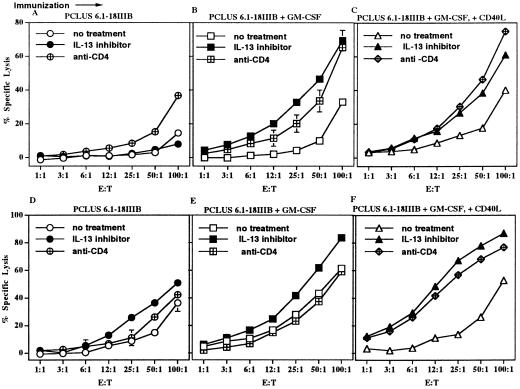
Enhancement of vaccine elicited CD8+ CTL response and memory by relief of CD4+ cell mediated suppression by treatment with an in vivo inhibitor of IL-13. (A and D) CTL response of female BALB/c mice given a single s.c. immunization with 20 nmol vaccine construct PCLUS 6.1–18IIIB in Montanide ISA51. Animals received five doses (175 μg/dose at day 0, 1, 2, 4, 6) i.p. of either IL-13Rα2Fc (filled circles) or control human IgG (Panglobulin) (open circles). Anti-CD4 (crossed circle) (0.5 mg/day) was given 1 day before immunization and 3 consecutive days thereafter. In all six exhibits, spleen cells were restimulated in vitro with P18IIIB peptide and IL-2 for 7 days before testing in a 51Cr release assay. Error bars < the symbols are not shown. Shown is specific lysis of P18IIIB (0.5 μM)-coated target cells by spleen cell effectors from the immunized mice harvested 14 days (A) or 7 weeks (D) after a single immunization. (B and E) CTL response of female BALB/c mice given a single s.c. immunization with 20 nmol of PCLUS 6.1–18IIIB plus GM-CSF, and either IL-13Rα2Fc (filled squares), control human IgG (Panglobulin) (open squares), or anti-CD4 (crossed square) (0.5 mg/day), and spleen cells tested for lysis as in A and D harvested 14 days (B) or 7 weeks (E) after immunization. (C and F) CTL response of female BALB/c mice given a single s.c. immunization with 20 nmol of PCLUS 6.1–18IIIB and the combination of GM-CSF (5 μg/mouse) and CD40L (15 μg/mouse), incorporated in adjuvant montanide-ISA 51. Mice were treated with control Ig (open triangle) or the IL-13 inhibitor (filled triangle) or anti CD4 antibody (crossed diamond) as in A and D and spleen cells harvested 14 days (C) or 7 weeks (F) after immunization tested as above. Except in A, CTL responses are significantly different in all vaccine groups given IL-13Rα2Fc treatment (filled symbols) compared with control IgG (open symbols) (P < 0.05–0.01). Nonspecific lysis was <15% in immunized groups and completely absent in anti-CD4-treated mice.

References

    1. Rowland-Jones S, Tan R, McMichael A. Adv Immunol. 1997;65:277–346. - PubMed
    1. Goulder P J R, Rowland-Jones S L, McMichael A J, Walker B D. AIDS. 1999;13:S121–S136. - PubMed
    1. Oscherwitz J, Gotch F M, Cease K B, Berzofsky J A. AIDS. 1999;13:S163–S174. - PubMed
    1. Schmitz J E, Kuroda M J, Santra S, Sasseville V G, Simon M A, Lifton M A, Racz P, Tenner-Racz K, Dalesandro M, Scallon B J, et al. Science. 1999;283:857–860. - PubMed
    1. Jin X, Bauer D E, Tuttleton S E, Lewin S, Gettie A, Blanchard J, Irwin C E, Safrit J T, Mittler J, Weinberger L, et al. J Exp Med. 1999;189:991–998. - PMC - PubMed