. 2002 Oct 1;99(20):13154-9.
doi: 10.1073/pnas.192432299. Epub 2002 Sep 16.

The membrane trafficking protein calpactin forms a complex with bluetongue virus protein NS3 and mediates virus release

Affiliations

The membrane trafficking protein calpactin forms a complex with bluetongue virus protein NS3 and mediates virus release

Andrew R Beaton et al. Proc Natl Acad Sci U S A. .

Abstract

Bluetongue virus, an arbovirus of the Orbivirus genus, infects and replicates in both insect and mammalian cells. However, the cytopathic effect (cpe) on each host is very different. Mammalian cells show substantial cpe, most likely a result of the mechanism of virus release, whereas insect cells show little cpe and appear to release virus without cell lysis. Expression analysis of each infected cell type shows one protein, the nonstructural (NS) protein NS3, to be differentially expressed in the different cell types, suggesting it may act in the virus egress pathway. The molecular basis of such an interaction, however, has never been clear. Here, by using yeast two-hybrid analysis, we show that NS3 interacts with a cellular protein p11 (calpactin light chain), part of the annexin II complex that is involved in exocytosis. We map the NS3 region of interaction with p11 to a 13-residue peptide found at the N terminus of the protein and show it effectively competes with p36 (annexin II heavy chain) for p11 ligand binding. Further, we show that the C-terminal domain of NS3 interacts with VP2, the outermost protein of the fully assembled virus particle, suggesting that NS3 forms a bridging molecule that draws assembled virus into contact with the cellular export machinery. Our data describe the first host protein involvement in orbivirus egress and provide new insights into understanding arbovirus interactions with their hosts.


Figures
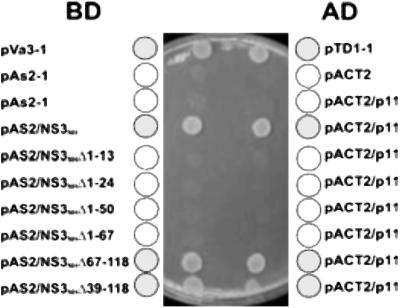
Figure 1
Figure 1
Yeast two-hybrid analysis identification of p11 as a cellular ligand for NS3 and mapping of NS3 subdomain involved. An initial yeast two-hybrid screen with a “bait” plasmid encoding the complete N-terminal domain of BTV NS3 and a cDNA activation domain library led to clones of p11 after initial screening by Leu selection and replica plating to establish true positives (-Leu, -Trp, -His selection). Subsequently, a selection of NS3 deletion mutants was cloned as bait and the same screen used to establish the subdomain of NS3 interacting with p11. Plate shows summary data for a variety of binding domain (BD) and activation domain (AD) plasmid combinations including specificity controls.
Figure 2
Figure 2
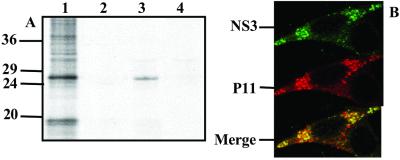
Affinity purification of baculovirus expressed NS3 with immobilized GST-p11 and colocalization of NS3 and p11 in BTV-infected cells. (A) Radiolabeled clarified lysate from Sf9 cells infected with the recombinant baculovirus expressing NS3 (lane 1) was incubated in the presence of GST alone (lane 2) or GST-p11 (lane 3). Wild-type baculovirus lysates were also incubated in the presence of GST-p11 as a control (lane 4). (B) BHK cells were infected with BTV and the colocalization of NS3 and p11 proteins was visualized by incubation with anti-NS3 antiserum (1:1,000) or/and anti-p11 antiserum (1:5,000), as primary antibodies followed by incubation with secondary antibodies labeled with FITC (green) or tetramethylrhodamine isothiocyanate (red) respectively. Immunofluorescent staining of NS3 (Top); immunofluorescent staining of p11 (Middle); dual staining of both NS3 and p11 proteins in infected cells (Bottom).
Figure 3
Figure 3
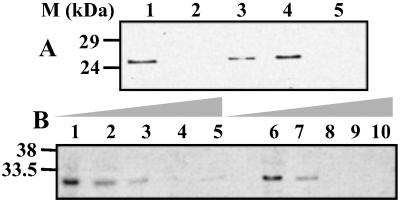
Effect of NS3 peptides on the GST-p11 affinity purification of NS3. (A) Pull-down of radiolabeled baculovirus-expressed NS3 was performed in the presence of NS3 peptides and the specific p36 peptide inhibitor, Ac1–14. Lanes: 1, no peptide; 2–5, 100 μg each of Ns1–14, Ns10–24, Ns20–34, and Ac1–14 peptides respectively. Note that Ns10–24 and Ns20–34 have no inhibitory effects on NS3 binding to p11. (B) The effects of increasing amounts of the Ns1–14 and Ac1–14 peptides. Lanes: 1 and 6, no peptide; 2–5, 1 μg/ml, 10 μg/ml, 100 μg/ml, and 1 mg/ml of Ns1–14, respectively; 7–10, 1 μg/ml to 1 mg/ml of Ac1–14 peptide.
Figure 4
Figure 4
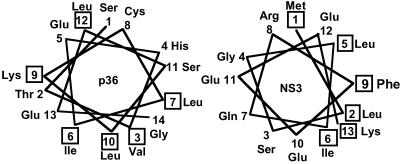
Helical wheel secondary structure prediction of the N-terminal sequence of NS3 and annexin II heavy chain (p36). Both NS3 and p36 demonstrate hydrophobic and hydrophilic faces, characteristic of amphiphatic α-helical motifs. Hydrophobic amino acids are boxed.
Figure 5
Figure 5
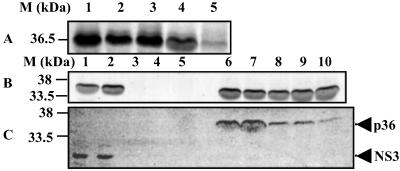
Effect of peptides on affinity purification of p36 with GST-p11 and competitive binding between NS3 and p36 for immobilized p11. (A) Affinity purification of baculovirus-expressed p36 with immobilized GST-p11 in the presence of NS3 and p36 peptides. Lanes: 1, Ns1–14; 2, Ns10–24; 3, Ns20–34; 4, Ac1–14. (B) Effect of increasing levels of Ns1–14 and Ac1–14 peptide concentrations on p36 affinity purification. Lanes: 1 and 6, no peptide; 2–5, 1 μg/ml, 10 μg/ml, 100 μg/ml, and 1 mg/ml of Ac1–14, respectively; 7–10, 1 μg/ml, 10 μg/ml, 100 μg/ml, and 1 mg/ml of Ns1–14, respectively. (C) Competition between p36 and NS3 for p11. Lanes: 1–5, a constant NS3 concentration bound to p11 was incubated with increasing amounts of p36; 6–10, increasing concentrations of NS3 were used to compete out a constant amount of p36 from the immobilized p11. The ratios of the proteins in competitive binding assays were approximately (in order) 1:0.5, 1:0.75, 1:1, 1:1.5, and 1:2.
Figure 6
Figure 6
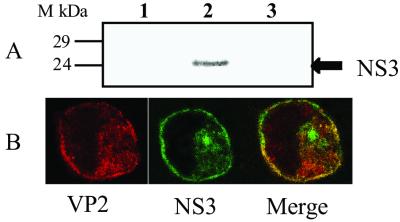
Interaction of NS3 and VP2. (A) Affinity purification of baculovirus-expressed NS3 with immobilized S-tag-VP2. Baculovirus-expressed and [35S]-labeled NS3 lysates were incubated in the presence of S-tag capture matrix alone (lane 1) or S-tag capture matrix loaded with S-tag-VP2 (lane 2). Clarified lysate from Sf cells infected with wild-type baculovirus was also incubated in the presence of S-tag-VP2-loaded matrix as a control (lane 3). Column eluates were resolved by SDS/PAGE and visualized by autoradiography. (B) Dual immunofluorescence staining of BTV-infected cells. BTV-infected (moi = 10) C6/36 cells were incubated at 37°C for 24 hr, fixed, and permeabilized with methanol/acetone (50/50) before immuno-probing with FITC labeled (green) anti-NS3 (1:1,000) and tetramethylrhodamine isothiocyanate-labeled (red) anti-VP2 (1:1,000). (Left) Immunofluorescent staining of VP2; (Center) immunofluorescent staining of NS3; (Right) dual staining of NS3 and VP2 proteins in infected cells.
Figure 7
Figure 7
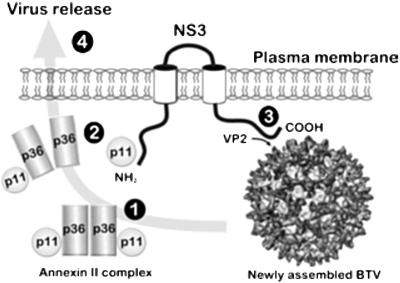
A model for the function of NS3 based on its membrane residency and known topology. (1) The host protein p11 is present in cells with p36 as part of the annexin II complex involved in cellular exocytosis. (2) NS3 is synthesized in the infected cell and localizes to the secretory pathway, where it engages with p11 either alone or in a partial annexin II complex by the displacement of one copy of p36 via a sequence at the N terminus. (3) Assembled virions formed in cytosolic virosomes similarly bind to NS3 via interaction between virion protein VP2 and a sequence in the NS3 carboxyl domain. (4) By virtue of the interactions, the assembled virions are drawn into contact with the p11/annexin II complex and engage to cellular exocytic machinery to affect nonlytic virus release.

References

    1. Monath T P, Guirakhoo F. In: Fields Virology. 3rd Ed. Fields B N, Knipe D M, Howley P M, Chanock R M, Melnick J L, Monath T P, Roizman B, Strauss S E, editors. Philadelphia: Lippincott–Raven; 1996. pp. 1735–1766.
    1. Jennings M, Boorman J. Arch Virol. 1979;59:121–126. - PubMed
    1. Wechsler S J, McHolland L E. J Clin Microbiol. 1988;26:2324–2327. - PMC - PubMed
    1. Homan E J, Yunker C E. Vet Microbiol. 1988;16:15–24. - PubMed
    1. Martin L A, Meyer A J, O'Hara R S, Fu H, Mellor P S, Knowles N J, Mertens P P. Arch Virol Suppl. 1998;14:281–293. - PubMed

Publication types

MeSH terms