


Functionalized congeners of tyrosine-based P2X(7) receptor antagonists: probing multiple sites for linking and dimerization
- PMID: 12236792
- PMCID: PMC5577561
- DOI: 10.1021/bc020025i
Functionalized congeners of tyrosine-based P2X(7) receptor antagonists: probing multiple sites for linking and dimerization
Abstract
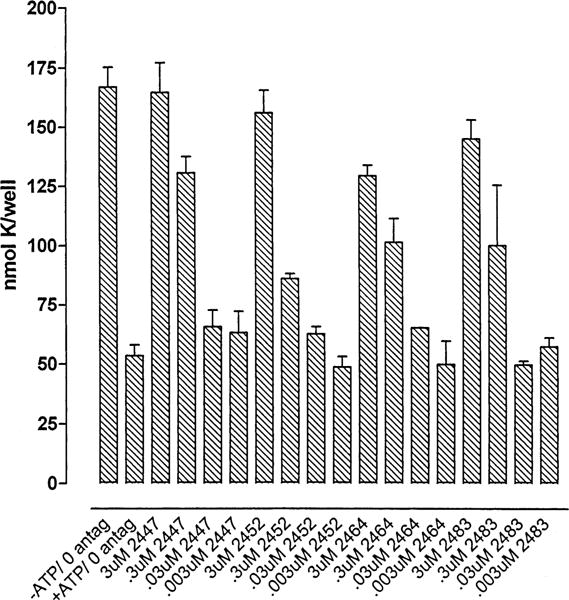
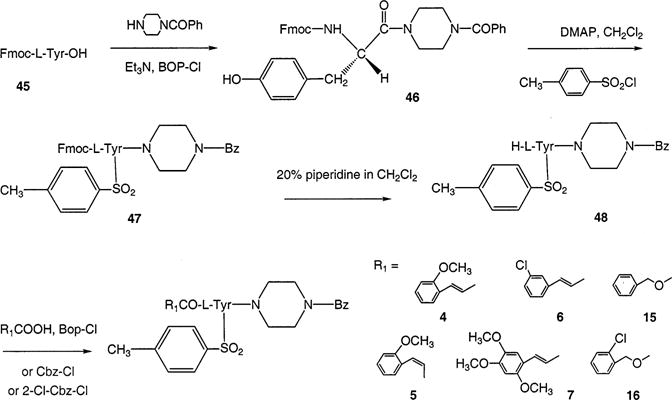
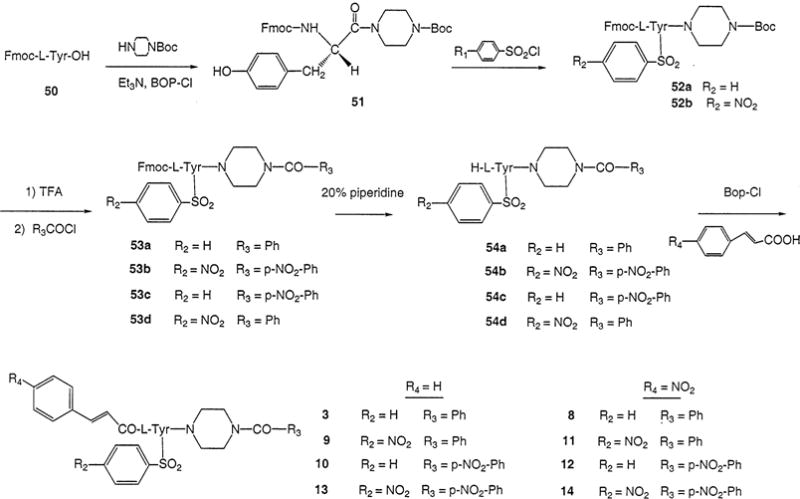
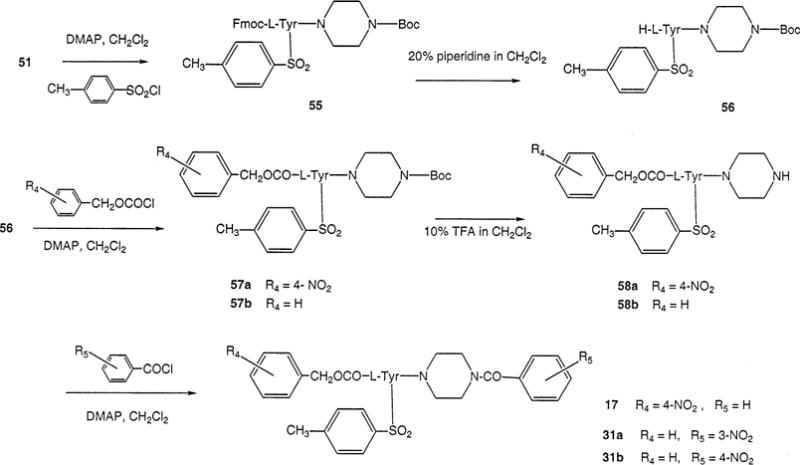
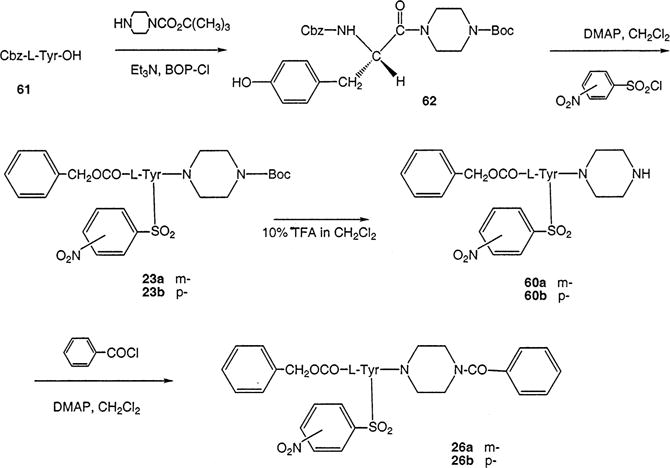
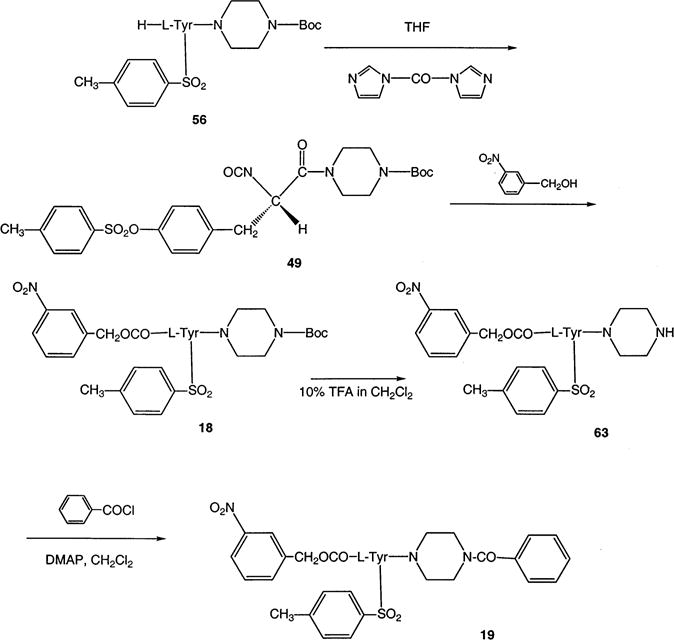
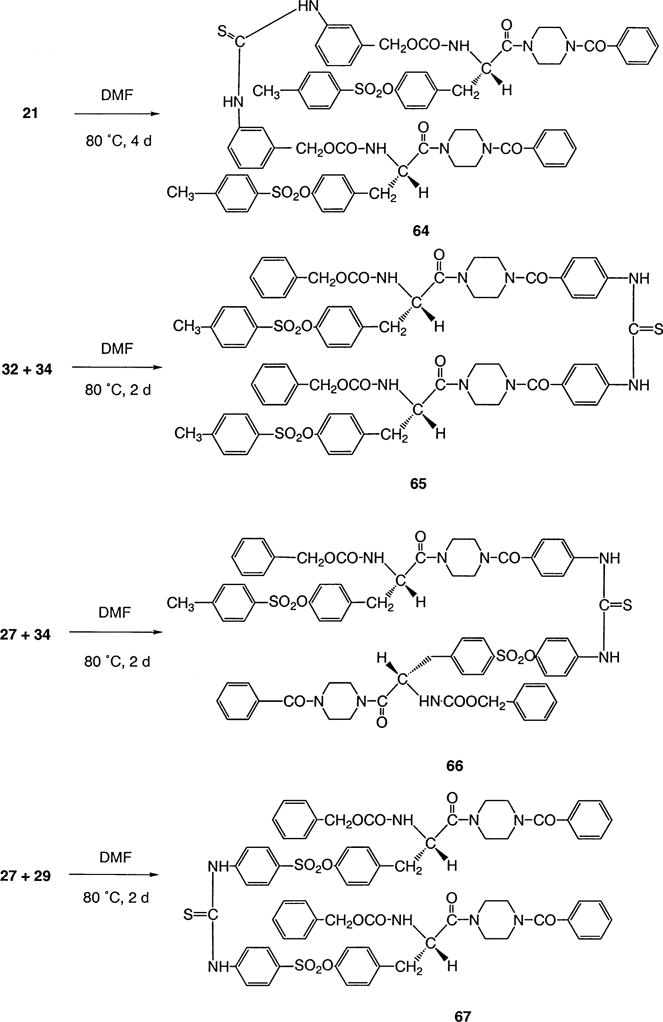
Chemically funtionalized analogues of antagonists of the P2X(7) receptor, an ATP-gated cation channel, were synthesized as tools for biophysical studies of the receptor. These functionalized congeners were intended for use in chemical conjugation with retention of biological potency. The antagonists were L-tyrosine derivatives, related to [N-benzyloxycarbonyl-O-(4-arylsulfonyl)-L-tyrosyl]benzoylpiperazine (such as MRS2409, 2). The analogues were demonstrated to be antagonists in an assay of human P2X(7) receptor function, consisting of inhibition of ATP-induced K(+) efflux in HEK293 cells expressing the recombinant receptor. The analogues were of the general structure R(1)-Tyr(OR(2))-piperazinyl-R(3), in which three positions (R(1)-R(3)) were systematically varied in structure through introduction of chemically reactive groups. Each of the three positions was designed to incorporate a 3- or 4-nitrophenyl group. The nitro groups were reduced using NaBH(4)-copper(II) acetylacetonate to amines, which were either converted to the isothiocyanate groups, as potential affinity labels for the receptor, or acylated, as models for conjugation. An alternate route to N(alpha)-3-aminobenzyloxycarbonyl functionalization was devised. The various positions of functionalization were compared for effects on biological potency, and the R(2) and R(3) positions were found to be most amenable to derivatization with retention of high potency. Four dimeric permutations of the antagonists were synthesized by coupling each of the isothiocyanate derivatives to either the precursor amine or to other amine congeners. Only dimers linked at the R(2)-position were potent antagonists. In concentration-response studies, two derivatives, a 3-nitrobenzyloxycarbonyl derivative 18 and a 4-nitrotoluenesulfonate 26b, displayed IC(50) values of roughly 100 nM as antagonists of P2X(7) receptor-mediated K(+) flux.
Figures

References
-
- Khakh BS, Burnstock G, Kennedy C, King BF, North RA, Seguela P, Voigt M, Humphrey PP. International union of pharmacology. XXIV. Current status of the nomenclature and properties of P2X receptors and their subunits. Pharmacol Rev. 2001;53:107–118. - PubMed
-
- King BF. Cardiovascular Biology of Purines. Kluwer Academic Publishers; Norwell, MA: 1998. pp. 159–186. Ch. 10.
-
- Collo G, Neidhart S, Kawashima E, Kosco-Vilbois M, North RA, Buell G. Tissue distribution of the P2 × 7 receptor. Neuropharmacology. 1997;36:1277–1283. - PubMed
-
- Ferrari D, Stroh C, Schulze-Osthoff K. P2X7/P2Z purinoreceptor-mediated activation of transcription factor NFAT in microglial cells. J Biol Chem. 1999;274:13205–13210. - PubMed
Publication types
MeSH terms
Substances
Grants and funding
LinkOut - more resources
Full Text Sources
Other Literature Sources
Miscellaneous
