


Magnitude and frequency of cytotoxic T-lymphocyte responses: identification of immunodominant regions of human immunodeficiency virus type 1 subtype C
- PMID: 12239290
- PMCID: PMC136554
- DOI: 10.1128/jvi.76.20.10155-10168.2002
Magnitude and frequency of cytotoxic T-lymphocyte responses: identification of immunodominant regions of human immunodeficiency virus type 1 subtype C
Abstract
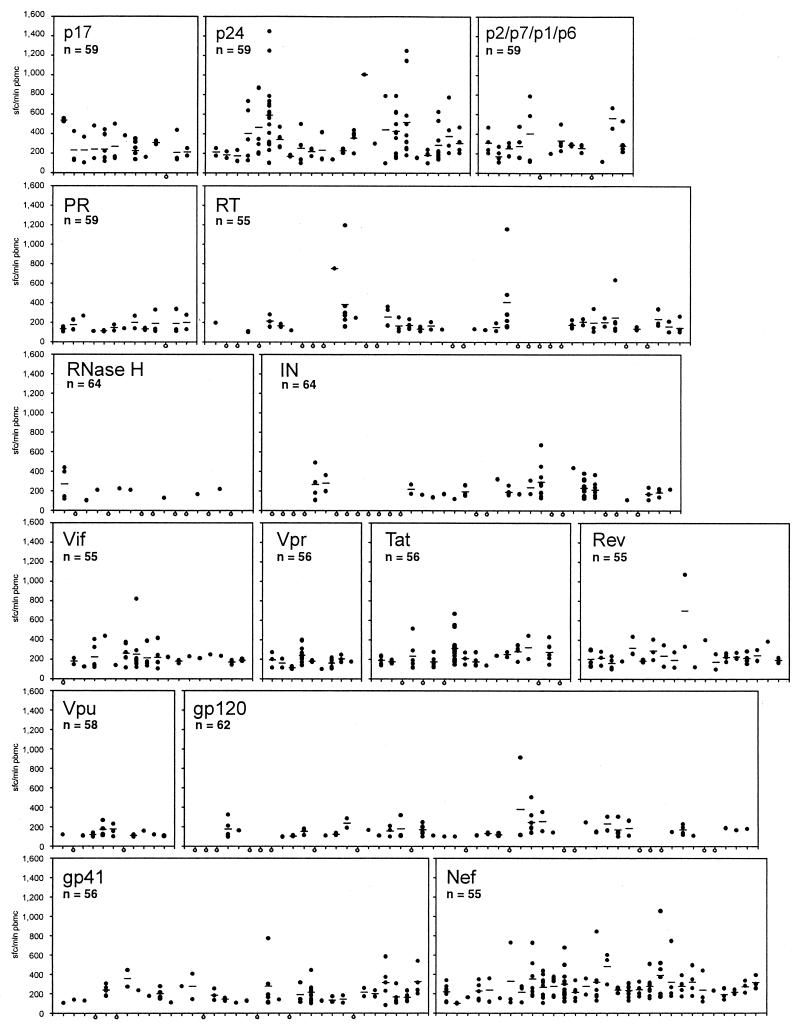
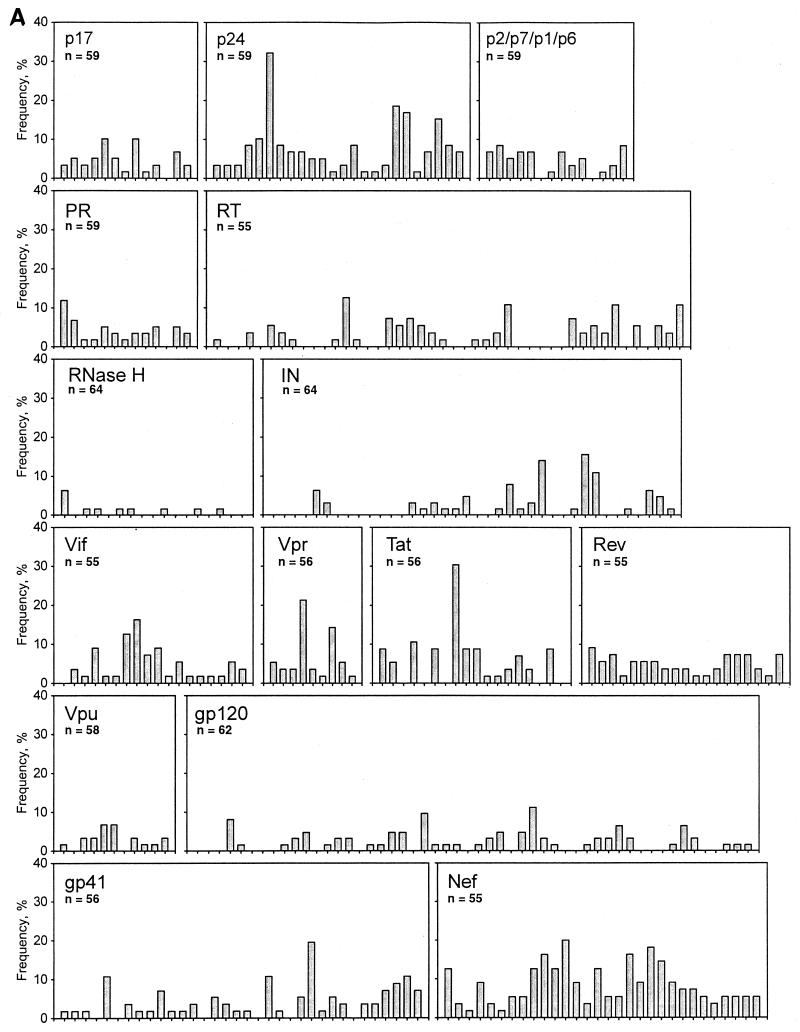
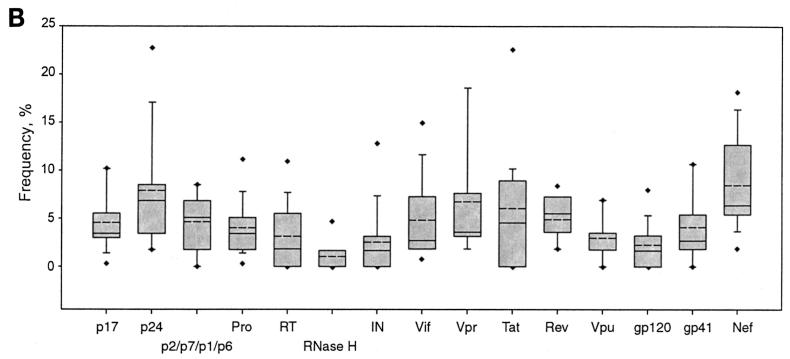
A systematic analysis of immune responses on a population level is critical for a human immunodeficiency virus type 1 (HIV-1) vaccine design. Our studies in Botswana on (i) molecular analysis of the HIV-1 subtype C (HIV-1C) epidemic, (ii) frequencies of major histocompatibility complex class I HLA types, and (iii) cytotoxic T-lymphocyte (CTL) responses in the course of natural infection allowed us to address HIV-1C-specific immune responses on a population level. We analyzed the magnitude and frequency of the gamma interferon ELISPOT-based CTL responses and translated them into normalized cumulative CTL responses. The introduction of population-based cumulative CTL responses reflected both (i) essentials of the predominant virus circulating locally in Botswana and (ii) specificities of the genetic background of the Botswana population, and it allowed the identification of immunodominant regions across the entire HIV-1C. The most robust and vigorous immune responses were found within the HIV-1C proteins Gag p24, Vpr, Tat, and Nef. In addition, moderately strong responses were scattered across Gag p24, Pol reverse transcriptase and integrase, Vif, Tat, Env gp120 and gp41, and Nef. Assuming that at least some of the immune responses are protective, these identified immunodominant regions could be utilized in designing an HIV vaccine candidate for the population of southern Africa. Targeting multiple immunodominant regions should improve the overall vaccine immunogenicity in the local population and minimize viral escape from immune recognition. Furthermore, the analysis of HIV-1C-specific immune responses on a population level represents a comprehensive systematic approach in HIV vaccine design and should be considered for other HIV-1 subtypes and/or different geographic areas.
Figures


References
-
- Abebe, A., D. Demissie, J. Goudsmit, M. Brouwer, C. L. Kuiken, G. Pollakis, H. Schuitemaker, A. L. Fontanet, and T. F. Rinke de Wit. 1999. HIV-1 subtype C syncytium- and non-syncytium-inducing phenotypes and coreceptor usage among Ethiopian patients with AIDS. AIDS 13:1305-1311. - PubMed
-
- Addo, M. M., M. Altfeld, E. S. Rosenberg, R. L. Eldridge, M. N. Philips, K. Habeeb, A. Khatri, C. Brander, G. K. Robbins, G. P. Mazzara, P. J. Goulder, B. D. Walker, and the HIV Controller Study Collaboration. 2001. The HIV-1 regulatory proteins Tat and Rev are frequently targeted by cytotoxic T lymphocytes derived from HIV-1-infected individuals. Proc. Natl. Acad. Sci. USA 98:1781-1786. - PMC - PubMed
-
- Aldovini, A., and R. A. Young. 1991. Humoral and cell-mediated immune responses to live recombinant BCG-HIV vaccines. Nature 351:479-482. - PubMed
-
- Allen, T. M., D. H. O'Connor, P. Jing, J. L. Dzuris, B. R. Mothe, T. U. Vogel, E. Dunphy, M. E. Liebl, C. Emerson, N. Wilson, K. J. Kunstman, X. Wang, D. B. Allison, A. L. Hughes, R. C. Desrosiers, J. D. Altman, S. M. Wolinsky, A. Sette, and D. I. Watkins. 2000. Tat-specific cytotoxic T lymphocytes select for SIV escape variants during resolution of primary viraemia. Nature 407:386-390. - PubMed
-
- Allen, T. M., T. U. Vogel, D. H. Fuller, B. R. Mothe, S. Steffen, J. E. Boyson, T. Shipley, J. Fuller, T. Hanke, A. Sette, J. D. Altman, B. Moss, A. J. McMichael, and D. I. Watkins. 2000. Induction of AIDS virus-specific CTL activity in fresh, unstimulated peripheral blood lymphocytes from rhesus macaques vaccinated with a DNA prime/modified vaccinia virus Ankara boost regimen. J. Immunol. 164:4968-4978. - PubMed
Publication types
MeSH terms
Substances
Grants and funding
LinkOut - more resources
Full Text Sources
Other Literature Sources
Medical
Research Materials
