. 2002 Oct 15;99(21):13926-31.
doi: 10.1073/pnas.162468699. Epub 2002 Sep 19.

COX-3, a cyclooxygenase-1 variant inhibited by acetaminophen and other analgesic/antipyretic drugs: cloning, structure, and expression

Affiliations

COX-3, a cyclooxygenase-1 variant inhibited by acetaminophen and other analgesic/antipyretic drugs: cloning, structure, and expression

N V Chandrasekharan et al. Proc Natl Acad Sci U S A. .

Abstract

Two cyclooxygenase isozymes, COX-1 and -2, are known to catalyze the rate-limiting step of prostaglandin synthesis and are the targets of nonsteroidal antiinflammatory drugs. Here we describe a third distinct COX isozyme, COX-3, as well as two smaller COX-1-derived proteins (partial COX-1 or PCOX-1 proteins). COX-3 and one of the PCOX-1 proteins (PCOX-1a) are made from the COX-1 gene but retain intron 1 in their mRNAs. PCOX-1 proteins additionally contain an in-frame deletion of exons 5-8 of the COX-1 mRNA. COX-3 and PCOX mRNAs are expressed in canine cerebral cortex and in lesser amounts in other tissues analyzed. In human, COX-3 mRNA is expressed as an approximately 5.2-kb transcript and is most abundant in cerebral cortex and heart. Intron 1 is conserved in length and in sequence in mammalian COX-1 genes. This intron contains an ORF that introduces an insertion of 30-34 aa, depending on the mammalian species, into the hydrophobic signal peptide that directs COX-1 into the lumen of the endoplasmic reticulum and nuclear envelope. COX-3 and PCOX-1a are expressed efficiently in insect cells as membrane-bound proteins. The signal peptide is not cleaved from either protein and both proteins are glycosylated. COX-3, but not PCOX-1a, possesses glycosylation-dependent cyclooxygenase activity. Comparison of canine COX-3 activity with murine COX-1 and -2 demonstrates that this enzyme is selectively inhibited by analgesic/antipyretic drugs such as acetaminophen, phenacetin, antipyrine, and dipyrone, and is potently inhibited by some nonsteroidal antiinflammatory drugs. Thus, inhibition of COX-3 could represent a primary central mechanism by which these drugs decrease pain and possibly fever.


Figures

Figure 1
Figure 1
Northern blot analysis and RT-PCR. (A) Northern blot of canine cerebral cortex poly(A) RNA (1, 5.0 μg; 2, 2.5 μg) probed with (1) 32P-labeled canine COX-1 cDNA fragment and (2) 32P-labeled canine antisense oligonucleotide to intron 1. (B) PCR amplification of PCOX-1 in canine cerebral cortex. Lane 1, ethidium bromide-stained gel of amplified products corresponding to PCOX-1a containing intron 1 (upper band) and PCOX-1b (lower band) lacking intron 1; lane 2, Southern blot of the amplified products probed with antisense oligonucleotide to intron 1; lane 3, Southern blot using COX-3 cDNA as probe. (C) Human Multiple Tissue Northern blots (MTN) probed with a 32P-labeled human antisense oligonucleotide to intron 1 (HCI). The ≈5.2-kb mRNA was detected in blots 1–3 (adult tissues), and 4 (fetal tissues). Am, amygdala; B, brain; C, cerebellum: Cc, cerebral cortex; Fl, frontal lobe; Hi, hippocampus; Ht, heart; K, kidney; Lu, lung; Li, liver; M, skeletal muscle; Md, medulla; Cn, caudate nucleus; Op, occipital pole; P, placenta; Pn, pancreas; Pu, putamen; Sc, spinal cord; Th, thalamus; Tl, temporal lobe; Co, corpus callosum.
Figure 2
Figure 2
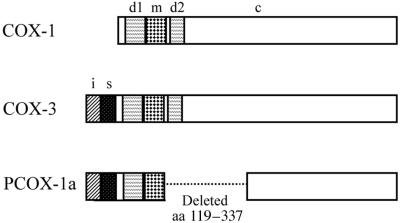
Structure of COX-3 and PCOX-1a. A schematic representation of the domains of COX-3 and PCOX-1 in comparison to COX-1. s, signal peptide; d1, dimerization domain/EGF-like domain 1; d2, dimerization domain 2; m, membrane binding domain; c, catalytic domain; i, 90-bp sequence encoded by intron 1. PCOX-1b is identical to PCOX-1a except that PCOX-1b lacks intron 1. Amino acid numbering is according to residues in sheep seminal vesicle COX-1.
Figure 3
Figure 3
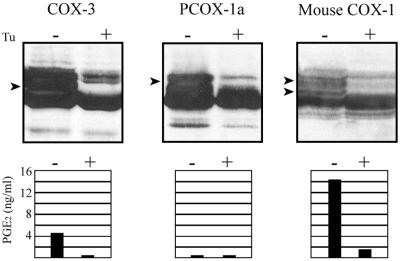
Expression in insect cells. Western blots showing the expression of COX-3, PCOX-1a, and COX-1 in insect cells treated with (+) and without (−) tunicamycin (Upper). Arrows indicate glycosylated forms of COX-1 that are not present in cells treated with tunicamycin. Polyclonal antibodies to human and mouse COX-1 intron 1 sequence were used to probe the COX-3 and PCOX-1a blots, whereas a monoclonal antibody to ovine COX-1 (Cayman Chemical) was used to probe the mouse COX-1 blot. COX activity in insect cells expressing COX-3, PCOX-1a, and COX-1 (Lower). Cells were treated with (+) and without (−) tunicamycin.
Figure 4
Figure 4
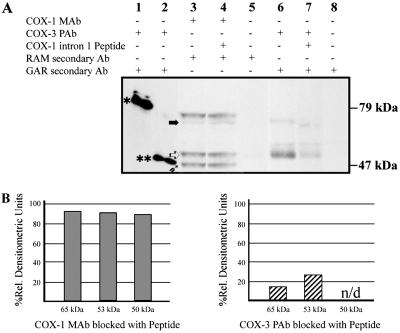
Western blot of human aorta lysate probed with COX-1 and -3 antibodies. (A) Western blot (lanes 3–8, 20 μg total aorta protein each lane) probed with primary, secondary, or blocked antibodies as indicated. A solid horizontal arrow indicates the 65-kDa protein, an open arrow indicates the 53-kDa proteins, and an upward diagonal solid arrow indicates the 50-kDa protein. A single asterisk denotes unglycosylated canine COX-3, and a double asterisk denotes unglycosylated canine PCOX-1a. (B) Densitometric analysis of 65-, 53-, and 50-kDa proteins. Percent relative densitometric units (% rdu) were calculated by comparison to the signal from unblocked primary antibodies. The 50-kDa protein is not detected (n/d) by unblocked or blocked COX-3 polyclonal antibody (pAb).
Figure 5
Figure 5
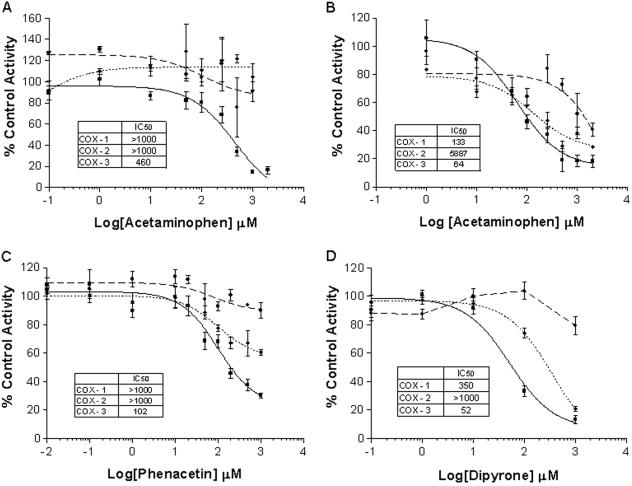
Drug inhibition studies. The effects of acetaminophen (A and B), phenacetin (C), and dipyrone (D) on COX-1 (♦), COX-2 (●), and COX-3 (▪) activity in insect cells. COX activity was measured by the formation of PGE2 after exposure to exogenous 5 μM (B) or 30 μM (A, C, and D) arachidonic acid for 10 min. Data are expressed as mean ± SEM (n = 6–9).

Comment in

References

    1. Botting R M. Clin Infect Dis. 2000;31:8202–8210. - PubMed
    1. Flower R J, Vane J R. Nature (London) 1972;240:410–411. - PubMed
    1. Sambrook J, Russell D. Molecular Cloning: A Laboratory Manual. 3rd Ed. Plainview, NY: Cold Spring Harbor Lab. Press; 2001.
    1. Simmons D L, Levy D B, Yannoni Y, Erikson R L. Proc Natl Acad Sci USA. 1989;86:1178–1182. - PMC - PubMed
    1. Hla T. Prostaglandins. 1996;51:81–85. - PubMed

Publication types

MeSH terms

Associated data