. 2002 Oct 1;99(20):13148-53.
doi: 10.1073/pnas.192319099. Epub 2002 Sep 23.

The Brucella suis genome reveals fundamental similarities between animal and plant pathogens and symbionts

Affiliations

The Brucella suis genome reveals fundamental similarities between animal and plant pathogens and symbionts

Ian T Paulsen et al. Proc Natl Acad Sci U S A. .

Abstract

The 3.31-Mb genome sequence of the intracellular pathogen and potential bioterrorism agent, Brucella suis, was determined. Comparison of B. suis with Brucella melitensis has defined a finite set of differences that could be responsible for the differences in virulence and host preference between these organisms, and indicates that phage have played a significant role in their divergence. Analysis of the B. suis genome reveals transport and metabolic capabilities akin to soil/plant-associated bacteria. Extensive gene synteny between B. suis chromosome 1 and the genome of the plant symbiont Mesorhizobium loti emphasizes the similarity between this animal pathogen and plant pathogens and symbionts. A limited repertoire of genes homologous to known bacterial virulence factors were identified.


Figures
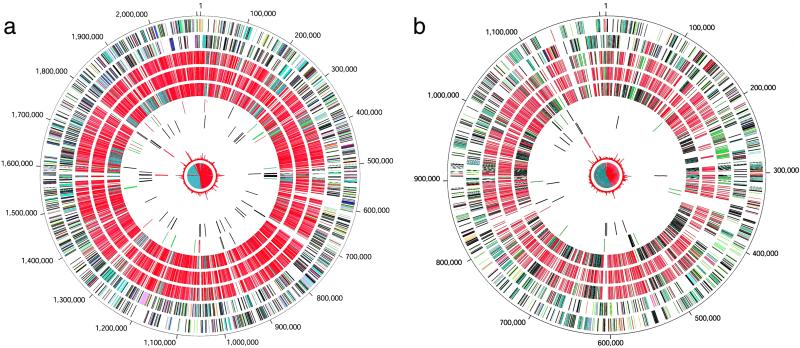
Figure 1
Figure 1
Circular representation of the two chromosomes of B. suis strain 1330. The outer circle shows predicted coding regions on the plus strand color-coded by role categories: salmon, amino acid biosynthesis; light blue, biosynthesis of cofactors, prosthetic groups and carriers; light green, cell envelope; red, cellular processes; brown, central intermediary metabolism; yellow, DNA metabolism; green, energy metabolism; purple, fatty acid and phospholipid metabolism; pink, protein fate/synthesis; orange, purines, pyrimidines, nucleosides, nucleotides; blue, regulatory functions; gray, transcription; teal, transport and binding proteins; black, hypothetical and conserved hypothetical proteins. Second circle, predicted coding regions on the minus strand color-coded by role categories. Third circle, top hits to S. meliloti, according to replicon: red, main chromosome; green, plasmid pSymA; gray, plasmid pSymB. Fourth circle, top hits to M. loti, according to replicon: red, main chromosome; green, plasmid pMLa; gray, plasmid pMLb. Fifth circle, top hits to A. tumefaciens, according to replicon: red, circular chromosome; gray, linear chromosome; green, plasmid pAtC58; blue, plasmid pTiC58. Sixth circle, locations of B. suis-specific regions greater than 100 base pairs, green; B. melitensis-specific regions greater than 100 base pairs, red; and transposase genes, black. Seventh circle, tRNAs in brown. Eighth circle, rRNA operons in red. Ninth circle, atypical nucleotide composition curve in red. Tenth circle, GC-skew curve in red/black.
Figure 2
Figure 2
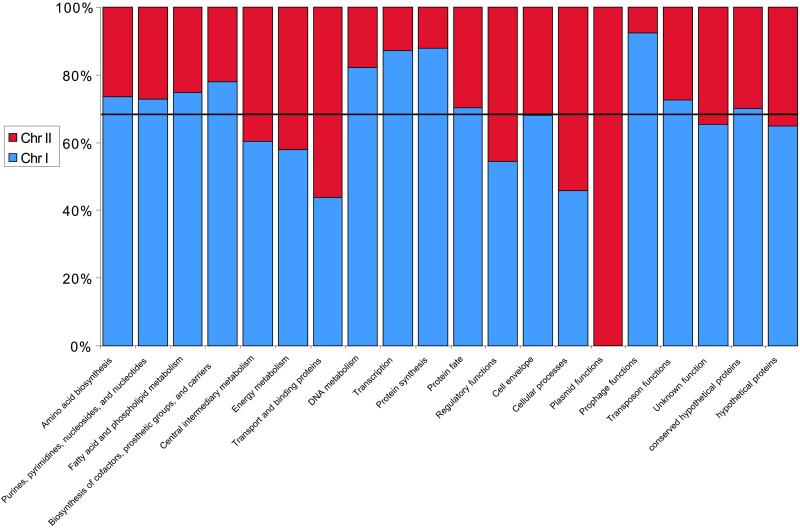
Percentage of B. suis ORFs encoded on Chr I (blue) and II (red) in biological role categories. The horizontal line represents the percentage of ORFs encoded on each of the two chromosomes.
Figure 3
Figure 3
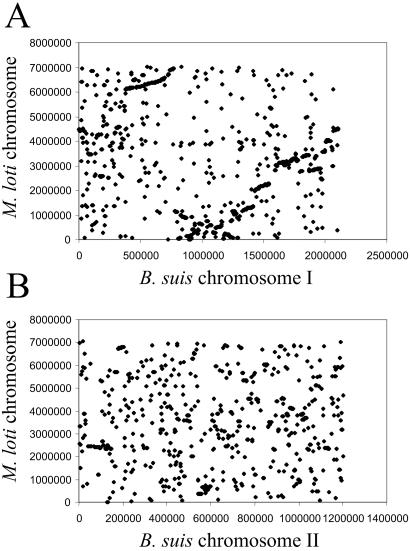
Whole genome proteome alignment (35) between proteins encoded on (A) B. suis chromosome I (horizontal axis) and the M. loti chromosome (vertical axis) and (B) B. suis chromosome II (horizontal axis) and the M. loti chromosome (vertical axis). Plots show the chromosome locations of pairs of predicted proteins that have significant similarity (P < 10−15).

Comment in

References

    1. Young E J. Clin Infect Dis. 1995;21:283–289. - PubMed
    1. Franz D R. Ann NY Acad Sci. 1999;894:100–104. - PubMed
    1. Regis E. The Biology of Doom: The History of America's Secret Germ Warfare Project. New York: Henry Holt and Associates; 1999.
    1. Kortepeter M G, Parker G W. Emerg Infect Dis. 1999;5:523–527. - PMC - PubMed
    1. Horn F P, Breeze R G. Ann NY Acad Sci. 1999;894:9–17. - PubMed

Publication types

Substances

Associated data