


Growth at low ammonium concentrations and starvation response as potential factors involved in niche differentiation among ammonia-oxidizing bacteria
- PMID: 12324316
- PMCID: PMC126422
- DOI: 10.1128/AEM.68.10.4751-4757.2002
Growth at low ammonium concentrations and starvation response as potential factors involved in niche differentiation among ammonia-oxidizing bacteria
Abstract
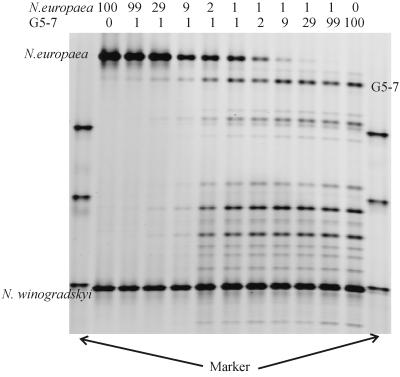
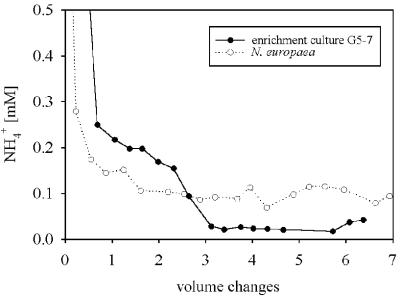
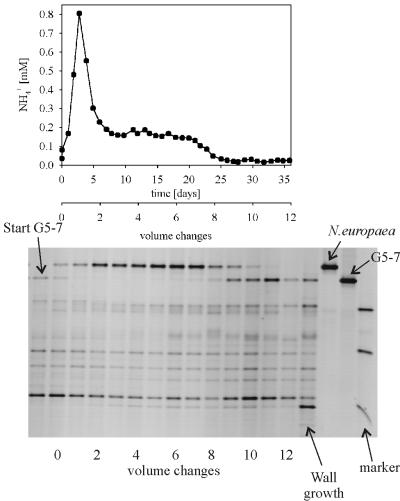
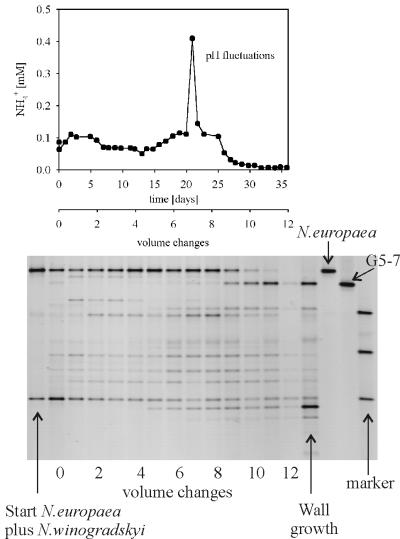
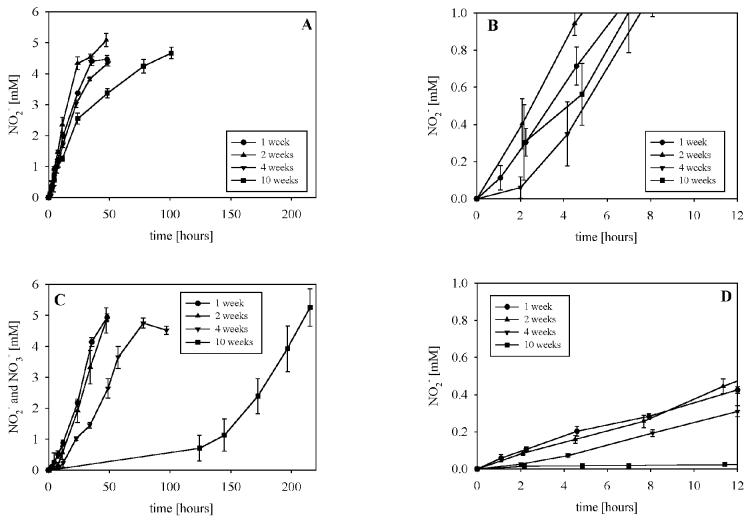
In nature, ammonia-oxidizing bacteria have to compete with heterotrophic bacteria and plants for limiting amounts of ammonium. Previous laboratory experiments conducted with Nitrosomonas europaea suggested that ammonia-oxidizing bacteria are weak competitors for ammonium. To obtain a better insight into possible methods of niche differentiation among ammonia-oxidizing bacteria, we carried out a growth experiment at low ammonium concentrations with N. europaea and the ammonia oxidizer G5-7, a close relative of Nitrosomonas oligotropha belonging to Nitrosomonas cluster 6a, enriched from a freshwater sediment. Additionally, we compared the starvation behavior of the newly enriched ammonia oxidizer G5-7 to that of N. europaea. The growth experiment at low ammonium concentrations showed that strain G5-7 was able to outcompete N. europaea at growth-limiting substrate concentrations of about 10 micro M ammonium, suggesting better growth abilities of the ammonia oxidizer G5-7 at low ammonium concentrations. However, N. europaea displayed a more favorable starvation response. After 1 to 10 weeks of ammonium deprivation, N. europaea became almost immediately active after the addition of fresh ammonium and converted the added ammonium within 48 to 96 h. In contrast, the regeneration time of the ammonia oxidizer G5-7 increased with increasing starvation time. Taken together, these results provide insight into possible mechanisms of niche differentiation for the ammonia-oxidizing bacteria studied. The Nitrosomonas cluster 6a member, G5-7, is able to grow at ammonium concentrations at which the growth of N. europaea, belonging to Nitrosomonas cluster 7, has already ceased, providing an advantage in habitats with continuously low ammonium concentrations. On the other hand, the ability of N. europaea to become active again after longer periods of starvation for ammonium may allow better exploitation of irregular pulses of ammonium in the environment.
Figures
References
-
- Andrews, J. H., and R. F. Harris. 1986. r- and K-selection and microbial ecology. Adv. Microb. Ecol. 9:99-147.
-
- Belser, L. W., and E. L. Schmidt. 1980. Growth and oxidation kinetics of three genera of ammonia-oxidizing nitrifiers. FEMS Microbiol. Lett. 7:213-216.
-
- Bodelier, P. L. E., H. Duyts, C. W. P. M. Blom, and H. J. Laanbroek. 1998. Interactions between nitrifying and denitrifying bacteria in gnotobiotic microcosms planted with the emergent macrophyte Glyceria maxima. FEMS Microbiol. Ecol. 25:63-78.
-
- Bollmann, A., and H. J. Laanbroek. 2001. Continuous culture enrichments of ammonia-oxidizing bacteria at low ammonium concentrations. FEMS Microbiol. Ecol. 37:211-221.
-
- Daims, H., P. H. Nielsen, J. L. Nielsen, S. Juretschko, and M. Wagner. 2000. Novel Nitrospira-like bacteria as dominant nitrite-oxidizers in biofilms from wastewater treatment plants: diversity and in situ physiology. Water Sci. Technol. 41:85-90.
Publication types
MeSH terms
Substances
LinkOut - more resources
Full Text Sources
Molecular Biology Databases
