


Genetic classification and differentiation of Bartonella species based on comparison of partial ftsZ gene sequences
- PMID: 12354859
- PMCID: PMC130884
- DOI: 10.1128/JCM.40.10.3641-3647.2002
Genetic classification and differentiation of Bartonella species based on comparison of partial ftsZ gene sequences
Abstract
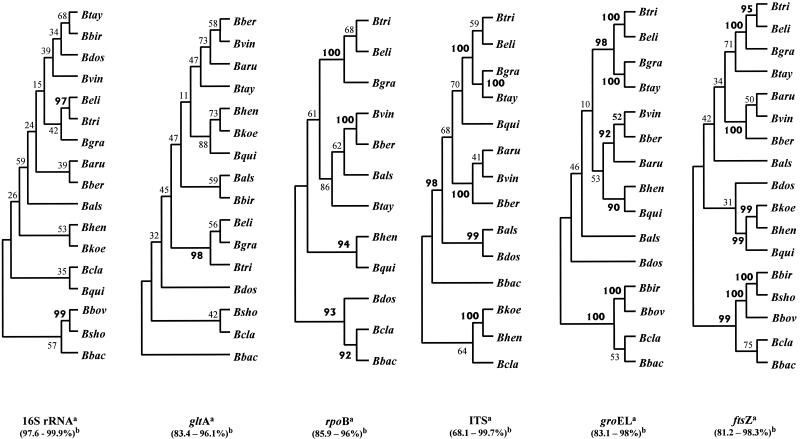
Currently, 19 species are recognized in the genus Bartonella, 7 of which are involved in an increasing variety of human diseases. Development of molecular tools for detection, identification, and subtyping of strains and isolates has promoted research on Bartonella spp. We amplified and sequenced the portion of the ftsZ gene encoding the N-terminal region of the cell division protein for 13 Bartonella species: Bartonella alsatica, B. birtlesii, B. doshiae, B. elizabethae, B. grahami, B. koehlerae, B. schoenbuchensis, B. taylorii, B. tribocorum, Bartonella vinsonii subsp. arupensis, Bartonella vinsonii subsp. berkhoffii, Bartonella vinsonii subsp. vinsonii, and B. bovis Bermond et al.("B. weissii"). Phylogenetically derived trees revealed four statistically supported groups, indicating that sequencing of the ftsZ gene is a useful tool for identifying evolutionary relationships among Bartonella species. Furthermore, we amplified and sequenced the portion of the ftsZ gene encoding the C-terminal region of the protein for 4 B. bacilliformis isolates, 14 B. clarridgeiae isolates, 14 B. quintana isolates, and 30 B. henselae isolates that were obtained from different geographic regions, hosts, and clinical specimens. B. clarridgeiae and B. quintana sequences were highly conserved, while those of the four B. bacilliformis isolates differed from the type strain at 5 positions. Among B. henselae strains isolated from cats and patients, only two genotypes were detected: Houston and Marseille. Among 80 clinical samples we detected Bartonella spp. in 35 (43.75%) and found the assay to be comparable to that of a combined intergenic-spacer-region- and pap31-based PCR assay. Our results show the usefulness of the portion of the ftsZ gene encoding the C-terminal region for diagnosis of Bartonella infections. More samples should be tested to study its usefulness for epidemiological investigations.
Figures
References
-
- Bermond, D., H. J. Boulouis, R. Heller, G. Van Laere, H. Monteil, B. B. Chomel, A. Sander, C. Dehio, and Y. Piemont. 2002. Bartonella bovis Bermond et al. sp.nov. and Bartonella capreoli sp. nov., isolated from European ruminants. Int. J. Syst. Evol. Microbiol. 52:383-390. - PubMed
Publication types
MeSH terms
Substances
LinkOut - more resources
Full Text Sources
Molecular Biology Databases
Miscellaneous
