. 2002 Oct 2;94(19):1494-503.
doi: 10.1093/jnci/94.19.1494.

Phenotypic reversion or death of cancer cells by altering signaling pathways in three-dimensional contexts

Affiliations

Phenotypic reversion or death of cancer cells by altering signaling pathways in three-dimensional contexts

Fei Wang et al. J Natl Cancer Inst. .

Abstract

Background: We previously used a three-dimensional (3D) reconstituted basement membrane (rBM) assay to demonstrate that tumorigenic HMT-3522 T4-2 human breast cells can be induced to form morphologically normal structures ("reversion") by treatment with inhibitors of beta1 integrin, the epidermal growth factor receptor (EGFR), or mitogen-activated protein kinase (MAPK). We have now used this assay to identify reversion and/or death requirements of several more aggressive human breast cancer cell lines.

Methods: Breast tumor cell lines MCF7, Hs578T, and MDA-MB-231 were cultured in 3D rBM and treated with inhibitors of beta1 integrin, MAPK, or phosphatidylinositol 3-kinase (PI3K). MDA-MB-231 cells, which lack E-cadherin, were transfected with an E-cadherin cDNA. The extent of reversion was assessed by changes in morphology and polarity, growth in 3D rBM or soft agar, level of invasiveness, and tumor formation in nude mice.

Results: All three cell lines showed partial reversion (MCF7 the greatest and Hs578T the least) of tumorigenic properties treated with a single beta1 integrin, MAPK, or PI3K inhibitor. Combined inhibition of beta1 integrin and either PI3K or MAPK resulted in nearly complete phenotypic reversion (MDA-MB-231, MCF7) or in cell death (Hs578T). E-cadherin-transfected MDA-MB-231 cells showed partial reversion, but exposure of the transfectants to an inhibitor of beta1 integrin, PI3K, or MAPK led to nearly complete reversion.

Conclusion: The 3D rBM assay can be used to identify signaling pathways that, when manipulated in concert, can lead to the restoration of morphologically normal breast structures or to death of the tumor cells, even highly metastatic cells. This approach may be useful to design therapeutic intervention strategies for aggressive breast cancers.


Figures
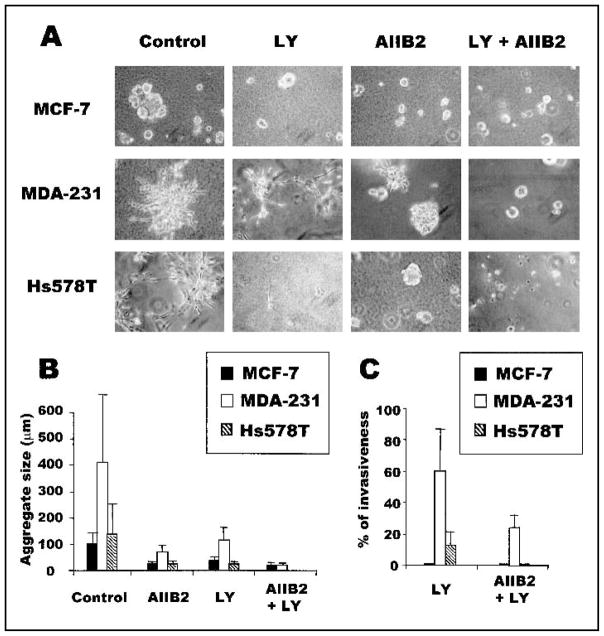
Fig. 1
Fig. 1
Inhibiting the combination of β1 integrin and phosphatidylinositol 3-kinase (PI3K) promotes a greater alteration in morphology, aggregate size, and invasiveness than inhibiting either PI3K or β1 integrin alone. A) MCF7, MDA-MB-231 (MDA-231), and Hs578T breast tumor cells grown in three-dimensional (3D) reconstituted basement membrane (rBM) cultures in the presence of anti-β1 integrin antibody (AIIB2) and/or PI3K inhibitor LY294002 (LY). All cultures were analyzed after 10 days of rBM culture. B) Size of the colonies formed by the three breast tumor cell lines grown in 3D rBM in the presence of inhibitors (error bars indicate 95% confidence intervals of triplicate samples). Experiments were repeated four times with similar results. C) Invasiveness of treated and untreated MDA-MB-231 (MDA-231) and Hs578T breast cancer cells in Matrigel-coated Boyden chamber assays. The invasiveness of these cells treated with AIIB2, LY294002, or AIIB2 plus LY294002 is shown as a percentage of control (error bars indicate 95% confidence intervals of triplicate samples; experiments were repeated four times with similar results). MCF7 cells were not invasive in this assay. Experiments were repeated three times with similar results.
Fig. 2
Fig. 2
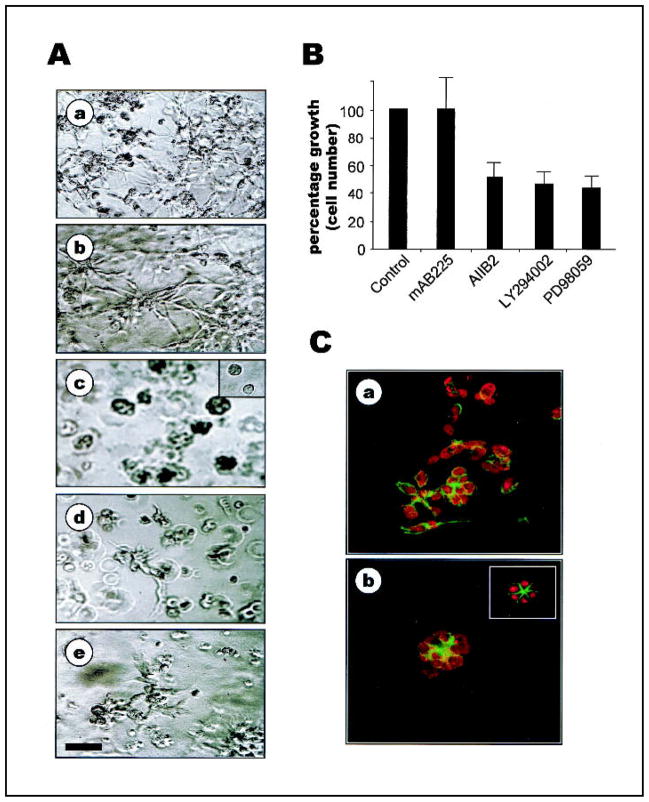
Inhibition of epidermal growth factor receptor (EGFR), β1 integrin, phosphatidylinositol 3-kinase (PI3K), or mitogen-activated protein kinase (MAPK) alone is not sufficient to induce phenotypic reversion of MDA-MB-231 cells. A) Phase-contrast micrographs of control untreated cells (a) or cells treated with EGFR inhibitory antibody mAb225 (b), β1 integrin inhibitory antibody AIIB2 (c), PI3K inhibitor LY294002 (d), or MAPK inhibitor PD98059 (e) in three-dimensional (3D) reconstituted basement membrane (rBM) cultures. Cb, inset) Phase-contrast micrograph of S1 cells in 3D rBM. Bar = 60 μm. B) Growth of MDA-MB-231 cells treated with mAb225, AIIB2, LY294002, or PD98059, as indicated by cell number shown as percentage of control (error bars indicate 95% confidence intervals of triplicate samples; experiments were repeated three times with similar results). C) Confocal fluorescence microscopy images of filamentous actin (fluorescein isothiocyanate = green) and nuclei (propidium iodide = red) in 5-μm cryosections of MDA-MB-231 cells in the presence (b) or absence (a) of AIIB2. Inset, Confocal fluorescence microscopy image of S1 cells. All cultures in AC were analyzed after 10 days of rBM culture.
Fig. 3
Fig. 3
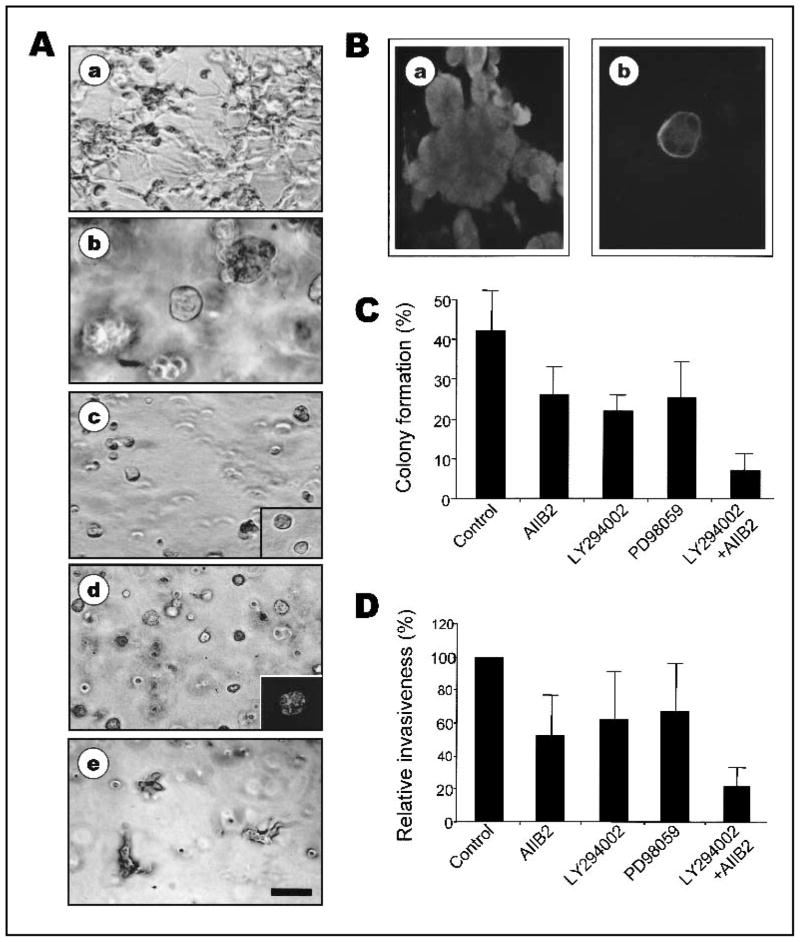
Inhibition of β1 integrin plus phosphatidylinositol 3-kinase (PI3K) or inhibition of β1 integrin plus mitogen-activated protein kinase (MAPK) is sufficient to induce phenotypic reversion of MDA-MB-231 cells. A) Phase-contrast micrographs of control untreated MDA-MB-231 cells (a), MDA-MB-231 cells treated with β1 integrin inhibitory antibody AIIB2 (b), AIIB2 plus PI3K inhibitor LY294002 (c), AIIB2 plus MAPK inhibitor PD98059 (d), or LY294002 plus PD98059 (e) in three-dimensional (3D) reconstituted basement membrane (rBM) cultures. Bar = 50 μm. c, inset) Phase-contrast micrograph of S1 cells in 3D rBM. d, inset) Confocal fluorescence microscopy image of filamentous actin (F-actin) in 5-μm cryosections of MDA-MB-231 cells treated with AIIB2 plus PD98059 (×2 image). Bar = 25 μm. Similar pattern of staining of F-actin and nuclei was obtained with cells treated with AIIB2 plus LY294002. B) Confocal immunofluorescence microscopy images of β4 integrin in untreated control (a) and AIIB2 plus LY294002 treated (b) MDA-MB-231 cells. C) Anchorage-independent growth of untreated and treated MDA-MB-231 cells in soft agar. Colony formation by MDA-MB-231 cells treated with AIIB2, LY294002, PD98059, or AIIB2 plus LY294002 shown as percentage of colony formation (mean ± 95% confidence intervals; experiments were repeated three times with similar results). D) Relative invasiveness of untreated and treated MDA-MB-231 cells, treated as in (B), shown as percentage of control (± 95% confidence intervals; experiments were repeated three times with similar results).
Fig. 4
Fig. 4
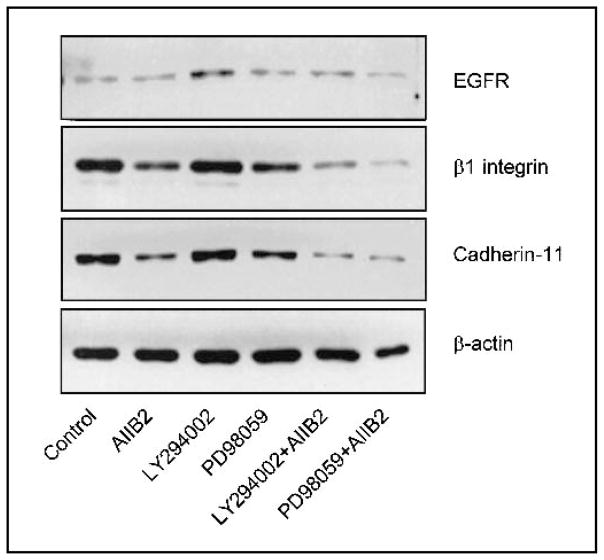
Immunoblot of epidermal growth factor receptor (EGFR), β1 integrin, and cadherin 11 protein levels as a function of inhibitor treatment. Control MDA-MB-231 cells and MDA-MB-231 cells treated with AIIB2, LY294002, PD98059, AIIB2 plus LY294002, or AIIB2 plus PD98059. β-Actin was used as the loading control.
Fig. 5
Fig. 5
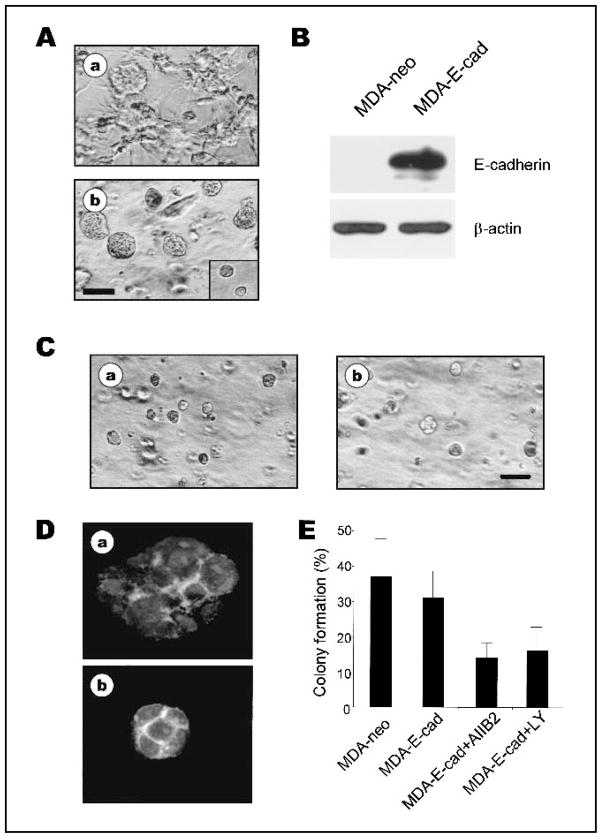
Expression of E-cadherin plus a single inhibitor is sufficient to induce phenotypic reversion of MDA-MB-231 cells. A) Phase-contrast micrographs of control vector-transfected MDA-MB-231 cells (MDA-neo, a) and MDA-MB-231 cells expressing E-cadherin (MDA-E-cad, b) in three-dimensional (3D) reconstituted basement membrane (rBM) cultures. Bar = 60 μm. B) Immunoblot of E-cadherin levels in MDA-neo and MDA-E-cad cells. β-Actin was used as a loading control. C) Phase-contrast micrographs of MDA-E-cad cells treated with β1 integrin inhibitory antibody AIIB2 (a), or phosphatidylinositol 3-kinase (PI3K) inhibitor LY294002 (b), in 3D rBM. Scale bar = 60 μm. D) Confocal fluorescence microscopy image of filamentous actin and nuclei in 5-μm cryosections of MDA-E-cad cells (a) and MDA-E-cad cells treated with LY294002 (b). E) Anchorage-independent growth of untreated and treated MDA-E-cad cells in soft agar. Percentage of colony formation by MDA-neo cells, MDA-E-cad cells, or MDA-E-cad cells treated with AIIB2 or LY294002 (mean ± 95% confidence intervals of duplicate samples; experiments were repeated three times).

References

    1. Bissell MJ, Weaver VM, Lelievre SA, Wang F, Petersen OW, Schmeichel KL. Tissue structure, nuclear organization, and gene expression in normal and malignant breast. Cancer Res. 1999;59(7 Suppl):1757s–63s. discussion 1763s–4s. - PubMed
    1. Gumbiner BM. Cell adhesion: the molecular basis of tissue architecture and morphogenesis. Cell. 1996;84:345–57. - PubMed
    1. Werb Z, Vu TH, Rinkenberger JL, Coussens LM. Matrix-degrading proteases and angiogenesis during development and tumor formation. APMIS. 1999;107:11–8. - PubMed
    1. Bissell MJ, Radisky D. Putting tumours in context. Nature Rev Cancer. 2001;1:46–54. - PMC - PubMed
    1. Petersen OW, Ronnov-Jessen L, Howlett AR, Bissell MJ. Interaction with basement membrane serves to rapidly distinguish growth and differentiation pattern of normal and malignant human breast epithelial cells [published erratum appears in Proc Natl Acad Sci U S A 1993;90:2556] Proc Natl Acad Sci U S A. 1992;89:9064–8. - PMC - PubMed

Publication types

MeSH terms