


A conserved flavin-shielding residue regulates NO synthase electron transfer and nicotinamide coenzyme specificity
- PMID: 12359874
- PMCID: PMC129705
- DOI: 10.1073/pnas.192283399
A conserved flavin-shielding residue regulates NO synthase electron transfer and nicotinamide coenzyme specificity
Abstract
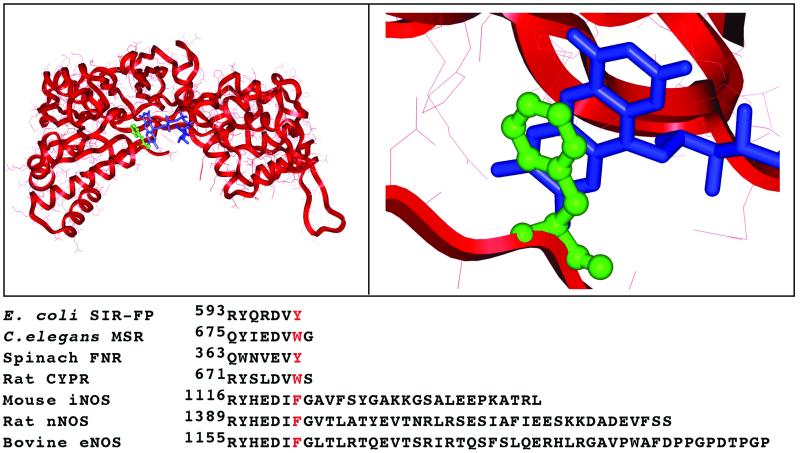
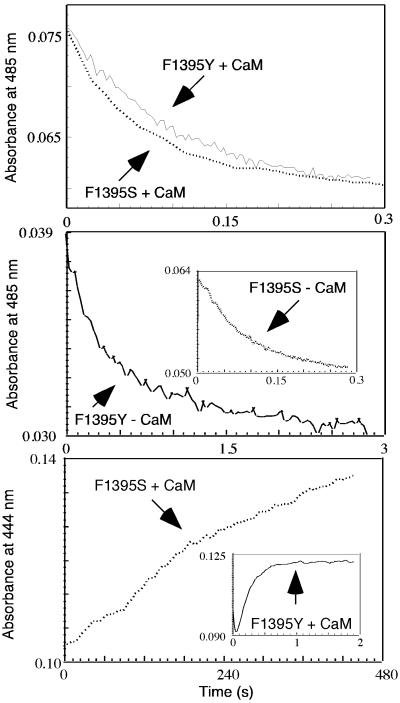
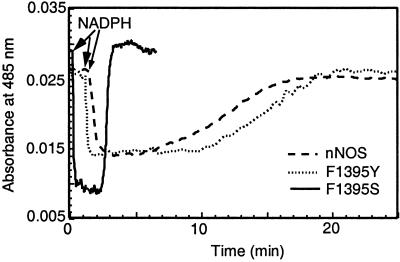
Nitric oxide synthases (NOSs) are flavoheme enzymes that contain a ferredoxin:NADP(+)-reductase (FNR) module for binding NADPH and FAD and are unusual because their electron transfer reactions are controlled by the Ca(2+)-binding protein calmodulin. A conserved aromatic residue in the FNR module of NOS shields the isoalloxazine ring of FAD and is known to regulate NADPH binding affinity and specificity in related flavoproteins. We mutated Phe-1395 (F1395) in neuronal NOS to Tyr and Ser and tested their effects on nucleotide coenzyme specificity, catalytic activities, and electron transfer in the absence or presence of calmodulin. We found that the aromatic side chain of F1395 controls binding specificity with respect to NADH but does not greatly affect affinity for NADPH. Measures of flavin and heme reduction kinetics, ferricyanide and cytochrome c reduction, and NO synthesis established that the aromatic side chain of F1395 is required to repress electron transfer into and out of the flavins of neuronal NOS in the calmodulin-free state, and is also required for calmodulin to fully relieve this repression. We speculate that the phenyl side chain of F1395 is part of a conformational trigger mechanism that negatively or positively controls NOS electron transfer depending on the presence of calmodulin. Such use of the conserved aromatic residue broadens our understanding of flavoprotein structure and regulation.
Figures
References
-
- Ignarro L J, editor. Nitric Oxide, Biology and Pathobiology. San Diego: Academic; 2000.
-
- Furchgott R F. Biosci Rep. 1999;19:235–251. - PubMed
-
- Stuehr D, Pou S, Rosen G M. J Biol Chem. 2001;276:14533–14536. - PubMed
-
- Pferiffer S, Mayer B, Hemmens B. Angew Chem Int Ed Engl. 1999;38:1714–1731. - PubMed
-
- Roman L J, Martasek P, Masters B S. Chem Rev. 2002;102:1179–1190. - PubMed
Publication types
MeSH terms
Substances
Grants and funding
LinkOut - more resources
Full Text Sources
Miscellaneous
