. 2002 Oct 15;99(21):13549-53.
doi: 10.1073/pnas.222243999. Epub 2002 Oct 2.

Combinatorial mutagenesis to restrict amino acid usage in an enzyme to a reduced set

Affiliations

Combinatorial mutagenesis to restrict amino acid usage in an enzyme to a reduced set

Satoshi Akanuma et al. Proc Natl Acad Sci U S A. .

Abstract

We developed an effective strategy to restrict the amino acid usage in a relatively large protein to a reduced set with conservation of its in vivo function. The 213-residue Escherichia coli orotate phosphoribosyltransferase was subjected to 22 cycles of segment-wise combinatorial mutagenesis followed by 6 cycles of site-directed random mutagenesis, both coupled with a growth-related phenotype selection. The enzyme eventually tolerated 73 amino acid substitutions: In the final variant, 9 amino acid types (A, D, G, L, P, R, T, V, and Y) occupied 188 positions (88%), and none of 7 amino acid types (C, H, I, M, N, Q, and W) appeared. Therefore, the catalytic function associated with a relatively large protein may be achieved with a subset of the 20 amino acid. The converged sequence also implies simpler constituents for proteins in the early stage of evolution.


Figures
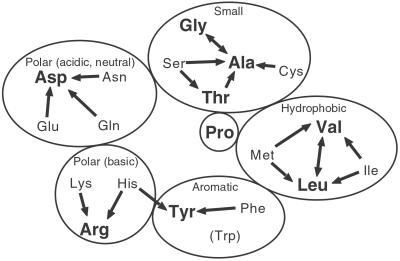
Figure 1
Figure 1
Amino acid substitutions to reduce the amino acid types contained in E. coli OPRTase.
Figure 2
Figure 2
Construction of a combinatorial library for the pyrE gene and selection in E. coli strain RK1032. The entire sequence of the E. coli OPRTase gene was simplified stepwise in 22 rounds of mutagenesis and phenotype selection. In steps 1–3, a genetic library was constructed by a strategy similar to that of Huang et al. (15). (Step 1) A target nucleotide sequence on pUC119 was replaced with a linker containing a SalI restriction site to eliminate wild-type DNA contamination in the following library constructions. E. coli CJ236 was transformed with the resulting plasmid, and then uracil-containing single-stranded DNA was isolated. A synthetic oligonucleotide designed to replace the linker sequence and generate several types of amino acid substitutions within the target segment was annealed to the single-stranded DNA. (Step 2) Second strands were synthesized, and the resulting double-stranded plasmid mixture was amplified in E. coli JM109. (Step 3) In rounds 1–15, the amplified plasmid DNA variants were digested with HindIII and EcoRI to excise the pyrE gene variants with the combinatorial sequence, and the HindIII–EcoRI fragments were inserted into low copy-number plasmid pSTV29. The resulting plasmids were amplified again in E. coli JM109. The phenotype selection was through steps 4–5. (Step 4) The amplified plasmid mixture was used to transform the ΔpyrE E. coli strain RK1032. (Step 4′) In rounds 16–22, the pyrE gene variants were not cloned into the low copy-number plasmid. The mutated pyrE genes inserted into pUC119 were used to transform E. coli RK1032. The RK1032 transformants were spread on M9 medium agar plates without uracil and incubated for 2 days at 37°C. (Step 5) On average, 12 of the largest colonies then were selected from the plates. The plasmid DNA variants were prepared from the colonies and used for the subsequent PCR amplification of the pyrE genes. The amplified PCR products were sequenced directly to determine the amino acid sequence within the mutagenized region. Based on the sequence analyses, the positions where the reduced-set residues are tolerated were determined. Thus a simplified amino acid sequence was generated within the targeted segment on pUC119. (Step 6) The resulting sequence variant on the plasmid was subjected to the next round of mutagenesis.
Figure 3
Figure 3
Amino acid sequences of E. coli OPRTase and its simplified variants. The nonreduced set and the substituting amino acids are shown in cyan and red, respectively. Orange shading indicates the region semiselectively randomized in each round.
Figure 4
Figure 4
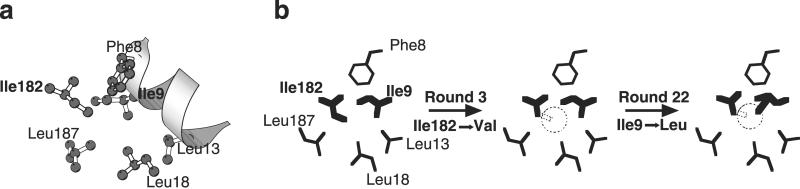
Avoidance of the interference between mutations at different segments by stepwise mutagenesis. (a) The wild-type enzyme structure around positions 9 and 182. (b) Schematic illustration of amino acid substitutions at positions 9 and 182.
Figure 5
Figure 5
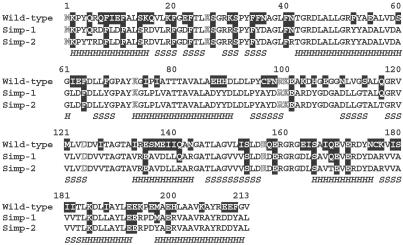
Sequence alignment of the wild-type enzyme and simplified variants. The nonreduced-set amino acid residues are highlighted with black boxes. The N-terminal and catalytically important residues that were not subjected to mutagenesis are indicated with open letters. The secondary structures of the wild-type OPRTase are shown below their corresponding sequences. H, α-helix; S, β-strand.
Figure 6
Figure 6
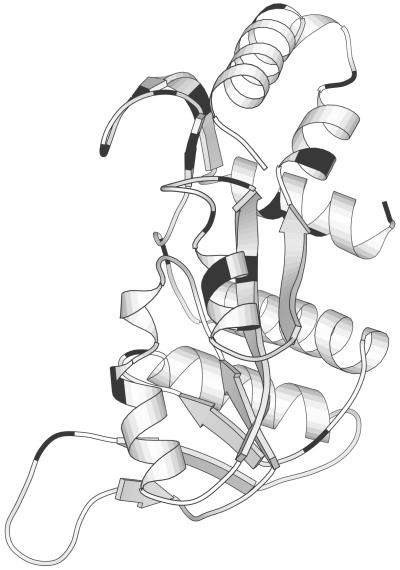
MOLSCRIPT (26) representation of a model of the monomer structure of the simplified OPRTase variant Simp-2. Eighty-eight percent of Simp-2 is composed of the reduced-set of nine amino acids, which are shown as a gray backbone ribbon. The residues not simplified in Simp-2 are rendered in black.

References

    1. Regan L, DeGrado W F. Science. 1988;241:976–978. - PubMed
    1. Kamtekar S, Schiffer J M, Xiong H, Babik J M, Hecht M H. Science. 1993;262:1680–1685. - PubMed
    1. Schafmeister C E, LaPorte S L, Miercke L J, Stroud R M. Nat Struct Biol. 1997;4:1039–1046. - PubMed
    1. Riddle D S, Santiago J V, Bray-Hall S T, Doshi N, Grantcharova V P, Yi Q, Baker D. Nat Struct Biol. 1997;4:805–809. - PubMed
    1. Brown B M, Sauer R T. Proc Natl Acad Sci USA. 1999;96:1983–1988. - PMC - PubMed

Publication types