. 2002 Nov;76(21):10791-800.
doi: 10.1128/jvi.76.21.10791-10800.2002.

Identification of conserved and variable structures in the human immunodeficiency virus gp120 glycoprotein of importance for CXCR4 binding

Affiliations

Identification of conserved and variable structures in the human immunodeficiency virus gp120 glycoprotein of importance for CXCR4 binding

Stéphane Basmaciogullari et al. J Virol. 2002 Nov.

Abstract

CD4 and the chemokine receptors, CXCR4 and CCR5, serve as receptors for human immunodeficiency virus type 1 (HIV-1). Binding of the HIV-1 gp120 envelope glycoprotein to the chemokine receptors normally requires prior interaction with CD4. Mapping the determinants on gp120 for the low-affinity interaction with CXCR4 has been difficult due to the nonspecific binding of this viral glycoprotein to cell surfaces. Here we examine the binding of a panel of gp120 mutants to paramagnetic proteoliposomes displaying CXCR4 on their surfaces. We show that the gp120 beta19 strand and third variable (V3) loop contain residues important for CXCR4 interaction. Basic residues from both elements, as well as a conserved hydrophobic residue at the V3 tip, contribute to CXCR4 binding. Removal of the gp120 V1/V2 variable loops allows the envelope glycoprotein to bind CXCR4 in a CD4-independent manner. These results indicate that although some variable gp120 residues contribute to the specific binding to CCR5 or CXCR4, gp120 elements common to CXCR4- or CCR5-using strains are involved in the interaction with both coreceptors.


Figures
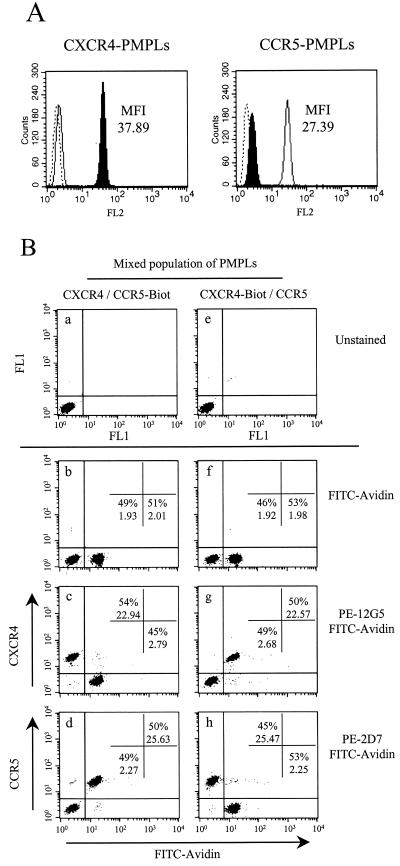
FIG. 1.
FIG. 1.
Detection of discontinuous epitopes on chemokine receptors incorporated into PMPLs. (A) Approximately 2 × 10⁶ CXCR4-PMPLs (left panel) or CCR5-PMPLs (right panel) in 2-μl volumes were separately stained with 20 μl of the PE-coupled anti-CXCR4 MAb 12G5 (filled profile), the PE-coupled anti-CCR5 MAb 2D7 (empty profile), or an irrelevant Ab (dotted lines). PMPLs were then washed and analyzed by FACS. The MFI values of CXCR4- and CCR5-PMPLs stained with 12G5 (left panel) and 2D7 (right panel), respectively, are indicated. (B) CXCR4-PMPLs and CCR5-PMPLs were mixed and analyzed simultaneously. Approximately 106 CXCR4-PMPLs and 106 CCR5-Biot-PMPLs, each in 1 μl of buffer, were mixed (panels a to d). Alternatively, CXCR4-Biot-PMPLs and CCR5-PMPLs were mixed (panels e to h). PMPLs were left unstained (panels a and e), stained with FITC-coupled avidin (1:50) alone (panels b and f), or stained with FITC-coupled avidin in the presence of 20 μl of PE-coupled 12G5 (panels c and g) or 2D7 (panels d and h) and analyzed by FACS. The percentage of events in each population and the MFI of each population are indicated. Representative results of experiments performed at least three times are shown.
FIG. 2.
FIG. 2.
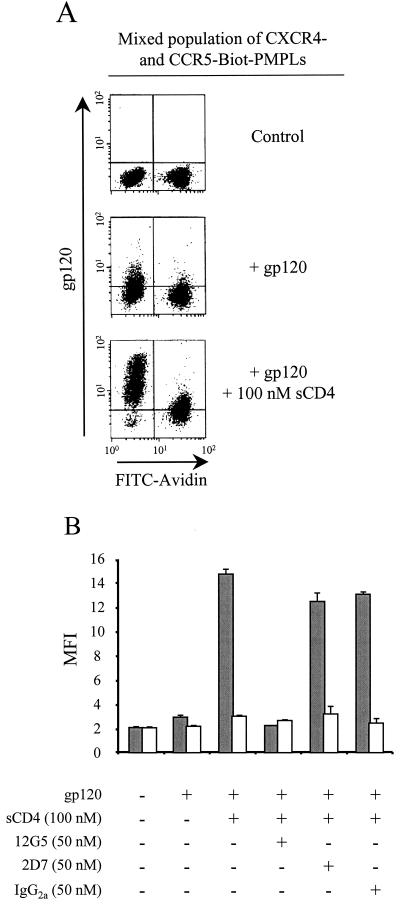
Binding of HXBc2 gp120 to CXCR4- and CCR5-PMPLs. (A) Equal numbers (106 each) of CXCR4- and CCR5-Biot-PMPLs were mixed and incubated with HXBc2 gp120 (middle and lower panels) and 100 nM of sCD4 (lower panel). Bound gp120 was then detected by an additional incubation with the anti-gp120 C11 MAb and with a PE-coupled secondary Ab (all panels). In addition, PMPLs were stained with FITC-coupled avidin (1:50) to detect the CCR5-Biot-PMPLs (all panels). Stained PMPLs were washed and analyzed by FACS. (B) Equal numbers (106 each) of CXCR4- and CCR5-Biot-PMPLs were mixed and incubated with or without HXBc2 gp120 and sCD4 in the presence of 12G5, 2D7, or an irrelevant MAb. Bound gp120 was then detected by staining PMPLs with the anti-gp120 C11 MAb and a PE-coupled anti-human IgG Ab. In addition, PMPLs were stained with FITC-coupled avidin (1:50) to sort the CCR5-Biot-PMPLs. The MFI values of the gp120 staining for the CXCR4-PMPLs (filled bars) and CCR5-Biot-PMPLs (open bars) are reported.
FIG. 3.
FIG. 3.
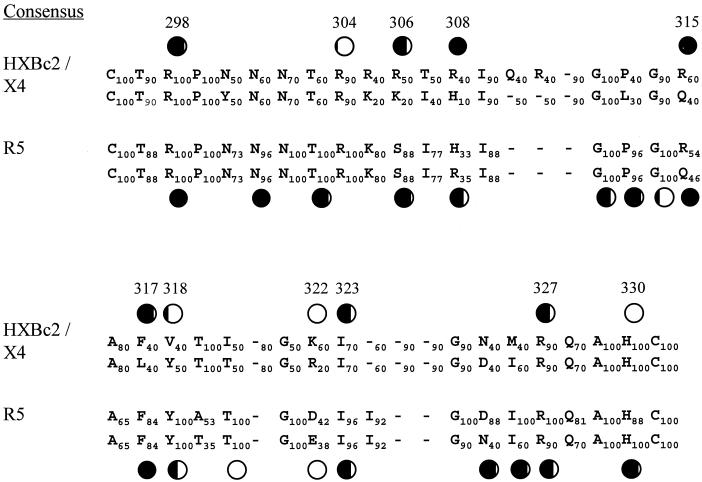
V3 loop sequence comparison between CXCR4- and CCR5-using viruses. The consensus sequences of the V3 loops from X4 and R5 strains are compared, with the upper row in the CXCR4 consensus corresponding to the sequence of HXBc2 gp120. The number next to each residue indicates the frequency at which Hung et al. (32) found the corresponding residue. A hyphen without any number denotes a deletion in the consensus sequence. The amino acids are numbered according to the sequence of HXBc2 gp120 (39). The circles are located above residues in which single amino acid changes have been introduced, and the resulting mutants were assessed for ability to bind CXCR4 or CCR5 (references , , and and this study). The ability of the mutant to bind the chemokine receptor, relative to that of the wild-type gp120, is indicated by the amount of the circle that is filled (completely open, wild-type binding; completely filled, no detectable binding).
FIG. 4.
FIG. 4.
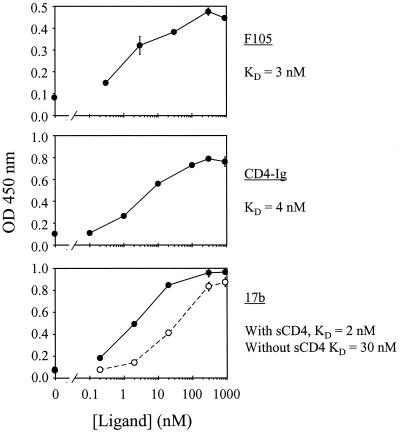
Measurements of HXBc2 gp120 affinity for various ligands by ELISA. Microtiter plates previously coated with the D7324 Ab were incubated with a 1:2,000 dilution of concentrated cell culture supernatant containing HXBc2 gp120. Increasing concentrations of F105 (upper panel), CD4-Ig (middle panel), and 17b (lower panel) were then incubated with the immobilized gp120 and detected by a PX-coupled anti-human IgG Ab. The binding of the 17b MAb to gp120 was studied in the absence (open circles) or the presence (filled circles) of sCD4. The apparent KD values, which were estimated according to the ligand concentration that yielded an optical density (OD) value that was half that obtained at saturation, are noted. Representative results of the ELISA, which was performed at least three times, are shown.

References

    1. Alkhatib, G., C. Combadiere, C. C. Broder, Y. Feng, P. E. Kennedy, P. M. Murphy, and E. A. Berger. 1996. CC CKR5: a RANTES, MIP-1α, MIP-1β receptor as a fusion cofactor for macrophage-tropic HIV-1. Science 272:1955-1958. - PubMed
    1. Babcock, G. J., T. Mirzabekov, W. Wojtowicz, and J. Sodroski. 2001. Ligand binding characteristics of CXCR4 incorporated into paramagnetic proteoliposomes. J. Biol. Chem. 276:38433-38440. - PubMed
    1. Blanpain, C., B. Lee, J. Vakili, B. J. Doranz, C. Govaerts, I. Migeotte, M. Sharron, V. Dupriez, G. Vassart, R. W. Doms, and M. Parmentier. 1999. Extracellular cysteines of CCR5 are required for chemokine binding, but dispensable for HIV-1 coreceptor activity. J. Biol. Chem. 274:18902-18908. - PubMed
    1. Brelot, A., N. Heveker, M. Montes, and M. Alizon. 2000. Identification of residues of CXCR4 critical for human immunodeficiency virus coreceptor and chemokine receptor activities. J. Biol. Chem. 275:23736-23744. - PubMed
    1. Cao, J., N. Sullivan, E. Desjardin, C. Parolin, J. Robinson, R. Wyatt, and J. Sodroski. 1997. Replication and neutralization of human immunodeficiency virus type 1 lacking the V1 and V2 variable loops of the gp120 envelope glycoprotein. J. Virol. 71:9808-9812. - PMC - PubMed

Publication types

LinkOut - more resources