


doi: 10.1128/jvi.76.21.11155-11158.2002.
Identification of a hepatitis B virus genome in wild chimpanzees (Pan troglodytes schweinfurthi) from East Africa indicates a wide geographical dispersion among equatorial African primates
Affiliations
- PMID: 12368360
- PMCID: PMC136620
- DOI: 10.1128/jvi.76.21.11155-11158.2002
Item in Clipboard
Identification of a hepatitis B virus genome in wild chimpanzees (Pan troglodytes schweinfurthi) from East Africa indicates a wide geographical dispersion among equatorial African primates
J Virol.
2002 Nov.
Abstract
DNAs from four wild chimpanzees (Pan troglodytes schweinfurthi) from eastern Africa were screened for 14 DNA viruses and retroviruses. Between two and three viruses were found in each animal. An entire hepatitis B virus (HBV) genome was amplified and sequenced from samples taken from one animal. This indicates that HBV is distributed across the entire range of chimpanzee habitats.
Figures
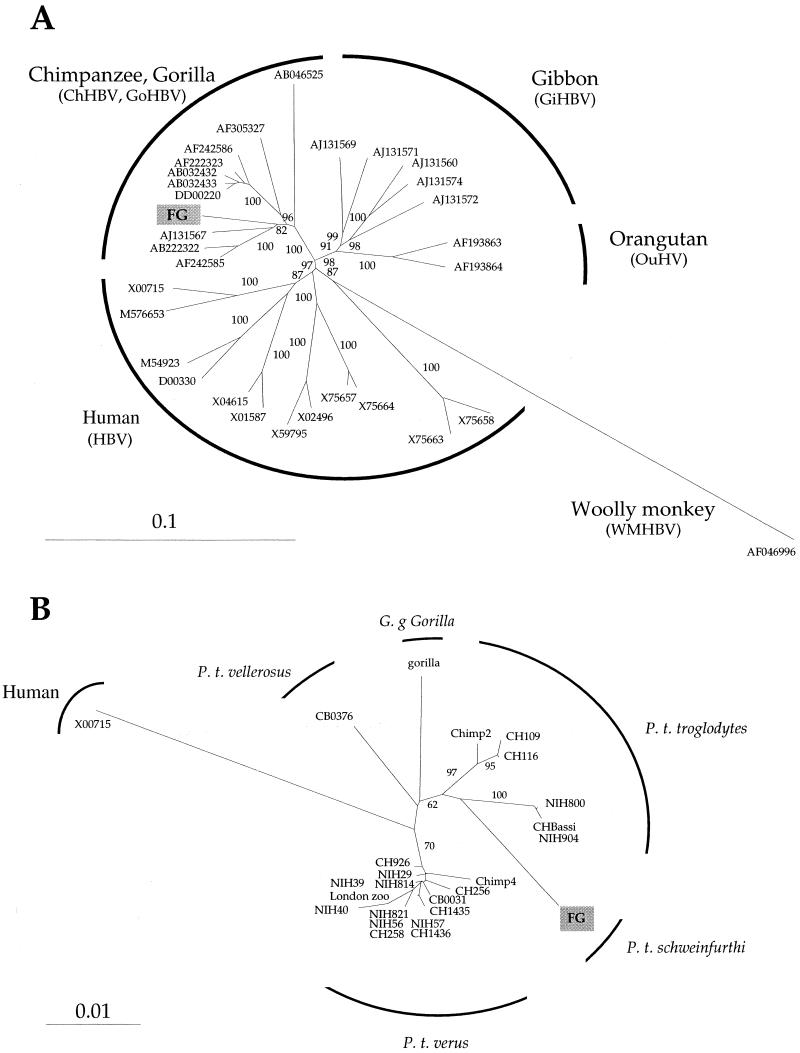
Phylogenetic analysis of HBV sequences. (A) Phylogenetic comparison of HBV sequences of viruses from chimpanzees, humans, and other nonhuman primates. Sequences were aligned by CLUSTAL W. Nucleotide sequence distances were determined with Dnadist of the Phylip package (version 3.5). Calculated distances were then used by applying the neighbor-joining method to pairwise sequence distances calculated by the Kimura two-parameter method to generate unrooted trees. Horizontal branch lengths are drawn to scale, with the bar indicating 0.1 nucleotide replacement per site. The final output was generated with Treeview. The number at each node represents the percentage of bootstrap replicates (out of 100). Only bootstrap values of ≥80 are given. The sequence of the virus obtained from FG was most closely related to those of chimpanzees and gorilla subtypes (0.5 to 0.7% nucleic acid divergence) and was distinct from the genotypes of human (10 to 15% divergence), gibbon ape (11% divergence), orangutan (11% divergence), and woolly monkey (28% divergence) viruses. (B) Phylogenetic comparison of HBV S-region sequences of viruses from chimpanzee subspecies. Horizontal branch lengths are drawn to scale, with the bar indicating 0.01 nucleotide replacement per site. The number at each node represents the percentage of bootstrap replicates (out of 100). Only bootstrap values of ≥60 are given. Sequences, identified by common names, and their GenBank accession numbers were as follows: CHBassi, AB046525; CB0376, AF305327; chimp4, AF242586; CH926, AF222322; CH256, AB032433; gorilla, AJ131567; CH109, AB222322; chimp2, AF242585; NIH800, AF222318; NIH904, AF222321; CH116, AF305328; NIH814, AF222319; NIH29, AF222312; NIH39, AF222313; NIH821, AF222320; NIH56, AF222316; NIH40, AF222314; CB0031, AF305326; NIH57, AF222317; CH1435, AF305329; CH1436, AF305330; CH258, AB032433; London zoo chimpanzee, DD00220; and the HBV subtype as an outgroup, X00715.
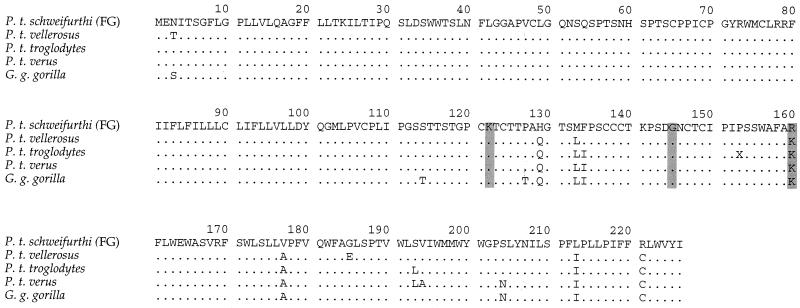
Alignment of the small S protein from chimpanzee HBVs with the sequence of the virus obtained from the animal FG (P. t. schweinfurthi). Only differences are shown. Grey boxes represent amino acid positions involved in determining the human HBV serodeterminants d/y, a, and r/w, respectively. The other sequences shown are from viruses isolated from P. t. vellerosus (sequence CB0376, accession number AF305327), P. t. troglodytes (sequence chimp2, accession number AF242585), P. t. verus from the London zoo (sequence DD00220), and G. g. gorilla (accession number AJ131567).
References
-
- Bancroft, W. H., F. K. Mundon, and P. K. Russell. 1972. Detection of additional antigenic determinants of hepatitis B antigen. J. Immunol. 109:842-848. - PubMed
-
- Corbet, S., M. C. Müller-Trutwin, P. Versmisse, S. Delarue, A. Ayouba, J. Lewis, S. Brunak, P. Martin, F. Brun-Vezinet, F. Simon, F. Barre-Sinoussi, and P. Mauclere. 2000. env sequences of simian immunodeficiency viruses from chimpanzees in Cameroon are strongly related to those of human immunodeficiency virus group N from the same geographic area. J. Virol. 74:529-534. - PMC - PubMed
-
- Courouce-Pauty, A. M., A. Plancon, and J. P. Soulier. 1983. Distribution of HBsAg subtypes in the world. Vox Sang. 44:197-211. - PubMed
-
- Greensill, J., J. A. Sheldon, K. K. Murthy, J. S. Bessonette, B. E. Beer, and T. F. Schulz. 2000. A chimpanzee rhadinovirus sequence related to Kaposi's sarcoma-associated herpesvirus/human herpesvirus 8: increased detection after HIV-1 infection in the absence of disease. AIDS 14:F129-F135. - PubMed
Publication types
MeSH terms
Substances
Associated data
- Actions
LinkOut - more resources
Full Text Sources
Medical
