


Getting across--bacterial type III effector proteins on their way to the plant cell
- PMID: 12374732
- PMCID: PMC129068
- DOI: 10.1093/emboj/cdf536
Getting across--bacterial type III effector proteins on their way to the plant cell
Abstract
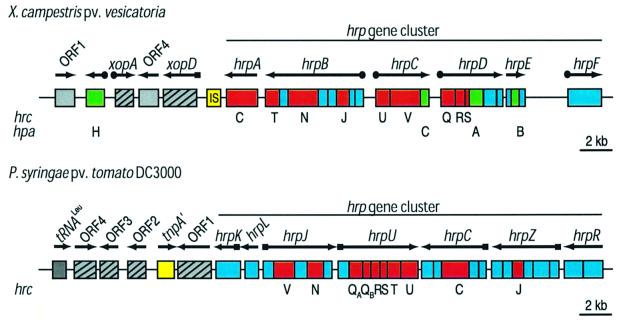
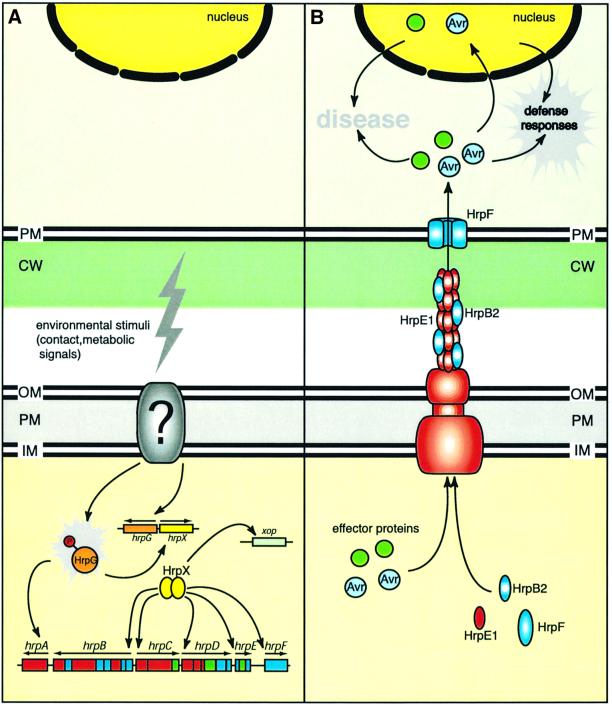
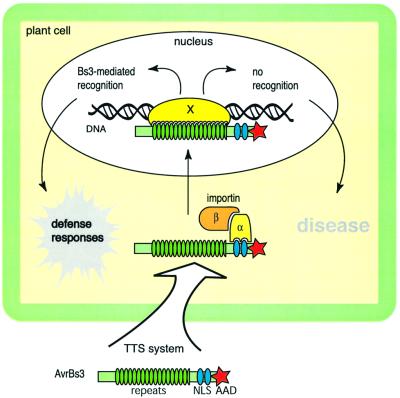
Pathogenicity of most Gram-negative bacterial plant pathogens depends on hrp (hypersensitive response and pathogenicity) genes, which control the ability to cause disease and to elicit specific defense responses in resistant plants. hrp genes encode a specialized type III secretion (TTS) system that mediates the vectorial delivery of bacterial effector proteins across both bacterial membranes as well as across the eukaryotic plasma membrane into the host cell cytosol. One well-studied effector protein is AvrBs3 from Xanthomonas campestris pv. vesicatoria, the causal agent of bacterial spot in pepper and tomato. AvrBs3 induces hypertrophy symptoms in susceptible plants and triggers a resistance gene-specific cell death reaction in resistant plants. Intriguingly, AvrBs3 has characteristic features of eukaryotic transcription factors, suggesting that it modulates the host's transcriptome. Here, we discuss the TTS system of X.campestris pv. vesicatoria in the light of current knowledge on type III-dependent protein secretion in plant pathogenic bacteria.
Figures
References
-
- Aizawa S.I. (2001) Bacterial flagella and type III secretion systems. FEMS Microbiol. Lett., 202, 157–64. - PubMed
-
- Alfano J.R., Bauer,D.W., Milos,T.M. and Collmer,A. (1996) Analysis of the role of the Pseudomonas syringae pv. syringae HrpZ harpin in elicitation of the hypersensitive response in tobacco using functionally non-polar hrpZ deletion mutations, truncated HrpZ fragments and hrmA mutations. Mol. Microbiol., 19, 715–728. - PubMed
Publication types
MeSH terms
Substances
LinkOut - more resources
Full Text Sources
Other Literature Sources
