


Transcription activation by FNR: evidence for a functional activating region 2
- PMID: 12374818
- PMCID: PMC135384
- DOI: 10.1128/JB.184.21.5855-5861.2002
Transcription activation by FNR: evidence for a functional activating region 2
Abstract
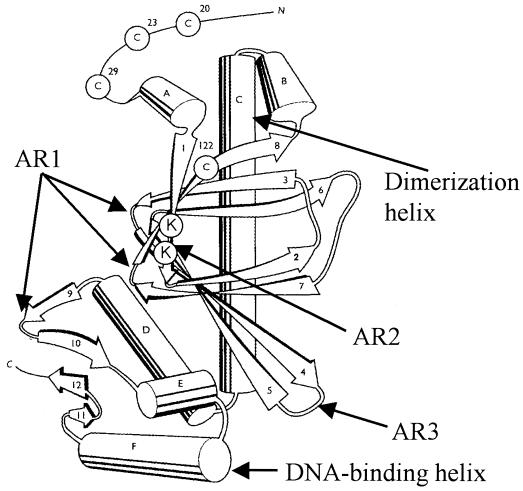
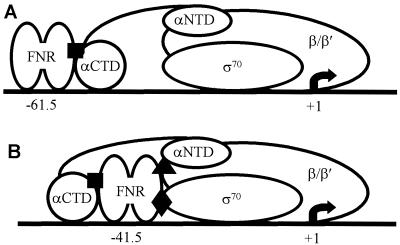
The FNR protein of Escherichia coli controls the transcription of target genes in response to anoxia via the assembly-disassembly of oxygen-labile iron-sulfur clusters. Previous work identified patches of surface-exposed amino acids (designated activating regions 1 and 3 [AR1 and AR3, respectively]) of FNR which allow it to communicate with RNA polymerase (RNAP) and thereby activate transcription. Previously it was thought that FNR lacks a functional activating region 2 (AR2), although selecting for mutations that compensate for defective AR1 or a miscoordinated iron-sulfur cluster can reactivate AR2. Here we show that the substitution of two surface-exposed lysine residues (Lys49 and Lys50) of FNR impaired transcription from class II (FNR box centered at -41.5) but not class I (FNR box centered at -71.5) FNR-dependent promoters. The degree of impairment was greater when a negatively charged residue (Glu) replaced either Lys49 or Lys50 than when uncharged amino acid Ala was substituted. Oriented heterodimers were used to show that only the downstream subunit of the FNR dimer was affected by the Lys-->Ala substitutions at a class II promoter. Site-directed mutagenesis of a negatively charged patch ((162)EEDE(165)) within the N-terminal domain of the RNAP alpha subunit that interacts with the positively charged AR2 of the cyclic AMP receptor protein suggested that Lys49 and Lys50 of FNR interact with this region of the alpha subunit of RNAP. Thus, it was suggested that Lys49 and Lys50 form part of a functional AR2 in FNR.
Figures

References
-
- Bell, A., and S. J. W. Busby. 1994. Location and orientation of an activating region in the Escherichia coli transcription factor, FNR. Mol. Microbiol. 11:383-390. - PubMed
-
- Browning, D., D. Lee, J. Green, and S. Busby. 2002. Secrets of bacterial transcription initiation taught by the Escherichia coli FNR protein, p. 127-142. In D. A. Hodgson and C. M. Thomas (ed.), SGM symposium 61: signals, switches, regulons and cascades: control of bacterial gene expression. Cambridge University Press, Cambridge, United Kingdom.
-
- Busby, S., and R. H. Ebright. 1999. Transcription activation by catabolite activator protein (CAP). J. Mol. Biol. 293:199-213. - PubMed
-
- Green, J., and M. L. Baldwin. 1997. HlyX, the FNR homologue of Actinobacillus pleuropneumoniae, is a [4Fe 4S]-containing oxygen-responsive transcription regulator that anaerobically activates FNR-dependent class I promoters via an enhanced AR1-contact. Mol. Microbiol. 24:593-605. - PubMed
-
- Green, J., C. Scott, and J. R. Guest. 2001. Functional versatility in the CRP-FNR superfamily of transcription factors: FNR and FLP. Adv. Microb. Physiol. 44:1-34. - PubMed
Publication types
MeSH terms
Substances
LinkOut - more resources
Full Text Sources
Molecular Biology Databases
