


Carbon monoxide cycling by Desulfovibrio vulgaris Hildenborough
- PMID: 12374824
- PMCID: PMC135394
- DOI: 10.1128/JB.184.21.5903-5911.2002
Carbon monoxide cycling by Desulfovibrio vulgaris Hildenborough
Abstract
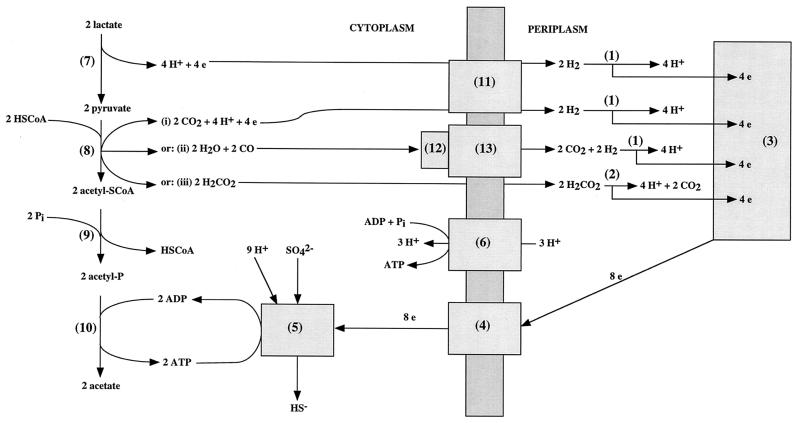
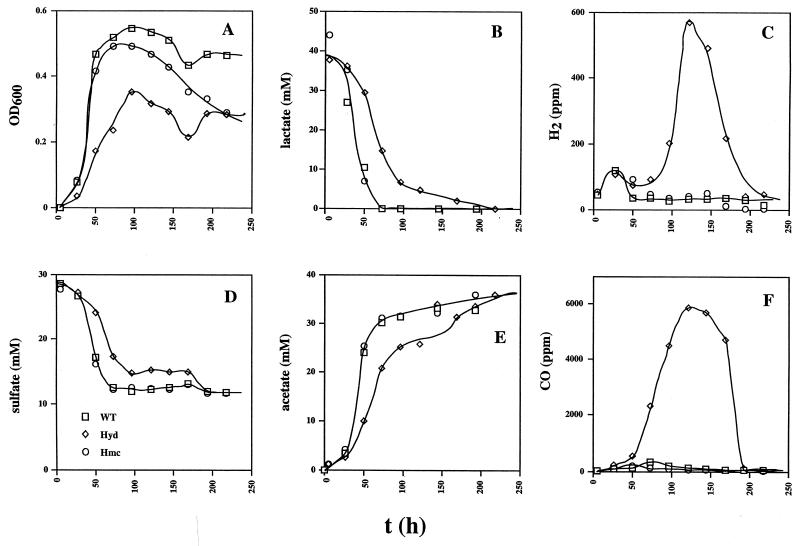
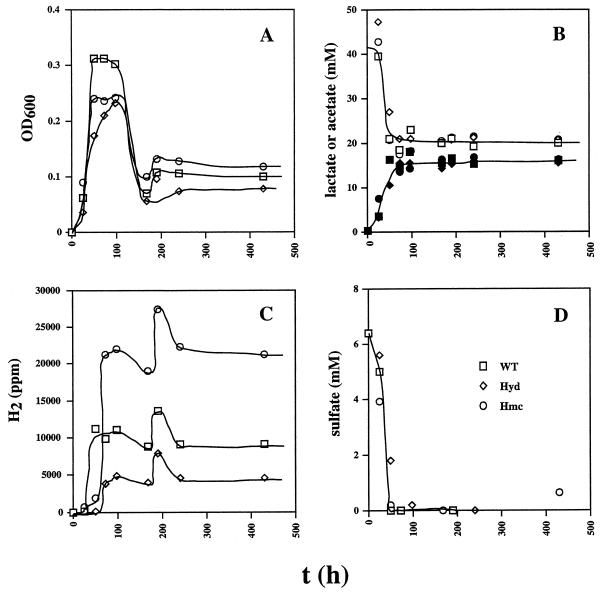
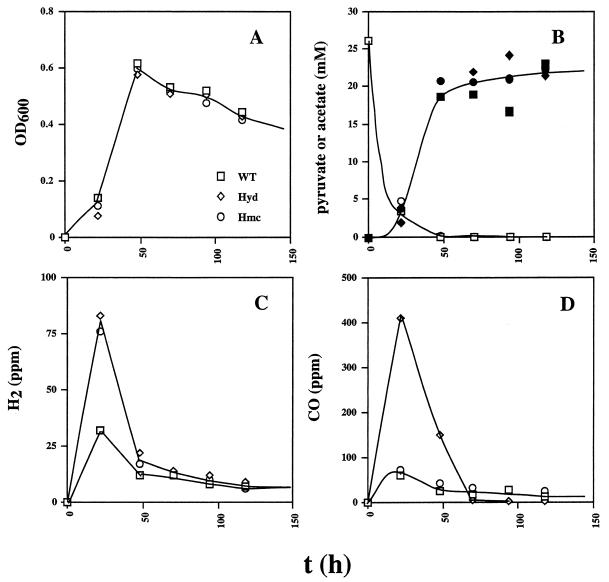
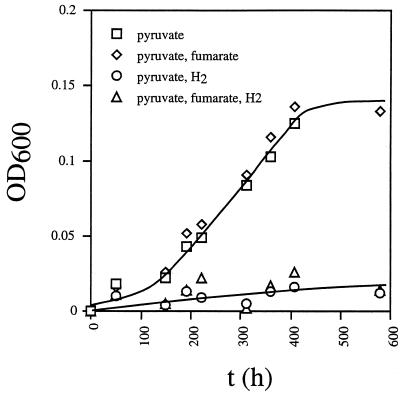
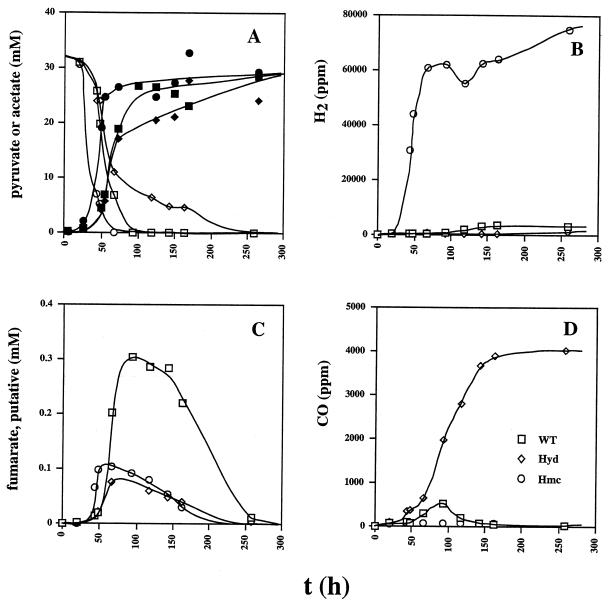
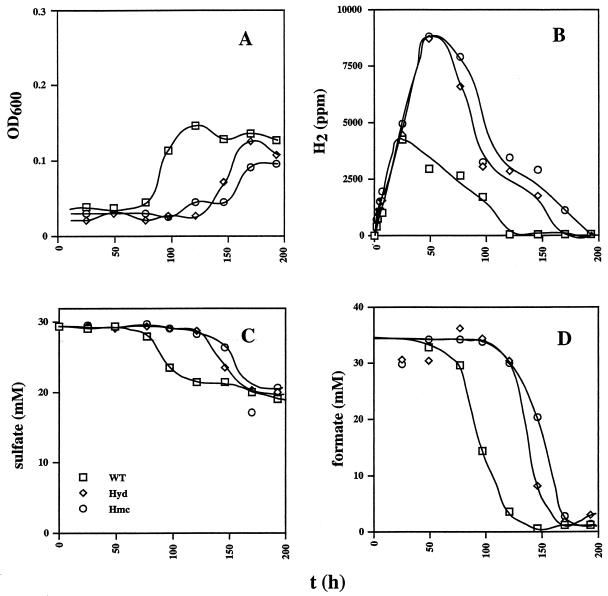
Sulfate-reducing bacteria, like Desulfovibrio vulgaris Hildenborough, use the reduction of sulfate as a sink for electrons liberated in oxidation reactions of organic substrates. The rate of the latter exceeds that of sulfate reduction at the onset of growth, causing a temporary accumulation of hydrogen and other fermentation products (the hydrogen or fermentation burst). In addition to hydrogen, D. vulgaris was found to produce significant amounts of carbon monoxide during the fermentation burst. With excess sulfate, the hyd mutant (lacking periplasmic Fe-only hydrogenase) and hmc mutant (lacking the membrane-bound, electron-transporting Hmc complex) strains produced increased amounts of hydrogen from lactate and formate compared to wild-type D. vulgaris during the fermentation burst. Both hydrogen and CO were produced from pyruvate, with the hyd mutant producing the largest transient amounts of CO. When grown with lactate and excess sulfate, the hyd mutant also exhibited a temporary pause in sulfate reduction at the start of stationary phase, resulting in production of 600 ppm of headspace hydrogen and 6,000 ppm of CO, which disappeared when sulfate reduction resumed. Cultures with an excess of the organic electron donor showed production of large amounts of hydrogen, but no CO, from lactate. Pyruvate fermentation was diverse, with the hmc mutant producing 75,000 ppm of hydrogen, the hyd mutant producing 4,000 ppm of CO, and the wild-type strain producing no significant amount of either as a fermentation end product. The wild type was most active in transient production of an organic acid intermediate, tentatively identified as fumarate, indicating increased formation of organic fermentation end products in the wild-type strain. These results suggest that alternative routes for pyruvate fermentation resulting in production of hydrogen or CO exist in D. vulgaris. The CO produced can be reoxidized through a CO dehydrogenase, the presence of which is indicated in the genome sequence.
Figures
References
-
- Badziong, W., and R. K. Thauer. 1978. Growth yields and growth rates of Desulfovibrio vulgaris (Marburg) growing on hydrogen plus sulfate and hydrogen plus thiosulfate as the sole energy sources. Arch. Microbiol. 117:209-214. - PubMed
-
- Badziong, W., and R. K. Thauer. 1980. Vectorial electron transport in Desulfovibrio vulgaris (Marburg) growing on hydrogen plus sulfate as sole energy source. Arch. Microbiol. 125:167-174.
-
- Bak, F., G. Scheff, and K. H. A. Jansen. 1991. Rapid and sensitive ion chromatographic technique for the determination for sulfate and sulfate reduction rates in fresh water lake sediments. FEMS Microbiol. Ecol. 85:23-30.
-
- Cornish-Bowden, A., and M. L. Cardenas. 2001. Silent genes given voice. Nature 409:571-572. - PubMed
-
- Dolla, A., B. K. J. Pohorelic, J. K. Voordouw, and G. Voordouw. 2000. Deletion of the hmc-operon of Desulfovibrio vulgaris subsp. vulgaris Hildenborough hampers hydrogen metabolism and low-redox potential niche establishment. Arch. Microbiol. 174:143-151. - PubMed
Publication types
MeSH terms
Substances
LinkOut - more resources
Full Text Sources
Molecular Biology Databases
