. 2002 Nov;184(21):5955-65.
doi: 10.1128/JB.184.21.5955-5965.2002.

The first archaeal ATP-dependent glucokinase, from the hyperthermophilic crenarchaeon Aeropyrum pernix, represents a monomeric, extremely thermophilic ROK glucokinase with broad hexose specificity

Affiliations

The first archaeal ATP-dependent glucokinase, from the hyperthermophilic crenarchaeon Aeropyrum pernix, represents a monomeric, extremely thermophilic ROK glucokinase with broad hexose specificity

Thomas Hansen et al. J Bacteriol. 2002 Nov.

Abstract

An ATP-dependent glucokinase of the hyperthermophilic aerobic crenarchaeon Aeropyrum pernix was purified 230-fold to homogeneity. The enzyme is a monomeric protein with an apparent molecular mass of about 36 kDa. The apparent K(m) values for ATP and glucose (at 90 degrees C and pH 6.2) were 0.42 and 0.044 mM, respectively; the apparent V(max) was about 35 U/mg. The enzyme was specific for ATP as a phosphoryl donor, but showed a broad spectrum for phosphoryl acceptors: in addition to glucose, which showed the highest catalytic efficiency (k(cat)/K(m)), the enzyme also phosphorylates glucosamin, fructose, mannose, and 2-deoxyglucose. Divalent cations were required for maximal activity: Mg(2+), which was most effective, could partially be replaced with Co(2+), Mn(2+), and Ni(2+). The enzyme had a temperature optimum of at least 100 degrees C and showed significant thermostability up to 100 degrees C. The coding function of open reading frame (ORF) APE2091 (Y. Kawarabayasi, Y. Hino, H. Horikawa, S. Yamazaki, Y. Haikawa, K. Jin-no, M. Takahashi, M. Sekine, S. Baba, A. Ankai, H. Kosugi, A. Hosoyama, S. Fukui, Y. Nagai, K. Nishijima, H. Nakazawa, M. Takamiya, S. Masuda, T. Funahashi, T. Tanaka, Y. Kudoh, J. Yamazaki, N. Kushida, A. Oguchi, and H. Kikuchi, DNA Res. 6:83-101, 145-152, 1999), previously annotated as gene glk, coding for ATP-glucokinase of A. pernix, was proved by functional expression in Escherichia coli. The purified recombinant ATP-dependent glucokinase showed a 5-kDa higher molecular mass on sodium dodecyl sulfate-polyacrylamide gel electrophoresis, but almost identical kinetic and thermostability properties in comparison to the native enzyme purified from A. pernix. N-terminal amino acid sequence of the native enzyme revealed that the translation start codon is a GTG 171 bp downstream of the annotated start codon of ORF APE2091. The amino acid sequence deduced from the truncated ORF APE2091 revealed sequence similarity to members of the ROK family, which comprise bacterial sugar kinases and transcriptional repressors. This is the first report of the characterization of an ATP-dependent glucokinase from the domain of Archaea, which differs from its bacterial counterparts by its monomeric structure and its broad specificity for hexoses.


Figures
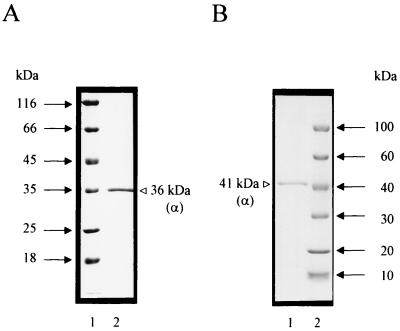
FIG. 1.
FIG. 1.
Purified ATP-GLK from A. pernix (A) and recombinant ATP-GLK from transformed E. coli (B) as analyzed by SDS-PAGE (30). Protein was denatured in SDS and separated in 12% polyacrylamide slab gels (8 by 7 cm), which were stained with Coomassie brilliant blue R-250. (A) Lane 1, molecular mass standards; lane 2, native enzyme purified from A. pernix. (B) Lane 1, recombinant enzyme purified from E. coli (see Materials and Methods); lane 2, molecular mass standards.
FIG. 2.
FIG. 2.
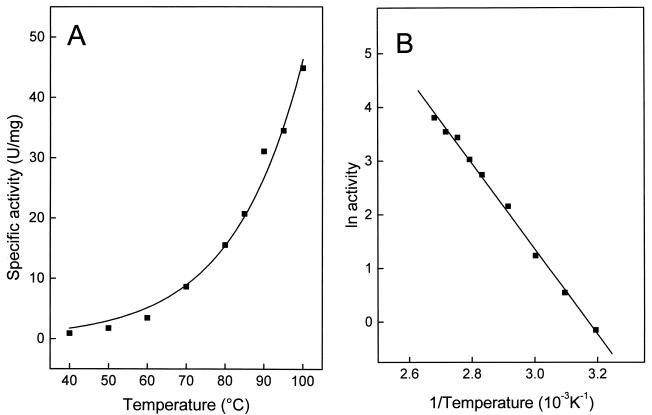
Effect of temperature on the specific activity of the ATP-GLK from A. pernix. (A) Temperature dependence of specific activity. (B) Arrhenius plot of the same data from panel A. The assay mixture contained 1 μg of enzyme purified from A. pernix, 100 mM triethanolamine or Tris-HCl (pH 6.2) at the indicated temperature, 2 mM ATP, 4 mM MgCl2, and 5 mM glucose.
FIG. 3.
FIG. 3.
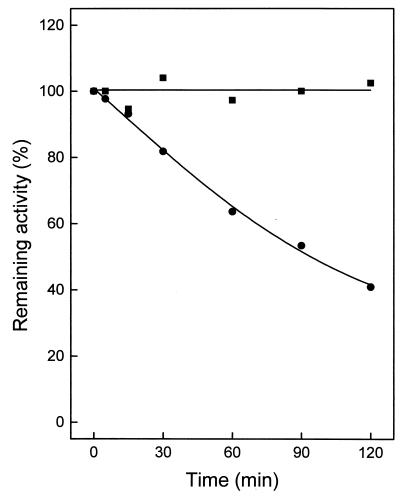
Thermostability of ATP-GLK from A. pernix. Enzyme (1 μg purified from A. pernix) was incubated in 40 μl of 50 mM potassium phosphate buffer (pH 7.0) at 95°C (▪) and at 100°C (•). At the times indicated, samples were cooled on ice for 10 min and assayed for the remaining activity at 90°C in the direction of G6P formation. One hundred percent activity corresponded to a specific activity of 35 U/mg.
FIG.4.
FIG.4.
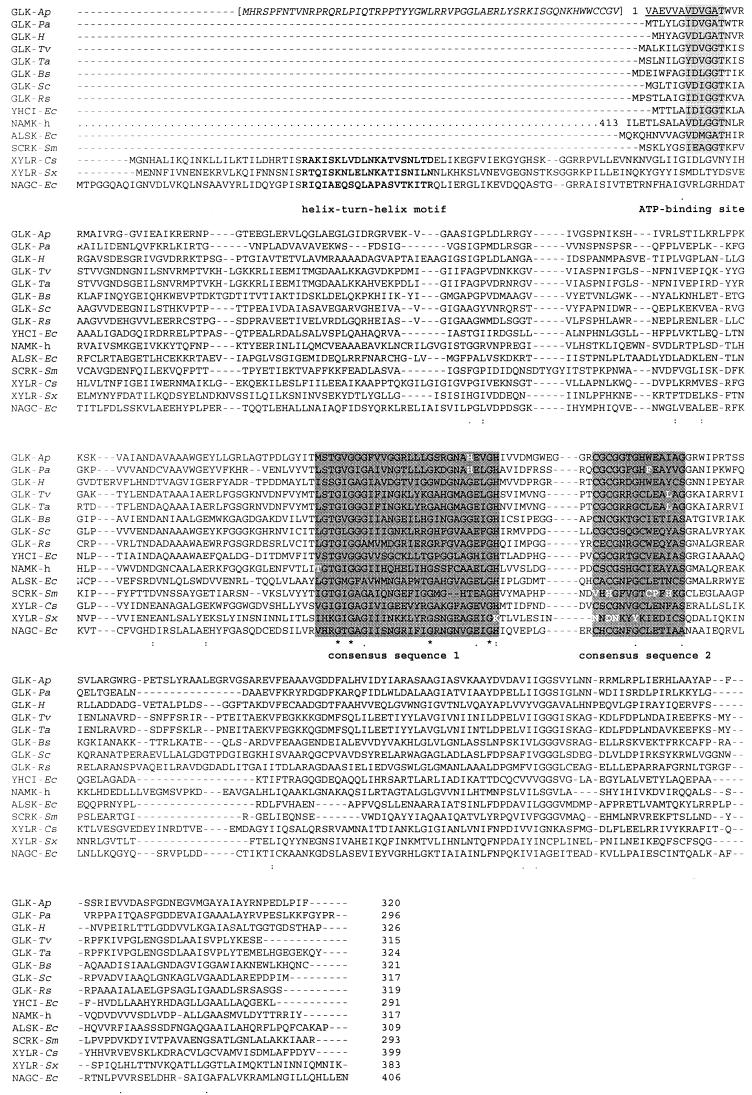
Multiple sequence alignment generated by Clustal X (55) of deduced amino acid sequences of ATP-GLK from A. pernix and putative archaeal GLKs with selected members of the ROK family, which comprises sugar kinases and repressors (6, 56). Deduced amino acid sequences are shown for proteins from the following organisms (accession numbers given in parentheses): GLK-Ap, GLK from Aeropyrum pernix, with the N-terminal extension of ORF APE2091 given in italic letters and brackets and with the N terminus according to N-terminal sequencing underlined; GLK-Pa, putative GLK from Pyrobaculum aerophilum (PAE3437); GLK-H, putative GLK from Halobacterium sp. strain NRC1 (Q9HMA7); GLK-Tv, putative GLK from Thermoplasma volcanicum (Q97AS0); GLK-Ta, putative GLK from Thermoplasma acidophilum (Q9HJY6); GLK-Bs, GLK from Bacillus subtilis (P54495); GLK-Sc, GLK from Streptomyces coelicolor (P40184); GLK-Rs, GLK from Renibacterium salmoninarum (Q53165); YHCI-Ec, product of E. coli yhcI (P45425); NAMK-h, N-acetylmannosamine kinase domain of the bifunctional enzyme UDP-N-acetylglucosamine 2-epimerase/N-acetylmannosamine kinase (residues 413 to 722) (Q9Y223); ALSK-Ec, allokinase from E. coli (P32718); SCRK-Sm, fructokinase from Streptococcus mutans (Q07211); XYLR-Cs, xylose repressor from Caldicellulosiruptor sp. (P40981); XYLR-Sx, xylose repressor from Staphylococcus xylosus (P27159); and NAGC-Ec, N-acetylglucosamine repressor from E. coli (P15301). The helix-turn-helix-motif found in the repressors (56) is marked in boldface; the ATP-binding (3, 14) site found in the kinases is shaded gray; and the two consensus sequences proposed, [LIVM]-x(2)-G-[LIVMFCT]-G-X-[GA]-X-G-X(3-5)-[GATP]-X(2)-G-[RKH] (19) and C-X-C-G-X(2)-G-X-[WILV]-E-X-[YFVIN]-X-[STAG] (10), are shaded dark gray.
FIG. 5.
FIG. 5.
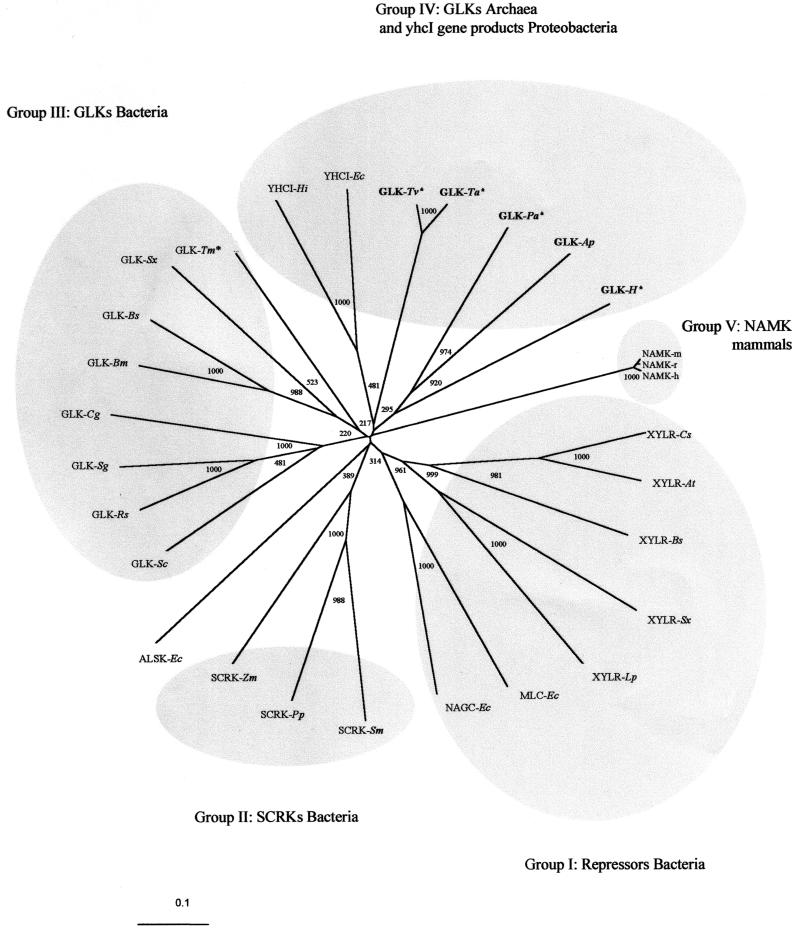
Phylogenetic relationships among ROK proteins. The tree was generated by the neighbor-joining method of Clustal X (55). Bootstrap values are based on 1,000 replicates and are given at each node. Archaeal sequences are marked in boldface, and putative sequences are marked with an asterisk. Sequence accession numbers are shown in parentheses. Group I abbreviations: XYLRs, xylose repressors; Cs, Caldicellulosiruptor sp. (P40981); At, Anaerocellum thermophilum (Q44406); Bs, Bacillus subtilis (P16557); Sx, Staphylococcus xylosus (P27159); Lp, Lactobacillus pentosus (P21940); NAGC-Ec, N-acetylglucosamine repressor from E. coli (P15301); and MLC-Ec, product of E. coli mlc (P50456). Group II abbreviations: SCRKs, fructokinases; Sm, Streptococcus mutans (Q07211); Pp, Pediococcus pentosaceus (P43468); Zm; Zymomonas mobilis (Q03417); ALSK-Ec, allokinase from E. coli (P32718). Group III abbreviations: Sc, Streptomyces coelicolor (P40184); Rs, Renibacterium salmoni-narum (Q53165); Sg, Streptomyces griseus (Q9F1W1); Cg, Corynebacterium glutamicum (Q9KKE7); Bm, Bacillus megaterium (O31392); Bs, Bacillus subtilis (P54495); Sx, Staphylococcus xylosus (Q56198); Tm, putative Thermotoga maritima (Q9X1I0). Group IV abbreviations: YHCI, gene product of yhcI; Hi, Haemophilus influenzae (P44541); Ec, E. coli (P45425); Tv, putative Thermoplasma volcanicum (Q97AS0); Ta, putative Thermoplasma acidophilum (Q9HJY6); Pa, putative Pyrobaculum aerophilum (PAE3437); H, GLK-H, putative Halobacterium sp. strain NRC1 (Q9HMA7). Group V abbreviations: NAMK-h, N-acetylmannosamine kinase domain of the bifunctional enzyme UDP-N-acetylglucosamine 2-epimerase/N-acetylmannosamine kinase (residues 413 to 722); h, human (Q9Y223); r, rat (O35826); m, mouse (Q9Z0P6).

References

    1. Altschul, S. F., W. Gish, W. Miller, E. W. Myers, and D. J. Lipman. 1990. Basic local alignment search tool. J. Mol. Biol. 215:403-410. - PubMed
    1. Altschul, S. F., T. L. Madden, A. A. Schaffer, J. Zhang, Z. Zhang, W. Miller, and D. J. Lipman. 1997. Gapped BLAST and PSI-BLAST: a new generation of protein database search programs. Nucleic Acids Res. 25:3389-3402. - PMC - PubMed
    1. Arora, K. K., P. Shenbagamurthi, M. Fanciulli, and P. L. Pedersen. 1990. Glucose phosphorylation. Interaction of a 50-amino acid peptide of yeast hexokinase with trinitrophenyl ATP. J. Biol. Chem. 265:5324-5328. - PubMed
    1. Bateman, A., E. Birney, R. Durbin, S. R. Eddy, R. D. Finn, and E. L. Sonnhammer. 1999. Pfam 3.1: 1,313 multiple alignments and profile HMMs match the majority of proteins. Nucleic Acids Res. 27:260-262. - PMC - PubMed
    1. Bateman, A., E. Birney, R. Durbin, S. R. Eddy, K. L. Howe, and E. L. Sonnhammer. 2000. The Pfam protein families database. Nucleic Acids Res. 28:263-266. - PMC - PubMed

Publication types

MeSH terms

LinkOut - more resources