


Evidence for a type III secretion system in Aeromonas salmonicida subsp. salmonicida
- PMID: 12374830
- PMCID: PMC135387
- DOI: 10.1128/JB.184.21.5966-5970.2002
Evidence for a type III secretion system in Aeromonas salmonicida subsp. salmonicida
Abstract
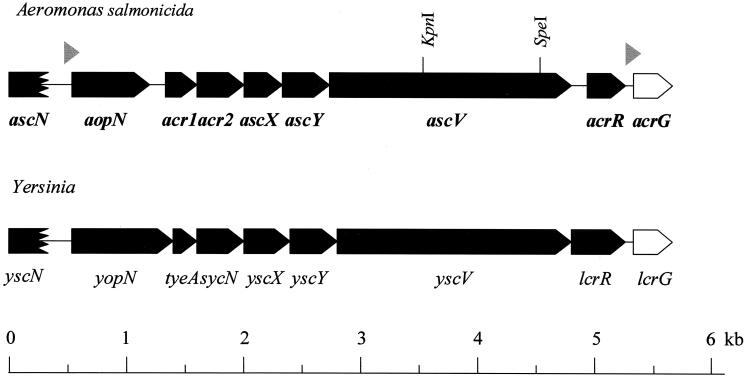
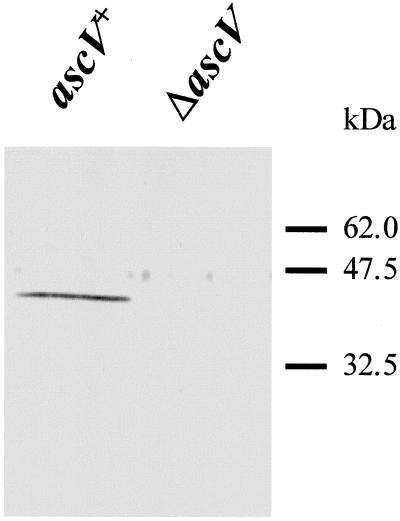
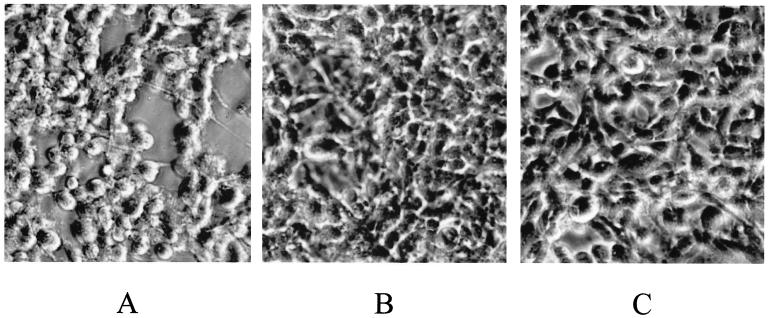
Aeromonas salmonicida subsp. salmonicida, the etiological agent of furunculosis, is an important fish pathogen. We have screened this bacterium with a broad-host-range probe directed against yscV, the gene that encodes the archetype of a highly conserved family of inner membrane proteins found in every known type III secretion system. This has led to the identification of seven open reading frames that encode homologues to proteins functioning within the type III secretion systems of Yersinia species. Six of these proteins are encoded by genes comprising a virA operon. The A. salmonicida subsp. salmonicida yscV homologue, ascV, was inactivated by marker replacement mutagenesis and used to generate an isogenic ascV mutant. Comparison of the extracellular protein profiles from the ascV mutant and the wild-type strain indicates that A. salmonicida subsp. salmonicida secretes proteins via a type III secretion system. The recently identified ADP-ribosylating toxin AexT was identified as one such protein. Finally, we have compared the toxicities of the wild-type A. salmonicida subsp. salmonicida strain and the ascV mutant against RTG-2 rainbow trout gonad cells. While infection with the wild-type strain results in significant morphological changes, including cell rounding, infection with the ascV mutant has no toxic effect, indicating that the type III secretion system we have identified plays an important role in the virulence of this pathogen.
Figures
References
-
- Altschul, S. F., W. Gish, W. Miller, E. W. Myers, and D. J. Lipman. 1990. Basic local alignment search tool. J. Mol. Biol. 215:403-410. - PubMed
-
- Ausubel, F. M., R. Brent, R. E. Kingston, D. D. Moore, J. G. Seidman, J. A. Smith, and K. Struhl. 1999. Current protocols in molecular biology. John Wiley & Sons, Inc., New York, N.Y.
-
- Bergman, T., K. Erickson, E. Galyov, C. Persson, and H. Wolf-Watz. 1994. The lcrB (yscN/U) gene cluster of Yersinia pseudotuberculosis is involved in Yop secretion and shows high homology to the spa gene clusters of Shigella flexneri and Salmonella typhimurium. J. Bacteriol. 176:2619-2626. - PMC - PubMed
Publication types
MeSH terms
Substances
Associated data
- Actions
LinkOut - more resources
Full Text Sources
