


Neurotoxic effects of thioflavin S-positive amyloid deposits in transgenic mice and Alzheimer's disease
- PMID: 12374847
- PMCID: PMC137824
- DOI: 10.1073/pnas.222433299
Neurotoxic effects of thioflavin S-positive amyloid deposits in transgenic mice and Alzheimer's disease
Abstract
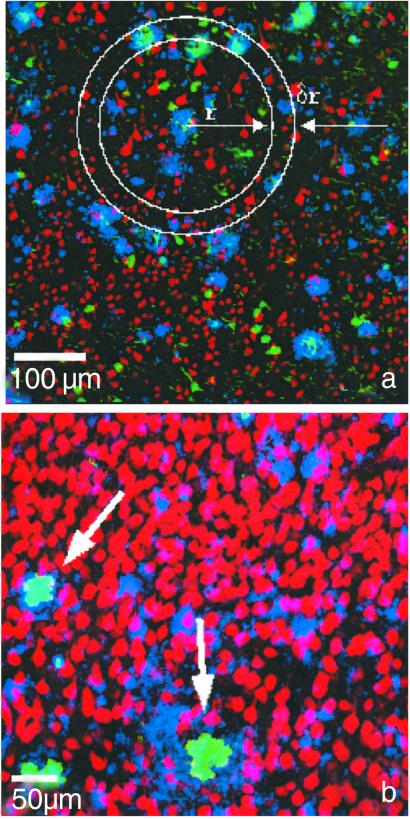
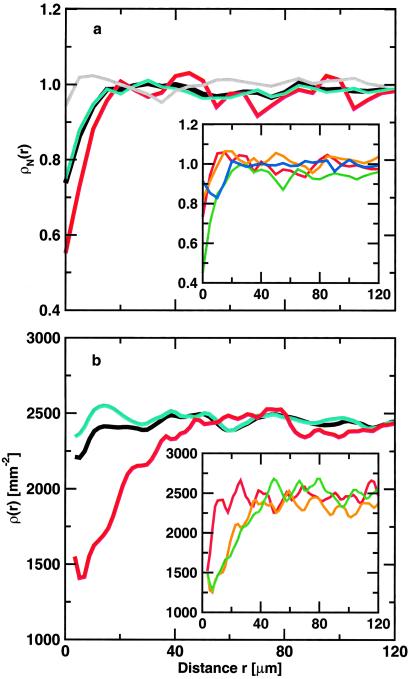
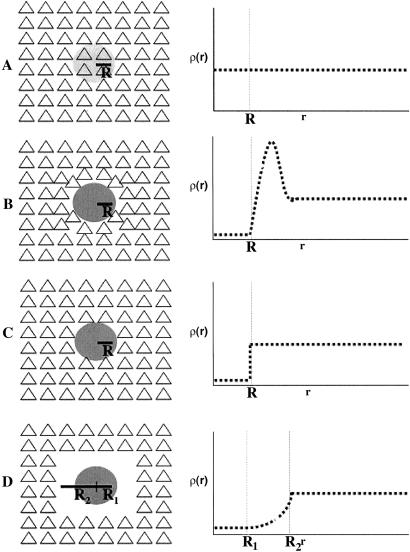
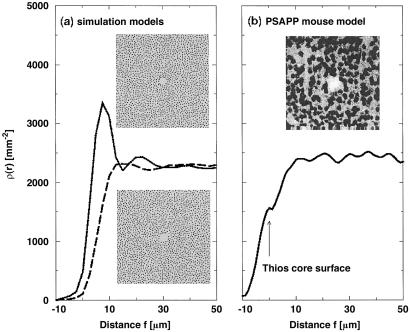
Despite extensive deposition of putatively neurotoxic amyloid-beta (Abeta) protein in the brain, it has not been possible to demonstrate an association of Abeta deposits with neuronal loss in Alzheimer's disease (AD), and neuronal loss is minimal in transgenic mouse models of AD. Using triple immunostaining confocal microscopy and analyzing the images with the cross-correlation density map method from statistical physics, we directly compared Abeta deposition, Abeta morphology, and neuronal architecture. We found dramatic, focal neuronal toxicity associated primarily with thioflavin S-positive fibrillar Abeta deposits in both AD and PSAPP mice. These results, along with computer simulations, suggest that Abeta develops neurotoxic properties in vivo when it adopts a fibrillar beta-pleated sheet conformation.
Figures
References
-
- Selkoe D. (1994) J. Neuropathol. Exp. Neurol. 53, 438-447. - PubMed
-
- Goate A., Chartier-Harlin, M.-C., Mullan, M., Brown, J., Crawford, F., Fidani, L., Giuffra, L., Haynes, A., Irving, N., James, L., et al. (1991) Nature 349, 704-706. - PubMed
-
- Citron M., Oltersdorf, T., Haass, C., McConlogue, L., Hung, A. Y., Seubert, P., Vigopelfrey, C., Lieberburg, I. & Selkoe, D. J. (1992) Nature 360, 672-674. - PubMed
-
- Cai X.-D., Golde, T. E. & Younkin, S. G. (1993) Science 259, 514-516. - PubMed
-
- Duff K., Eckman, C., Zehr, C., Yu, X., Prada, C. M., Perez-tur, J., Hutton, M., Buee, L., Harigaya, Y., Yager, D., et al. (1996) Nature 383, 710-713. - PubMed
Publication types
MeSH terms
Substances
Grants and funding
LinkOut - more resources
Full Text Sources
Medical
