Comparative Study
. 2002 Oct;130(2):729-39.
doi: 10.1104/pp.006957.

Expression of genes involved in anthocyanin biosynthesis in relation to anthocyanin, proanthocyanidin, and flavonol levels during bilberry fruit development

Affiliations
Comparative Study

Expression of genes involved in anthocyanin biosynthesis in relation to anthocyanin, proanthocyanidin, and flavonol levels during bilberry fruit development

Laura Jaakola et al. Plant Physiol. 2002 Oct.

Abstract

The production of anthocyanins in fruit tissues is highly controlled at the developmental level. We have studied the expression of flavonoid biosynthesis genes during the development of bilberry (Vaccinium myrtillus) fruit in relation to the accumulation of anthocyanins, proanthocyanidins, and flavonols in wild berries and in color mutants of bilberry. The cDNA fragments of five genes from the flavonoid pathway, phenylalanine ammonia-lyase, chalcone synthase, flavanone 3-hydroxylase, dihydroflavonol 4-reductase, and anthocyanidin synthase, were isolated from bilberry using the polymerase chain reaction technique, sequenced, and labeled with a digoxigenin-dUTP label. These homologous probes were used for determining the expression of the flavonoid pathway genes in bilberries. The contents of anthocyanins, proanthocyanidins, and flavonols in ripening bilberries were analyzed with high-performance liquid chromatography-diode array detector and were identified using a mass spectrometry interface. Our results demonstrate a correlation between anthocyanin accumulation and expression of the flavonoid pathway genes during the ripening of berries. At the early stages of berry development, procyanidins and quercetin were the major flavonoids, but the levels decreased dramatically during the progress of ripening. During the later stages of ripening, the content of anthocyanins increased strongly and they were the major flavonoids in the ripe berry. The expression of flavonoid pathway genes in the color mutants of bilberry was reduced. A connection between flavonol and anthocyanin synthesis in bilberry was detected in this study and also in previous data collected from flavonol and anthocyanin analyses from other fruits. In accordance with this, models for the connection between flavonol and anthocyanin syntheses in fruit tissues are presented.


Figures

Figure 1
Figure 1
A schematic presentation of the anthocyanin biosynthetic pathway, with emphasis on the flavonols, proanthocyanidins, and anthocyanidins found in bilberry. Enzyme abbreviations: C4H, Cinnamate 4-hydroxylase4; 4CL, 4-coumaroyl:CoA ligase; CHI, chalcone isomerase; F3′H, flavonoid 3′ hydroxylase; F3′5′H, flavonoid 3′5′ hydroxylase; LCR, leucoanthocyanidin reductase; UFGT, UDP Glc-flavonoid 3-O -glucosyl transferase; MT, methyltransferase.
Figure 2
Figure 2
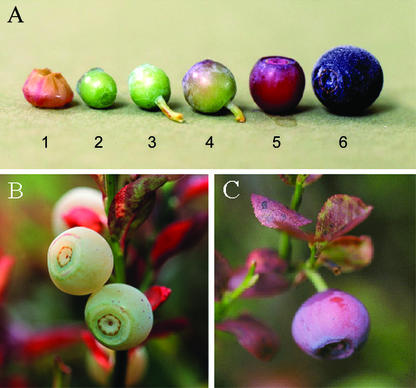
A, Bilberry from flower to ripe fruit. Six different stages were examined in this study. Stages: 1, flower; 2, small-sized green fruits; 3, middle-sized green fruits; 4, half-expanded, just after coloring began; 5, nearly expanded, half-colored, red fruits; 6, fully colored, blue, ripe fruits. B, The color mutation of bilberry with white berries. C, The color mutation of bilberry with pink berries.
Figure 3
Figure 3
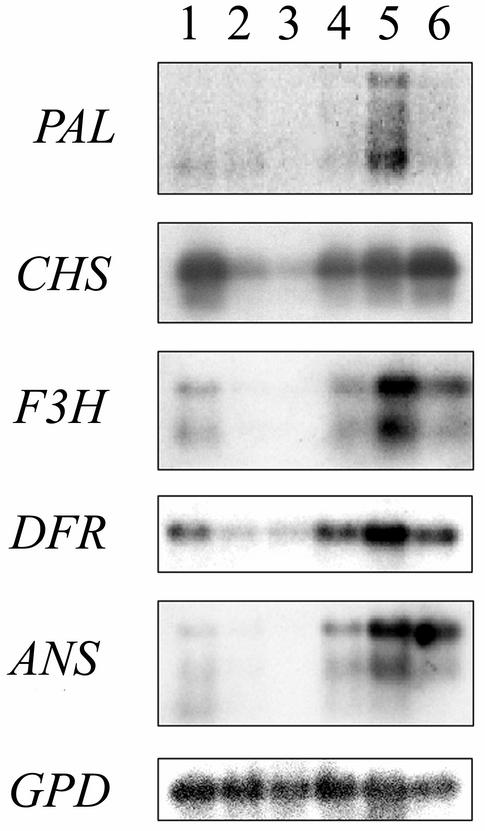
Temporal expression of the anthocyanin pathway genes of bilberry during berry development, probed with bilberry cDNA fragments for PAL, CHS, F3H, DFR, and ANS. Numbers (1–6) indicate the different stages examined from flower to ripe berry. The same membrane was also rehybridized with a GPD probe to show the equal loading of the RNA and cDNA amounts of the samples.
Figure 4
Figure 4
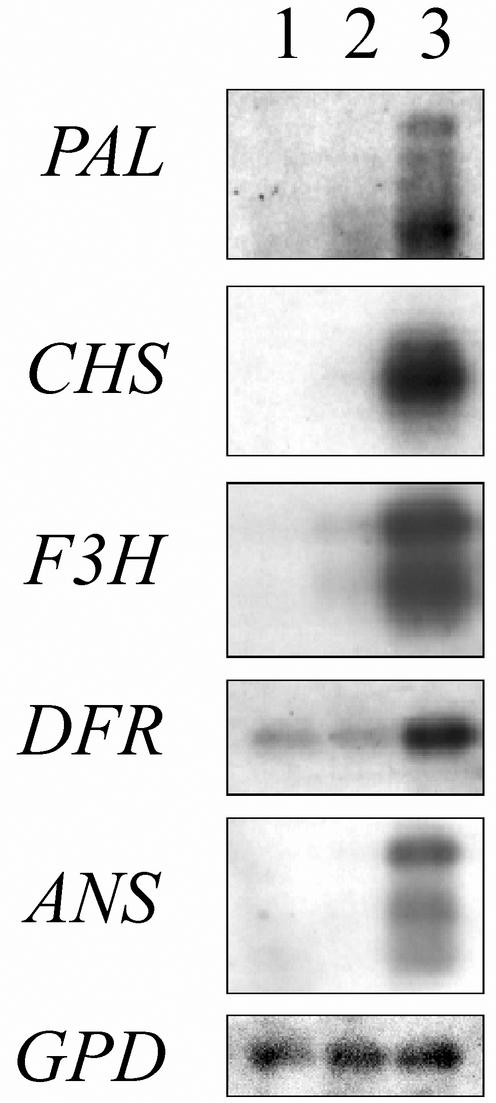
Expression of the anthocyanin pathway genes of bilberry in color mutation forms of bilberry, probed with bilberry cDNA fragments for PAL, CHS, F3H, DFR, and ANS. Five micrograms of RNA translated to cDNA of the white bilberry (lane 1), of the pink bilberry (lane 2), and of the wild bilberry (lane 3) was used. The same membrane was also rehybridized with GPD probe to show the loading of the equal RNA and cDNA amounts of the samples.
Figure 5
Figure 5
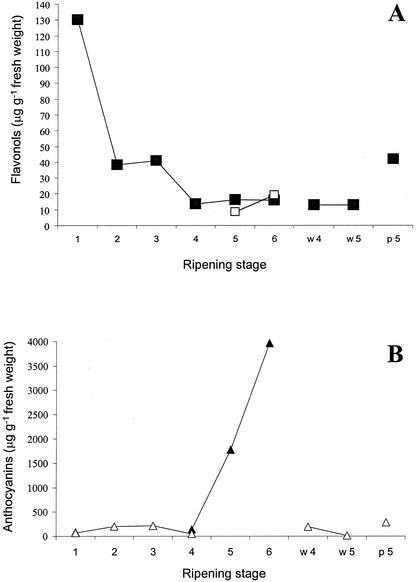
A, Contents of the flavonols quercetin (▪) and myricetin (□) during development and ripening of bilberries. B, Contents of anthocyanins (▴) and proanthocyanins (▵) during the same stages as in A. Numbers 1 through 6 indicate the different stages of ripening examined. W4 and W5, White mutant at the ripening stages 4 and 5. P5, Pink mutant at the ripening stage 5.
Figure 6
Figure 6
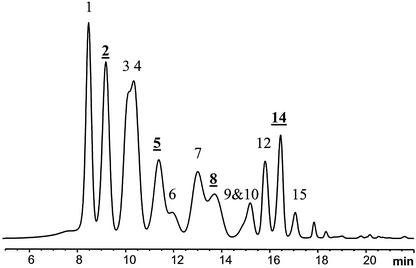
HPLC-DAD profiles of anthocyanins found in flower and ripe bilberry. Standards were available for the anthocyanins with underlined peak numbers. Peak numbers refer to Table II.
Figure 7
Figure 7
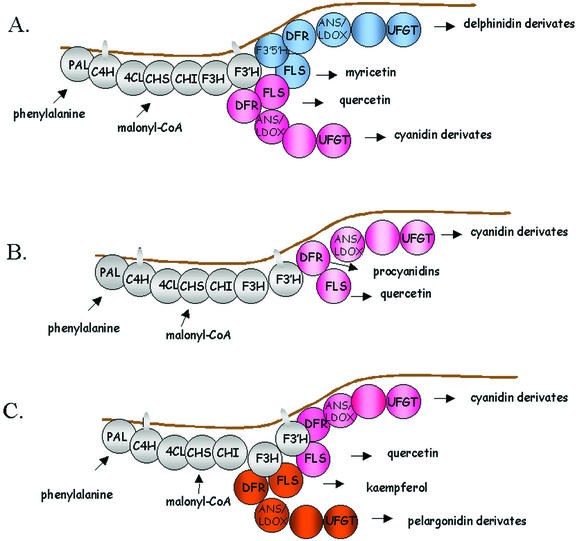
Models for the organization of flavonoid pathway enzymes for production of anthocyanidins and flavonols in fruits, supposedly as macromolecular complexes at the endoplasmic reticulum. A, Model for the production of myricetin and quercetin in connection to delphinidin- and cyanidin-derived anthocyanins (e.g. bilberry, blueberries, grape, and black currant). In grape and black currant, small amounts of kaempferol are found, but quercetin and myricetin are the predominant flavonols. B, Model for the production of quercetin in connection with cyanidin-derived anthocyanins (e.g. lingonberry, apple, rosehip , and flowers and callus cultures of bilberry, etc.). C, Model for the production of kaempferol and quercetin in connection with cyanidin- and pelargonidin-derived anthocyanins (strawberry, raspberry [partially]). Modified from Winkel-Shirley (1999). Enzyme names are abbreviated as in Figure 1.

References

    1. Bohm B. Introduction of Flavonoids. Singapore: Harwood Academic Publishers; 1998.
    1. Bomser J, Madhavi DL, Singletary K, Smith MAL. In vitro anticancer activity of fruit extracts from Vaccinium species. Planta Med. 1996;62:212–216. - PubMed
    1. Boss PK, Davies C, Robinson SP. Analysis and the expression of anthocyanins pathway genes in developing Vitis vinifera L. cv Shiraz grape berries and the implications for pathway regulation. Plant Physiol. 1996;11:1059–1066. - PMC - PubMed
    1. Brady CJ. Fruit ripening. Annu Rev Plant Physiol. 1987;38:155–178.
    1. Chang S, Puryear J, Cairney J. A simple and efficient method for isolating RNA from pine trees. Plant Mol Biol Rep. 1993;11:113–116.

Publication types

MeSH terms

LinkOut - more resources