. 2002 Nov;70(11):6355-64.
doi: 10.1128/IAI.70.11.6355-6364.2002.

Shigella flexneri DegP facilitates IcsA surface expression and is required for efficient intercellular spread

Affiliations

Shigella flexneri DegP facilitates IcsA surface expression and is required for efficient intercellular spread

Georgiana E Purdy et al. Infect Immun. 2002 Nov.

Abstract

A degP mutant of Shigella flexneri was identified in a screen for insertion mutants that invaded cultured cells but did not form wild-type plaques in monolayers. The degP mutant SM1100 invaded Henle cells at wild-type levels and induced apoptosis in macrophages but formed smaller plaques than those formed by wild-type S. flexneri in confluent monolayers of Henle and Caco-2 cells. The proportion of SM1100 bacteria with IcsA localized to the bacterial pole, a process required for actin polymerization into actin "tails," was reduced compared to results with wild-type bacteria. The reduction in proper IcsA localization may account for the reduced plaque size of the degP mutant. Although DegP is a protease, the protease activity of S. flexneri DegP was not required for IcsA localization or the formation of plaques in Henle cell monolayers. DegP was also required for efficient polar IcsA localization in E. coli expressing icsA. In addition, the growth or survival of SM1100 was compromised compared to that of the wild type at elevated temperatures and in acidic conditions.


Figures
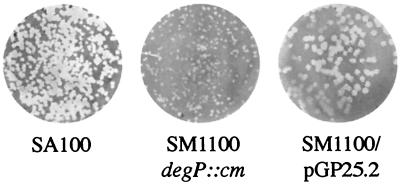
FIG. 1.
FIG. 1.
The S. flexneri degP mutant forms small plaques in Henle cell monolayers. Plaque formation by SA100, SM1100 (degP::cm), and SM1100/pGP25.2 (DegP+) on confluent Henle cell monolayers is shown.
FIG. 2.
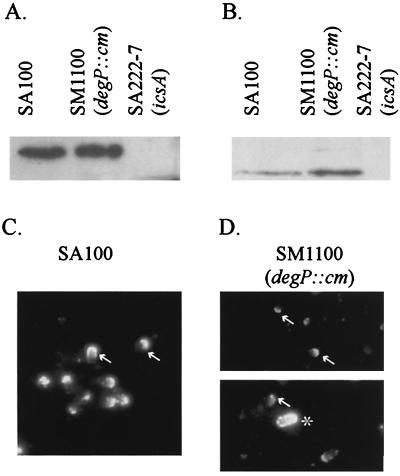
FIG. 2.
IcsA expression and localization in the S. flexneri degP mutant. Western analysis with IcsA antibodies of SA100, SM1100, and SA222-7 bacteria (A) and culture supernatants (B) is shown. IcsA localization in broth-grown cultures of SA100 (C) and SM1100 (D) was observed by indirect immunofluorescence. IcsA “caps” are denoted by arrows. An asterisk indicates a bacterium representative of the minority population of SM1100 that appears to have IcsA over the entire surface.
FIG.3.
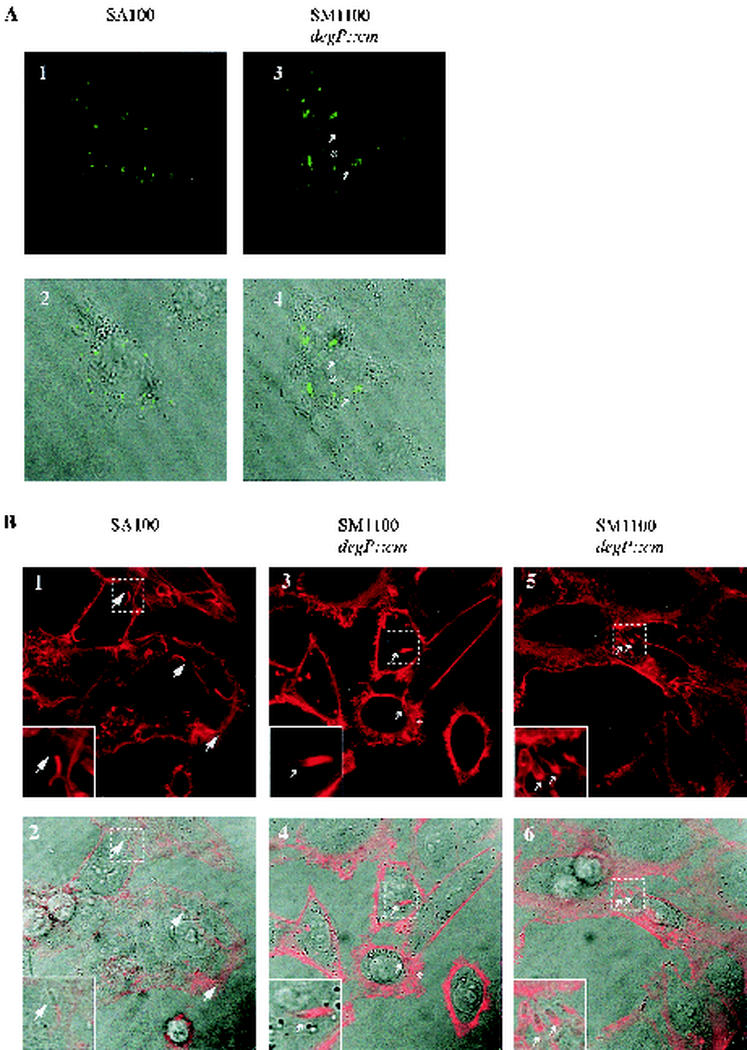
FIG.3.
IcsA localization and actin staining inside Shigella-infected Henle cells. (A) IcsA localization observed by indirect immunofluorescence. In the SM1100 panels A3 and A4, arrows point to representative bacteria with polar IcsA localization and an asterisk indicates IcsA localization over the entire bacterium. (B) Actin was stained with TRITC-phalloidin, and representative bacteria have been labeled as follows: a large arrowhead points to normal actin tail formation (B1 and B2), small arrowheads point to a tail descending on the bacterium (B3 to B6), and an asterisk indicates actin cloud formation (B3 and B4). Fluorescence images (A1, A3, B1, B3, and B5) and differential interference contrast overlay images (A2, A4, B2, B4, and B6) are shown.
FIG. 4.
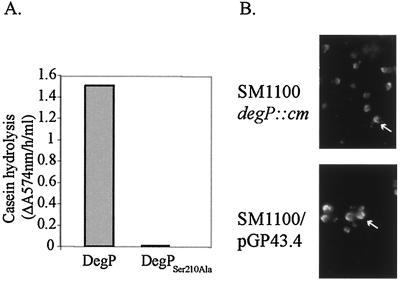
FIG. 4.
Characterization of S. flexneri DegPSer210Ala activity. (A) Proteolytic activity of DegPSer210Ala using the substrate resorufin-labeled casein. (B) IcsA localization in broth-grown SM1100 and SM1100/pGP43.4 bacteria. IcsA “caps” are denoted by arrows.
FIG. 5.
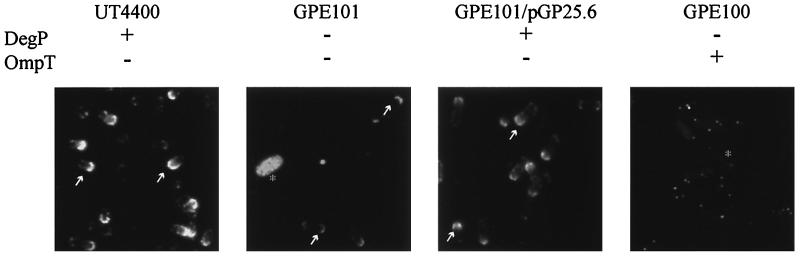
FIG. 5.
Indirect immunofluorescence of E. coli strains expressing IcsA. The relevant phenotype is given for each strain. Arrows point to proper IcsA localization to the bacterial pole.
FIG. 6.
FIG. 6.
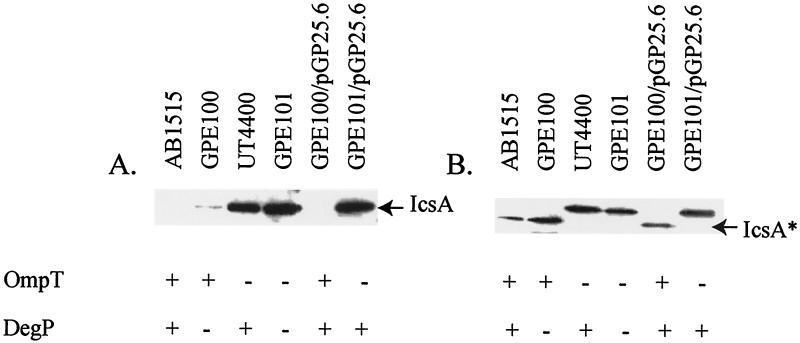
Western analysis of E. coli strains expressing IcsA. Whole-cell proteins (A) and proteins from culture supernatants (B) of E. coli strains expressing IcsA from pGP38.1 were analyzed with IcsA antibodies. The location of IcsA and the IcsA* fragment are indicated. The presence (+) or absence (−) of OmpT and DegP in each strain is indicated.
FIG. 7.
FIG. 7.
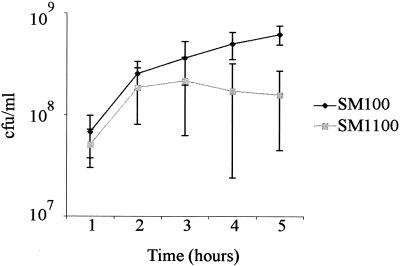
Survival of S. flexneri degP mutant at 44°C. SM100 and SM1100 cultures were grown for 2 h at 30°C until early log phase and then transferred to a 44°C environment. Standard deviation for three independent experiments is shown.
FIG. 8.
FIG. 8.
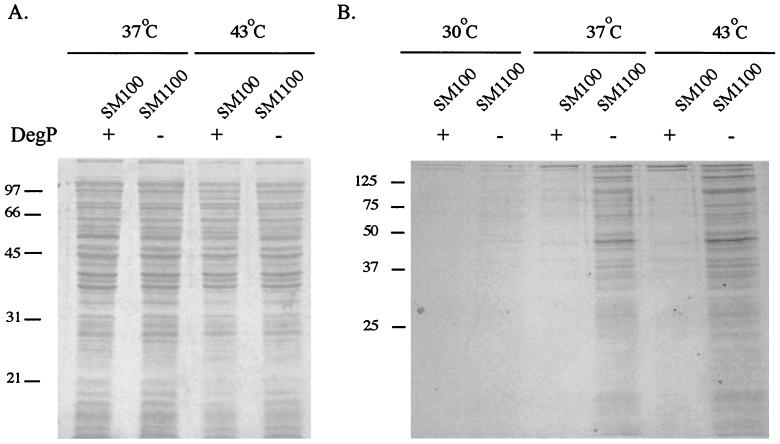
Cells and culture supernatants of S. flexneri SM100 and degP mutant SM1100. (A) Whole cells from SM100 and SM1100 at 37 and 43°C analyzed by SDS-PAGE. (B) Culture supernatants from equal numbers of bacteria grown at 30, 37, and 43°C were precipitated and analyzed by SDS-PAGE. The gels are stained with Coomassie blue.
FIG. 9.
FIG. 9.
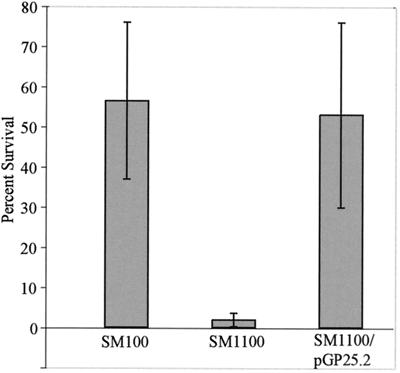
Survival of S. flexneri in acid. Percent survival of SM100, SM1100 (degP::cm), and SM1100/pGP25.2 (DegP+) after exposure to Luria broth (pH 2.5) for 2 h is shown.

References

    1. Altschul, S. F., W. Gish, W. Miller, E. W. Myers, and D. J. Lipman. 1990. Basic local alignment search tool. J. Mol. Biol. 215:403-410. - PubMed
    1. Baneyx, F., and G. Georgiou. 1990. In vivo degradation of secreted fusion proteins by the Escherichia coli outer membrane protease OmpT. J. Bacteriol. 172:491-494. - PMC - PubMed
    1. Bernardini, M. L., J. Mounier, H. d'Hauteville, M. Coquis-Rondon, and P. J. Sansonetti. 1989. Identification of icsA, a plasmid locus of Shigella flexneri that governs bacterial intra- and intercellular spread through interaction with F-actin. Proc. Natl. Acad. Sci. USA 86:3867-3871. - PMC - PubMed
    1. Boucher, J. C., J. Martinez-Salazar, M. J. Schurr, M. H. Mudd, H. Yu, and V. Deretic. 1996. Two distinct loci affecting conversion to mucoidy in Pseudomonas aeruginosa in cystic fibrosis encode homologs of the serine protease HtrA. J. Bacteriol. 178:511-523. - PMC - PubMed
    1. Brandon, L. D., and M. B. Goldberg. 2001. Periplasmic transit and disulfide bond formation of the autotransported Shigella protein IcsA. J. Bacteriol. 183:951-958. - PMC - PubMed

Publication types