. 2002 Nov;46(11):3591-6.
doi: 10.1128/AAC.46.11.3591-3596.2002.

In vitro activity of caspofungin against Candida albicans biofilms

Affiliations

In vitro activity of caspofungin against Candida albicans biofilms

Stefano P Bachmann et al. Antimicrob Agents Chemother. 2002 Nov.

Abstract

Most manifestations of candidiasis are associated with biofilm formation on biological or inanimate surfaces. Candida albicans biofilms are recalcitrant to treatment with conventional antifungal therapies. Here we report on the activity of caspofungin, a new semisynthetic echinocandin, against C. albicans biofilms. Caspofungin displayed potent in vitro activity against sessile C. albicans cells within biofilms, with MICs at which 50% of the sessile cells were inhibited well within the drug's therapeutic range. Scanning electron microscopy and confocal scanning laser microscopy were used to visualize the effects of caspofungin on preformed C. albicans biofilms, and the results indicated that caspofungin affected the cellular morphology and the metabolic status of cells within the biofilms. The coating of biomaterials with caspofungin had an inhibitory effect on subsequent biofilm development by C. albicans. Together these findings indicate that caspofungin displays potent activity against C. albicans biofilms in vitro and merits further investigation for the treatment of biofilm-associated infections.


Figures
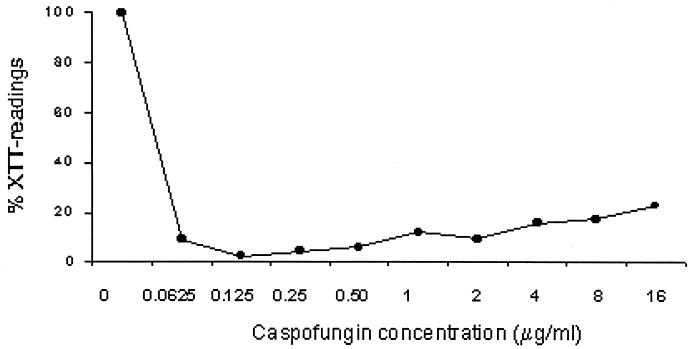
FIG. 1.
FIG. 1.
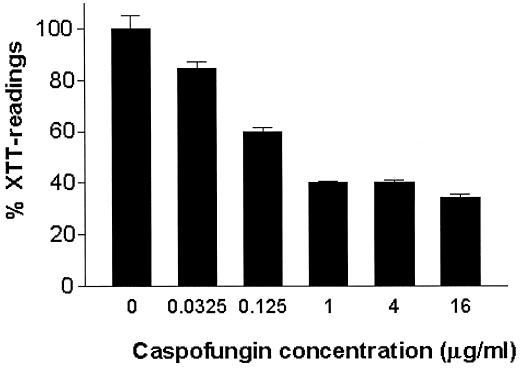
Activities of caspofungin at different concentrations against biofilms of C. albicans strain 3153A. Values are expressed as the average percentage of OD of wells containing treated biofilms compared to that of control wells (considered to be 100%) for the XTT assays. Results are from a single experiment performed with four replicate wells.
FIG. 2.
FIG. 2.
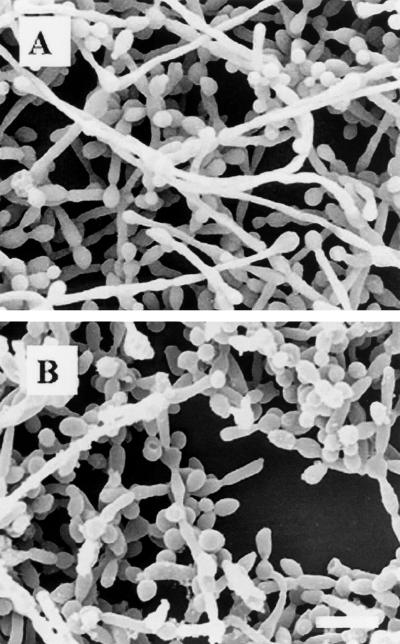
Electron micrographs of preformed C. albicans 3153A biofilms on plastic coverslips after incubation for 24 h with medium alone (A) or with 0.5 μg of caspofungin per ml (B). Bar, 10 μm.
FIG. 3.
FIG. 3.
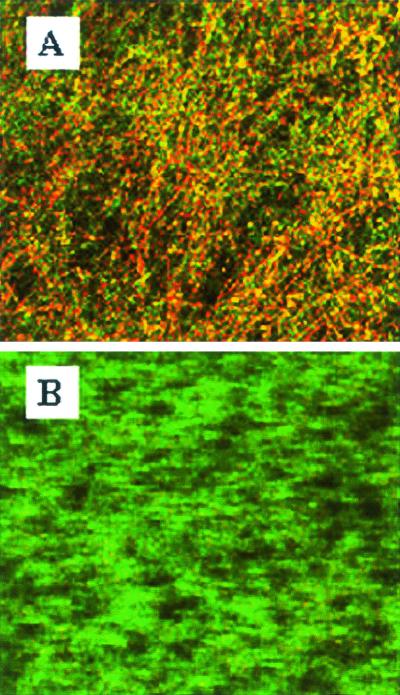
CLSM of C. albicans 3153A biofilms on plastic coverslips after incubation for 24 h with medium alone (A) or with 0.5 μg of caspofungin per ml (B). Experiments utilize the FUN 1 stain to directly visualize the effects of caspofungin on preformed biofilms. Note the shift from green to red fluorescence visible in panel A (untreated control biofilms), which reflects processing of the dye by metabolically active cells. In contrast, caspofungin-treated biofilms (B) show diffuse green fluorescence characteristic of dead cells. Images are single xy optical sections taken across the z axis. Magnification, ×200.
FIG. 4.
FIG. 4.
Effect of caspofungin impregnation on subsequent biofilm formation by C. albicans 3153A on the wells of microtiter plates. Values are expressed as the average percentage of OD (seven replicate wells) compared to that of control wells (considered to be 100%) for the XTT assays. Pretreatment at all caspofungin concentrations resulted in statistically significant differences in biofilm formation compared to that of control biofilms (P is 0.0379 for 0.03125 μg/ml and P is <0.001 for all other concentrations).

References

    1. Abruzzo, G. K., C. J. Gill, A. M. Flattery, L. Kong, C. Leighton, J. G. Smith, V. B. Pikounis, K. Bartizal, and H. Rosen. 2000. Efficacy of the echinocandin caspofungin against disseminated aspergillosis and candidiasis in cyclophosphamide-induced immunosuppressed mice. Antimicrob. Agents Chemother. 44:2310-2318. - PMC - PubMed
    1. Arikan, S., M. Lozano-Chiu, V. Paetznick, and J. H. Rex. 2001. In vitro susceptibility testing methods for caspofungin against Aspergillus and Fusarium isolates. Antimicrob. Agents Chemother. 45:327-330. - PMC - PubMed
    1. Arikan, S., M. Lozano-Chiu, V. Paetznick, and J. H. Rex. 2002. In vitro synergy of caspofungin and amphotericin B against Aspergillus and Fusarium spp. Antimicrob. Agents Chemother. 46:245-247. - PMC - PubMed
    1. Bachmann, S. P., T. F. Patterson, and J. L. López-Ribot. 2002. In vitro activity of caspofungin (MK-0991) against Candida albicans clinical isolates displaying different mechanisms of azole resistance. J. Clin. Microbiol. 40:2228-2230. - PMC - PubMed
    1. Baillie, G. S., and L. J. Douglas. 1999. Candida biofilms and their susceptibility to antifungal agents. Methods Enzymol. 310:644-656. - PubMed

Publication types