. 2002 Oct 29;99(22):14584-9.
doi: 10.1073/pnas.212325299. Epub 2002 Oct 16.

Interphase chromosomes in Arabidopsis are organized as well defined chromocenters from which euchromatin loops emanate

Affiliations

Interphase chromosomes in Arabidopsis are organized as well defined chromocenters from which euchromatin loops emanate

Paul Fransz et al. Proc Natl Acad Sci U S A. .

Abstract

Heterochromatin in the model plant Arabidopsis thaliana is confined to small pericentromeric regions of all five chromosomes and to the nucleolus organizing regions. This clear differentiation makes it possible to study spatial arrangement and functional properties of individual chromatin domains in interphase nuclei. Here, we present the organization of Arabidopsis chromosomes in young parenchyma cells. Heterochromatin segments are organized as condensed chromocenters (CCs), which contain heavily methylated, mostly repetitive DNA sequences. In contrast, euchromatin contains less methylated DNA and emanates from CCs as loops spanning 0.2-2 Mbp. These loops are rich in acetylated histones, whereas CCs contain less acetylated histones. We identified individual CCs and loops by fluorescence in situ hybridization by using rDNA clones and 131 bacterial artificial chromosome DNA clones from chromosome 4. CC and loops together form a chromosome territory. Homologous CCs and territories were associated frequently. Moreover, a considerable number of nuclei displayed perfect alignment of homologous subregions, suggesting physical transinteractions between the homologs. The arrangement of interphase chromosomes in Arabidopsis provides a well defined system to investigate chromatin organization and its role in epigenetic processes.


Figures

Fig 1.
Fig 1.
Heterochromatin distribution in A. thaliana. (A) Ideogram showing the five chromosomes with 5S and 45S loci. (B) Three optical sections of a paraformaldehyde-fixed interphase nucleus stained with 4′,6-diamidino-2-phenylindole showing CCs near the periphery and the nucleolus. (Bar = 2 μm.) (C) Distribution of the number of CCs per nucleus.
Fig 2.
Fig 2.
Identification and characterization of CCs by FISH and immunolabeling to nuclei of the accession Wassileskija. All preparations were counterstained with 4′,6-diamidino-2-phenylindole (blue). (A) FISH with centromeric pAL1 (red) and pericentromeric F17A20 repeats (green). (B) FISH with 5S (red) and 45S rDNA (green). Numbers correspond to chromosomes. (C) FISH with the telomeric sequence (red) yielded clustered signals around the nucleolus (n). (D) Immunolabeling with antibodies against 5-methylcytosine (green). (E) Immunolabeling with antibodies against histone H4Ac5 (green) and FISH with the centromeric pAL1 (red). [Bar = 2 μm (E) and 5 μm (AD).]
Fig 3.
Fig 3.
FISH localization of chromosome 4 regions in nuclei of the accessions Landsberg (A and B), Wassileskija (C and J), Zurich (D), and C24 (EI, K, and L). Diagrams on the left indicate the map position of the DNA clones in chromosome 4. Solid circle and rectangle represent NOR4 and pericentromere 4, respectively. (A) BAC clone T4B21 (green) is outside CC4, whereas 5S rDNA (red) colocalizes with CC4 and CC5. (B) Two contiguous BAC clones T4B21 (green) and T1J1 (red). Note the position of the distal T1J1 relative to T4B21 and CC4. B2 shows a FISH signal of aligned, homologous regions. Note the inverse order of centromere-T1J1-T4B21 signals. (C) Two contiguous yeast artificial chromosome clones, 8B1 (green) and 7C3 (red), localize close to CC4. 8B1 (980 kb) covers the heterochromatic knob hk4S, whereas the adjacent 7C3 (480 kb) is located in the proximal euchromatin. The difference in chromatin density between the two regions is illustrated by the length of the signals. (D) Two contiguous BACs, F5J10 (green) and F6N15 (red), from the distal end of chromosome arm 4S, showing separate (Left) and associated (Right) homologous regions. Note the loop structure in one of the homologs. (E) Two adjacent BACs, T19B17 (green) and the proximal T27D20 (red), form a small loop structure (see magnification). Note the difference in array position between the signals of the two homologs. (F) Pools of five BACs from the short (red) and long (green) arm adjacent to the pericentromere. The interrupted and uninterrupted white lines represent the hybridization patterns of the homologous regions. (G and H) Pachytene chromosome and interphase nuclei hybridized with a mix of 18 BACs covering 2 Mbp of chromosome arm 4S. During interphase, chromosome arm 4S forms either a cloud of small loops (G2) or a single giant loop (H). The arrows indicate corresponding nonlabeled regions in the nucleus and the pachytene chromosome. (I) Pachytene chromosome and interphase nucleus hybridized with a mix of 17 BACs that differs from G in labeling pattern. Note that the homologous arms, 4S, in H and I are perfectly aligned. (J) Pachytene chromosome and interphase nucleus hybridized with a mix of 113 BACs from the long-arm 4L. (K) Twelve long-arm BACs are labeled in green and map to the distal end. In interphase nuclei, this region may associate with CC4, which supports the conclusion that loop formation also occurs in the long arm. The short arm is visualized by 13 BACs in red and 1 distal BAC in green. (L) The middle region of the long arm (10 red BACs) may also associate with CC4, which is identified by 5S (green) and 45S rDNA (red) probes. CC2 and CC5 are identified by 45S and 5S rDNA, respectively. In this case, one CC2 colocalizes with its homolog or with CC4. (Bar = 5 μm.)
Fig 4.
Fig 4.
CC–loop model for the organization of chromosome 4 in Arabidopsis nuclei. Heterochromatic regions compartmentalize into one CC, whereas euchromatin forms 0.2- to 2-Mbp loops around this CC. CCs contain heavily methylated DNA (Me), whereas euchromatin loops are enriched in acetylated histone H4 (Ac). The colored blocks represent interstitial, contiguous BACs that show different positions relative to the CC depending on the loop organization.
Fig 5.
Fig 5.
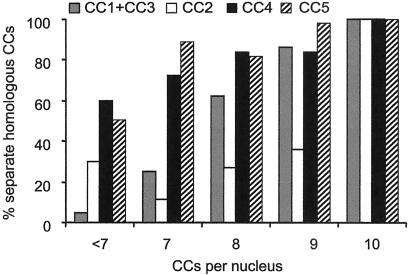
Histogram showing the percentage of separate homologous CCs. CC1 and CC3, which could not be distinguished from each other, are combined as one group.

References

    1. Sadoni N., Langer, S., Fauth, C., Bernardi, G., Cremer, T., Turner, B. M. & Zink, D. (1999) J. Cell Biol. 146, 1211-1226. - PMC - PubMed
    1. Lamond A. I. & Earnshaw, W. C. (1998) Science 280, 547-553. - PubMed
    1. Karpen G. H. & Alshire, R. C. (1997) Trends Genet. 13, 489-496. - PubMed
    1. Hennig W. (1997) Chromosoma 108, 1-9. - PubMed
    1. Jenuwein T. & Allis, C. D. (2001) Science 293, 1074-1080. - PubMed

Publication types