Comparative Study
. 2002 Oct 15;30(20):4432-41.
doi: 10.1093/nar/gkf566.

Genome sequence of Shigella flexneri 2a: insights into pathogenicity through comparison with genomes of Escherichia coli K12 and O157

Affiliations
Comparative Study

Genome sequence of Shigella flexneri 2a: insights into pathogenicity through comparison with genomes of Escherichia coli K12 and O157

Qi Jin et al. Nucleic Acids Res. .

Abstract

We have sequenced the genome of Shigella flexneri serotype 2a, the most prevalent species and serotype that causes bacillary dysentery or shigellosis in man. The whole genome is composed of a 4 607 203 bp chromosome and a 221 618 bp virulence plasmid, designated pCP301. While the plasmid shows minor divergence from that sequenced in serotype 5a, striking characteristics of the chromosome have been revealed. The S.flexneri chromosome has, astonishingly, 314 IS elements, more than 7-fold over those possessed by its close relatives, the non-pathogenic K12 strain and enterohemorrhagic O157:H7 strain of Escherichia coli. There are 13 translocations and inversions compared with the E.coli sequences, all involve a segment larger than 5 kb, and most are associated with deletions or acquired DNA sequences, of which several are likely to be bacteriophage-transmitted pathogenicity islands. Furthermore, S.flexneri, resembling another human-restricted enteric pathogen, Salmonella typhi, also has hundreds of pseudogenes compared with the E.coli strains. All of these could be subjected to investigations towards novel preventative and treatment strategies against shigellosis.


Figures
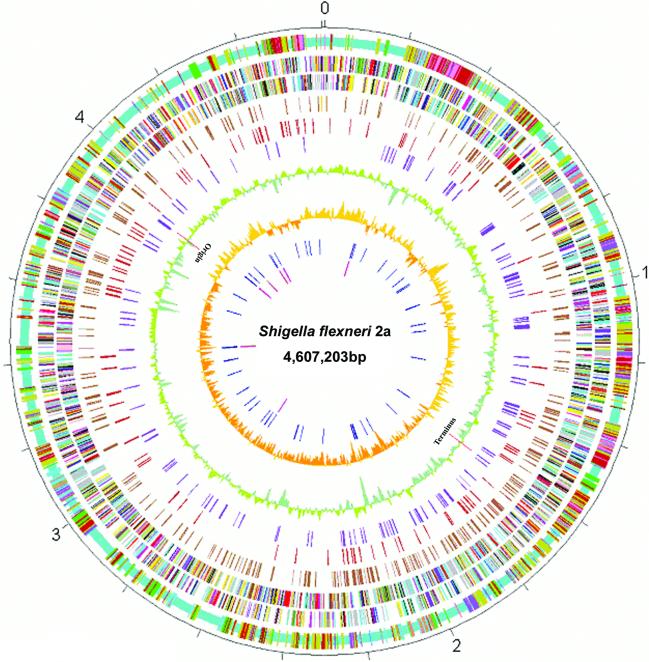
Figure 1
Figure 1
Circular map of Sf301 chromosome compared with those of E.coli K12 MG1655 and 0157 EDL933. Outer scale is marked in 200 kb. Circles range from 1 (outer circle) to 10 (inner circle). Circle 1, shared collinear backbone (light blue), and Shigella islands (SI) (cyan), K12 islands (KI) (green) and 0157 islands (OI) (tan); co-localized SI and KI (dark salmon); co-localized SI and OI (purple); co-localized KI and OI (dark blue); and co-localized SI, KI and OI (deep pink). Circles 2 and 3, ORFs encoded by leading and lagging strands with color code for functions: salmon, translation, ribosomal structure and biogenesis; light blue, transcription; cyan, DNA replication, recombination and repair; turquoise, cell division; deep pink, posttranslational modification, protein turnover and chaperones; olive drab, cell envelope biogenesis; purple, cell motility and secretion; forest green, inorganic ion transport and metabolism; magenta, signal transduction; red, energy production; sienna, carbohydrate transport and metabolism; yellow, amino acid transport; orange, nucleotide transport and metabolism; gold, co-enzyme transport and metabolism; dark blue, lipid metabolism; blue, secondary metabolites, transport and catabolism; gray, general function prediction only; black, function unclassified or unknown. Circle 4, distribution of pseudogenes. Circles 5 and 6, distribution of IS1 and other IS elements, respectively. Circle 7, G + C content with a window size of 10 kb. Circle 8, GC bias (G – C/G + C). Circle 9, distribution of tRNA genes. Circle 10, distribution of rrn operons. The replication origin and terminus are indicated.
Figure 2
Figure 2
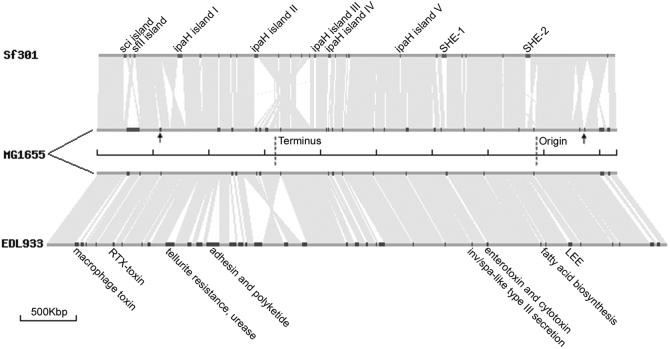
Schematic representation of translocations and inversions, and strain-specific islands (to scale). Chromosomes are represented by dark gray lines as indicated. Replication origin and terminus of MG1655 are indicated. The respective loci of Sf301 and EDL933 are at approximately the same positions. Regions in light gray indicate homologous sequences between paired chromosomes and triangular non-filling regions indicate the presence of inversions. Translocations are hardly visible because of the scale used. Regions in red, black and blue on the chromosomes represent SI, KI and OI, respectively. The known PAI among SIs and OIs are indicated. SIs with implications for a role in virulence are also indicated. Arrows indicate the KIs harboring ompT (left) and cadA (right) whose deletions are crucial for Shigella virulence.
Figure 3
Figure 3
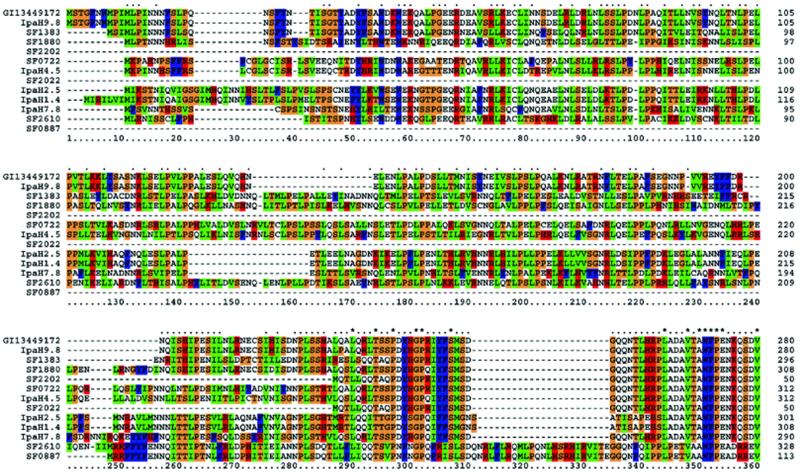
CLUSTALW amino acid sequence alignment of N-terminal halves of IpaH proteins identified in Sf301. IpaH9.8 of pWR501 (gi_13449172) serves as a reference on the top. The most homologous IpaH9.8 from pCP301 is placed in the second, and other IpaH family members are arranged in line with their homology to IpaH9.8. The consensus line displayed above the aligned sequences depicts identical amino acids as asterisks, with conserved residues shown as dots.
Figure 4
Figure 4
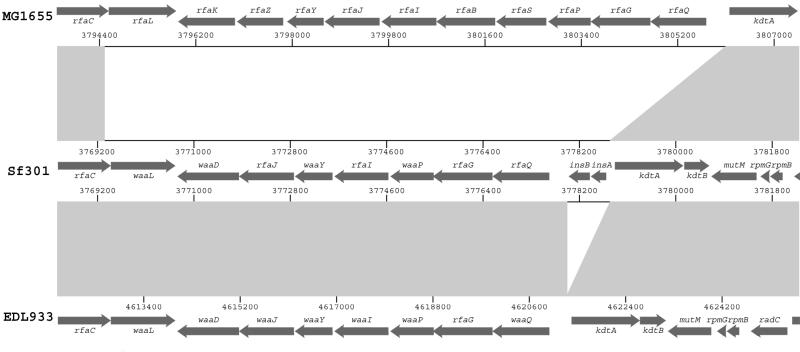
Comparison of the rfa/waa region (to scale). Arrows indicate predicted ORFs in both strands. Regions in gray indicate identical sequences among strains and the non-filling areas indicate sequences with non or low homology.

References

    1. Sansonetti P.J. (2001) Microbes and microbial toxins: paradigms for microbial–mucosal interactions III. Shigellosis: from symptoms to molecular pathogenesis. Am. J. Physiol. Gastrointest. Liver Physiol., 280, G319–G323. - PubMed
    1. Mei Y., Liu,H. and Xu,J. (1989) Cloning and application of genus specific DNA probes for Shigella. Chinese J. Epidemiol., 10, 167–170.
    1. Sansonetti P.J. (1998) Vaccines against enteric infections. Slaying the Hydra at once or head by head? Nature Med., 4 (Suppl.), 499–500. - PubMed
    1. Hale T.L. (1991) Genetic basis of virulence in Shigella species. Microbiol. Rev., 55, 206–224. - PMC - PubMed
    1. Pupo G.M., Lan,R. and Reeves,P.R. (2000) Multiple independent origins of Shigella clones of Escherichia coli and convergent evolution of many of their characteristics. Proc. Natl Acad. Sci. USA, 97, 10567–10572. - PMC - PubMed

Publication types

Substances

Associated data