


Frequent chromosome aberrations revealed by molecular cytogenetic studies in patients with aniridia
- PMID: 12386836
- PMCID: PMC385089
- DOI: 10.1086/344396
Frequent chromosome aberrations revealed by molecular cytogenetic studies in patients with aniridia
Abstract
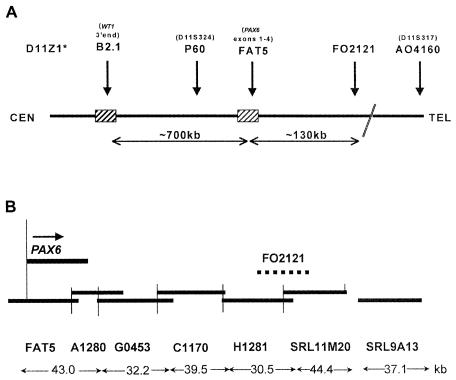
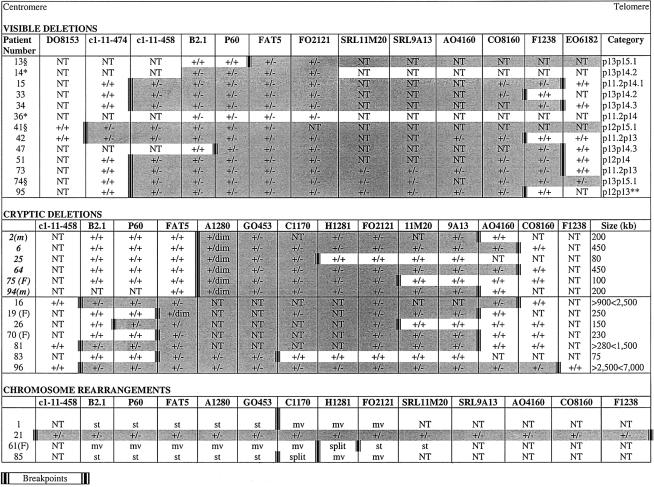
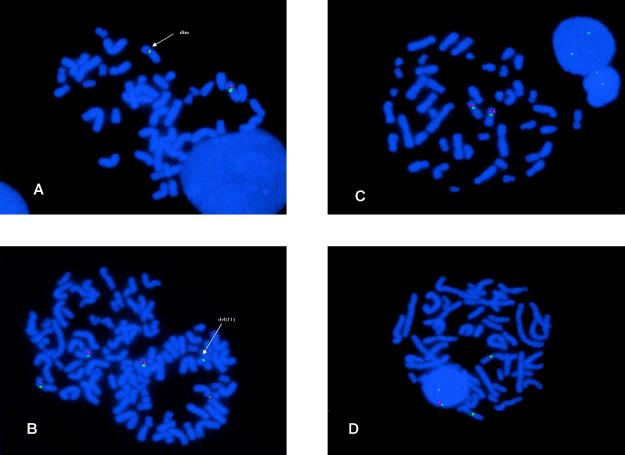
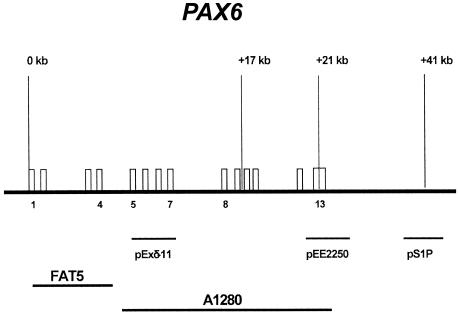
Seventy-seven patients with aniridia, referred for cytogenetic analysis predominantly to assess Wilms tumor risk, were studied by fluorescence in situ hybridization (FISH), through use of a panel of cosmids encompassing the aniridia-associated PAX6 gene, the Wilms tumor predisposition gene WT1, and flanking markers, in distal chromosome 11p13. Thirty patients were found to be chromosomally abnormal. Cytogenetically visible interstitial deletions involving 11p13 were found in 13 patients, 11 of which included WT1. A further 13 patients had cryptic deletions detectable only by FISH, 3 of which included WT1. Six of these, with deletions <500 kb, share a similar proximal breakpoint within a cosmid containing the last 10 exons of PAX6 and part of the neighboring gene, ELP4. Two of these six patients were mosaic for the deletion. The remaining four had chromosomal rearrangements: an unbalanced translocation, t(11;13), with a deletion including the WAGR (Wilms' tumor, aniridia, genitourinary abnormalities, and mental retardation) region, and three balanced rearrangements with what appear to be position effect breakpoints 3' of PAX6: (a) a t(7;11) with the 11p13 breakpoint approximately 30 kb downstream of PAX6, (b) a dir ins(12;11) with a breakpoint >50 kb from PAX6, and (c) an inv(11)(p13q13) with a breakpoint >75 kb downstream of PAX6. The proportion and spectrum of chromosome anomalies in familial (4/14, or 28.5%) and sporadic (26/63, or 41%) cases are not significantly different. An unexpectedly high frequency of chromosomal rearrangements is associated with both sporadic and familial aniridia in this cohort.
Figures
References
Electronic-Database Information
-
- Ensembl Genome Browser, http://www.ensembl.org/Homo_sapiens/
-
- GenBank, http://www.ncbi.nlm.nih.gov/Genbank/
-
- Online Mendelian Inheritance in Man (OMIM), http://www.ncbi.nlm.nih.gov/Omim/ (for aniridia [MIM 106200] and WAGR syndrome [MIM 194072])
References
-
- Ainsworth PJ, Chakraborty PK, Weksberg R (1997) Example of somatic mosaicism in a series of de novo neurofibromatosis type 1 cases due to a maternally derived deletion. Hum Mutat 9:452–457 - PubMed
-
- Bunyan DJ, Crolla JA, Collins AL, Robinson DO (1995) Fluorescence in situ hybridisation studies provide evidence for somatic mosaicism in de novo dystrophin gene deletions. Hum Genet 95:43–45 - PubMed
-
- Call KM, Glaser T, Ito CY, Buckler AJ, Pelletier J, Haber DA, Rose EA, Kral A, Yeger H, Lewis WH, Jones C, Houseman DE (1990) Isolation and characterization of a zinc finger polypeptide gene at the human chromosome 11 Wilms' tumor locus. Cell 60:509–520 - PubMed
-
- Chao LY, Huff V, Strong LC, Saunders GF (2000) Mutation in the PAX6 gene in twenty patients with aniridia. Hum Mutat 15:332–339 - PubMed
MeSH terms
Substances
Associated data
- Actions
- Actions
- Actions
Grants and funding
LinkOut - more resources
Full Text Sources
Molecular Biology Databases
