


The effects of prior light history on the suppression of melatonin by light in humans
- PMID: 12390501
- PMCID: PMC3925650
- DOI: 10.1034/j.1600-079x.2002.01885.x
The effects of prior light history on the suppression of melatonin by light in humans
Abstract
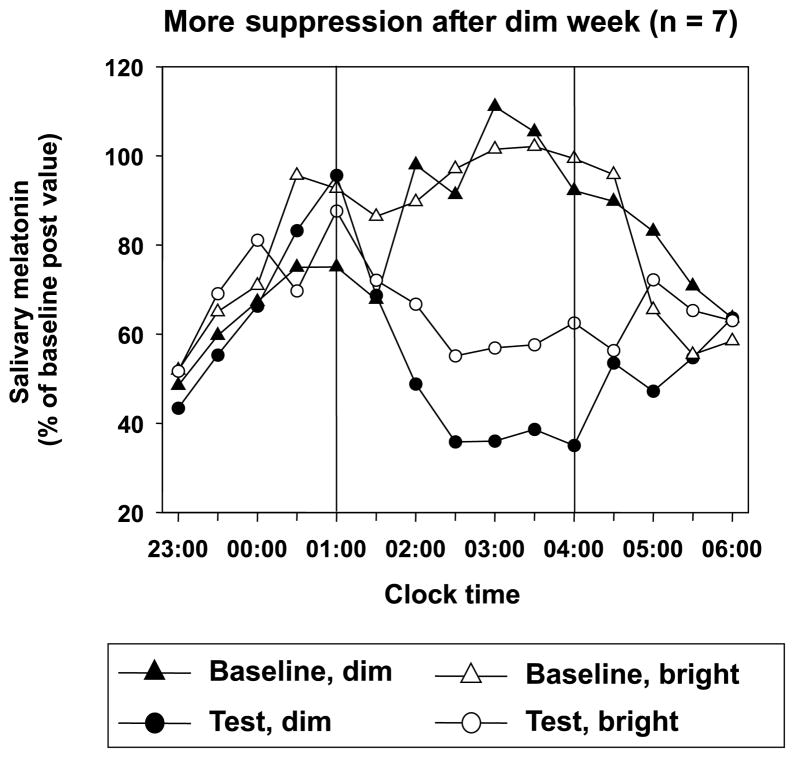
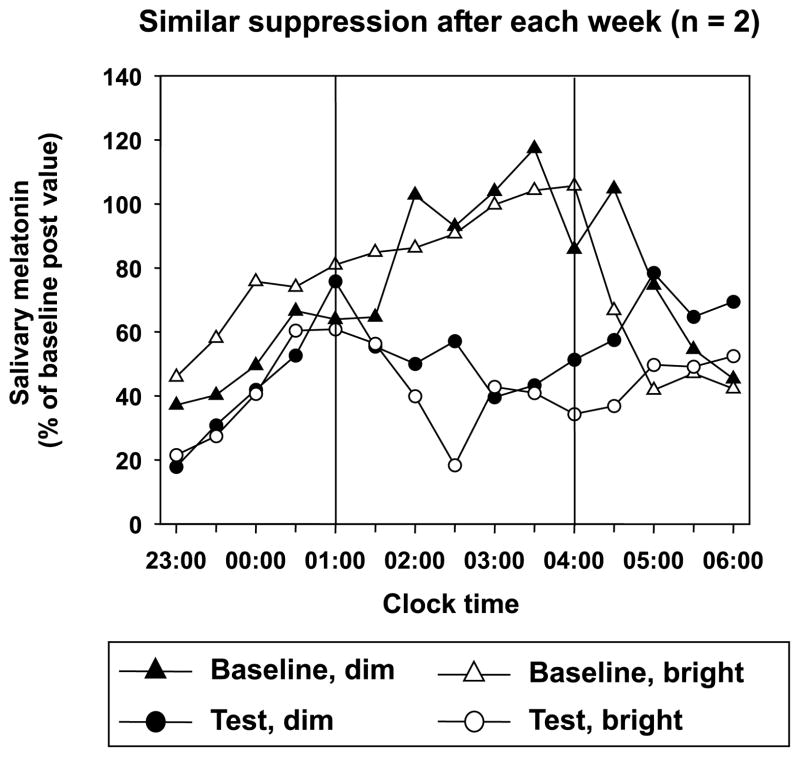
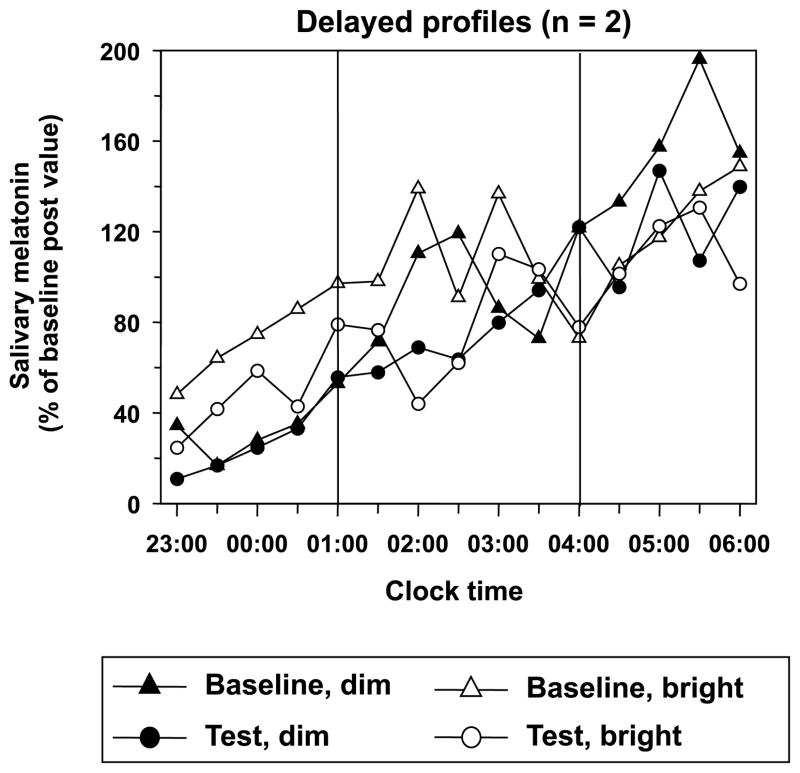
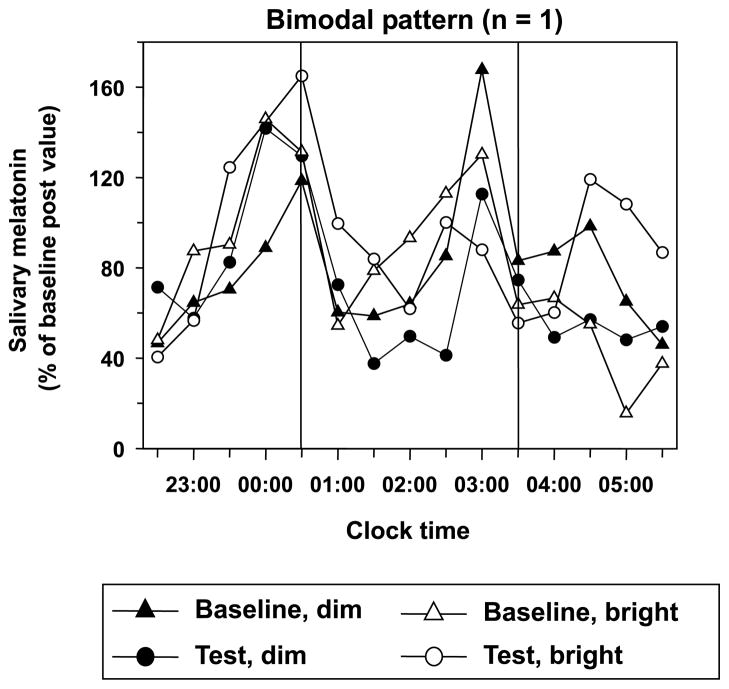
We investigated the impact of light exposure history on light sensitivity in humans, as assessed by the magnitude of the suppression of melatonin secretion by nocturnal light. The hypothesis was that following a week of increased daytime bright-light exposure, subjects would become less sensitive to light, and that after a week of restriction to dimmer light they would become more sensitive. During the bright week, subjects (n = 12) obtained 4.3 +/- 0.4 hr of bright light per day (by going outside and using light boxes indoors). During the dim week, they wore dark goggles (about 2% light transmission) when outside during daylight and spent 1.4 +/- 0.9 hr per day outside. Saliva samples were obtained every 30 min for 7 hr in dim light (<15 lux) on two consecutive nights (baseline and test night) at the end of each week. On the test night, 500 lux was presented for 3 hr in the middle of the collection period to suppress melatonin. There was significantly more suppression after the dim week compared with after the bright week (to 53 versus 41% of the baseline night values, P < 0.05). However, there were large individual differences, and the difference between the bright and dim weeks was most pronounced in seven of the 12 subjects. Possible reasons for these individual differences are discussed, including the possibility that 1 wk was not long enough to change light sensitivity in some subjects. In conclusion, this study suggests that the circadian system's sensitivity to light can be affected by a recent change in light history.
Figures
References
-
- Lewy AJ, Wehr TA, Goodwin FK, et al. Light suppresses melatonin secretion in humans. Science. 1980;210:1267–1269. - PubMed
-
- Klein DC, Moore RY, Reppert SM. The Mind’s Clock. Oxford University Press; Oxford: 1991. Suprachiasmatic Nucleus.
-
- Morin LP. The circadian visual system. Brain Res Rev. 1994;67:102–127. - PubMed
-
- Brainard GC, Lewy AJ, Menaker M, et al. Dose–response relationship between light irradiance and the suppression of plasma melatonin in human volunteers. Brain Res. 1988;454:212–218. - PubMed
-
- McIntyre IM, Norman TR, Burrows GD, et al. Human melatonin suppression by light is intensity dependent. J Pineal Res. 1989;6:149–156. - PubMed
Publication types
MeSH terms
Substances
Grants and funding
LinkOut - more resources
Full Text Sources
Other Literature Sources
