


Lamprey lymphocyte-like cells express homologs of genes involved in immunologically relevant activities of mammalian lymphocytes
- PMID: 12391333
- PMCID: PMC137888
- DOI: 10.1073/pnas.212527699
Lamprey lymphocyte-like cells express homologs of genes involved in immunologically relevant activities of mammalian lymphocytes
Abstract
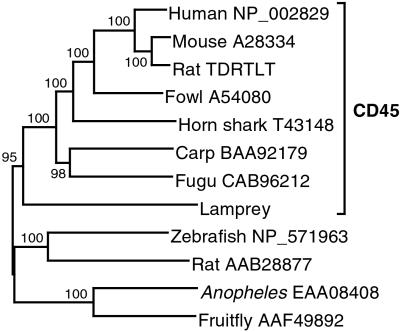
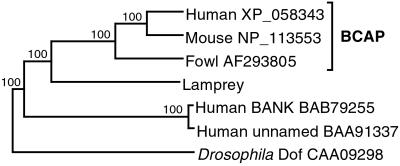
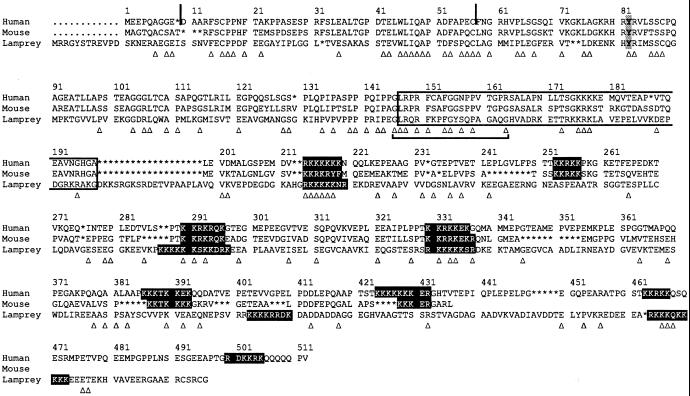
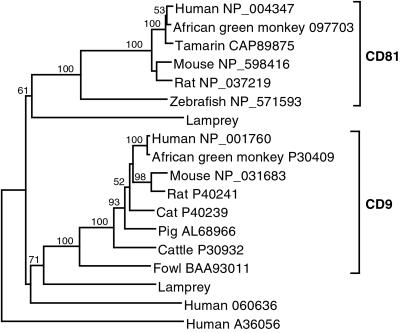
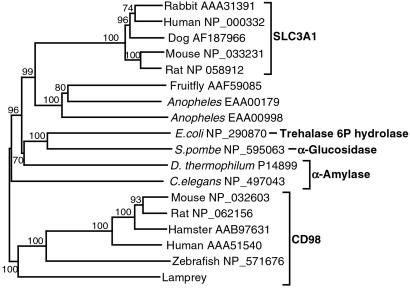
To shed light on the origin of adaptive immunity, a cDNA library was prepared from purified lymphocyte-like cells of a jawless vertebrate, the sea lamprey (Petromyzon marinus). Randomly selected cDNA clones were sequenced, and their homologies to proteins in the databases were determined. Of the sequences homologous to proteins involved in immune responses, five were selected for further characterization. Their encoding genes corresponded to loci that in jawed vertebrates are essential for activities of lymphocytes. These activities include regulation of T and B cell stimulation and proliferation (CD45); stabilization of molecular complexes involved in lymphocyte activation, adhesion, migration, and differentiation (CD9/CD81); adaptor functions in signaling leading to the activation of B lymphocytes (BCAP) and T lymphocytes (CAST); and amino acid transport associated with cell activation (CD98). The presence of these genes in the lamprey genome and their expression in lymphocyte-like cells support the notion that these cells perform many of the functions of gnathostome lymphocytes. It reopens the question of the stage jawless fishes reached in the evolution of their immune system.
Figures
References
-
- Pough F. H., Janis, C. M. & Heiser, J. B., (1998) Vertebrate Life (Prentice–Hall, Upper Saddle River, NJ).
-
- Paxton J. R. & Eschmeyer, W. N., (1994) Encyclopedia of Fishes (Univ. of New South Wales Press, Sydney).
-
- Klein J., Sato, A. & Mayer, W. E. (2000) in Major Histocompatibility Complex: Evolution, Structure, and Function, ed. Kasahara, M. (Springer, Tokyo), pp. 3–26.
-
- Klein J. & Horejsi, V., (1997) Immunology (Blackwell Scientific, Oxford).
-
- Kondo M., Scherer, D. C., King, A. G., Manz, M. G. & Weissman, I. L. (2001) Curr. Opin. Genet. Dev. 11, 520-526. - PubMed
MeSH terms
Substances
Associated data
- Actions
- Actions
- Actions
- Actions
- Actions
- Actions
LinkOut - more resources
Full Text Sources
Other Literature Sources
Molecular Biology Databases
Research Materials
Miscellaneous
