. 2002 Nov;184(22):6130-7.
doi: 10.1128/JB.184.22.6130-6137.2002.

Metabolic flux in both the purine mononucleotide and histidine biosynthetic pathways can influence synthesis of the hydroxymethyl pyrimidine moiety of thiamine in Salmonella enterica

Affiliations

Metabolic flux in both the purine mononucleotide and histidine biosynthetic pathways can influence synthesis of the hydroxymethyl pyrimidine moiety of thiamine in Salmonella enterica

Shara Allen et al. J Bacteriol. 2002 Nov.

Abstract

Together, the biosyntheses of histidine, purines, and thiamine pyrophosphate (TPP) contain examples of convergent, divergent, and regulatory pathway integration. Mutations in two purine biosynthetic genes (purI and purH) affect TPP biosynthesis due to flux through the purine and histidine pathways. The molecular genetic characterization of purI mutants and their respective pseudorevertants resulted in the conclusion that <1% of the wild-type activity of the PurI enzyme was sufficient for thiamine but not for purine synthesis. The respective pseudorevertants were found to be informational suppressors. In addition, it was shown that accumulation of the purine intermediate aminoimidazole carboxamide ribotide inhibits thiamine synthesis, specifically affecting the conversion of aminoimidazole ribotide to hydroxymethyl pyrimidine.


Figures
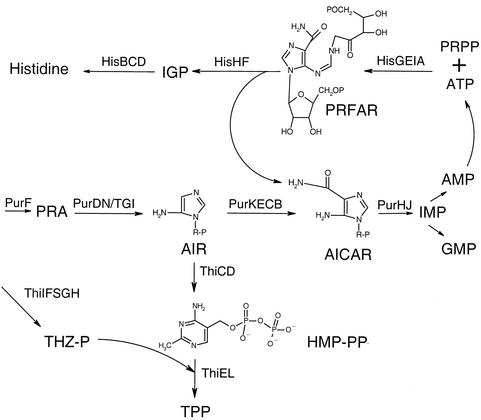
FIG. 1.
FIG. 1.
Model pathways for metabolic integration studies. Schematically shown are the pathways for purine mononucleotide, histidine, and thiamine biosynthesis. The gene products involved are indicated in the relevant part of each pathway. Abbreviations: IGP, imidazoleglycerol phosphate; PRFAR, phosphoribulosyl-formimino-5-aminoimidazole carboxamide ribonucleotide; PRPP, 5′-phosphoribosyl-1-pyrophosphate; GTP, GMP; THZ-P, 4-methyl-5(β-hydroxyethyl)thiazole phosphate; HMP-PP, 4-amino-5-hydroxymethyl-2-methylpyrimidine pyrophosphate.
FIG. 2.
FIG. 2.
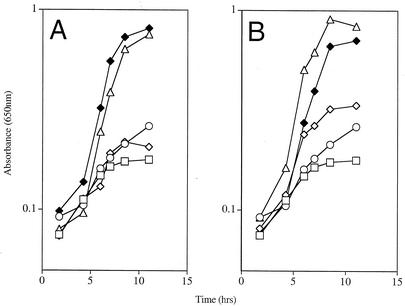
purH mutants require thiamine under broad conditions. (A) The effect of carbon source on the thiamine requirement of DM2 (purH355) and DM1936 (purF2085) in minimal media and adenine is shown. Cultures of DM2 were grown with glucose (□) or gluconate (⋄) as sole carbon source. Also shown is growth when gluconate medium was supplemented with thiamine (♦). Cultures of DM1936 were grown with glucose (○) or gluconate (▵) as sole carbon source. (B) The effect a purE null mutation on the thiamine requirement of a purH355 and a purF2085 mutant in glucose medium is shown. Cultures of DM929 (purF purE mutant) (▵) and DM5976 (purH purE mutant) (⋄) were grown in the absence of thiamine. Growth of DM5976 in the presence of thiamine is shown (♦). Included for comparison are the purH (□) and purF (○) mutants in glucose medium, as in panel A.
FIG. 3.
FIG. 3.
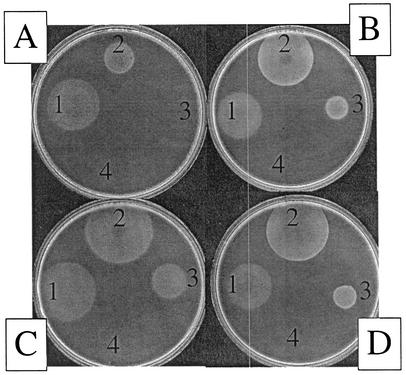
Accumulation of AICAR impairs the conversion of AIR to HMP. The nutritional phenotype of strains DM6123 (purG2324:: MudJ stm4068-1 zxx9126::Tn10d purH355) and DM6124 (purG2324::MudJ stm4068-1 zxx9126::Tn10d) were determined. In each case soft agar containing cells of DM6123 (A to C) or DM6124 (D) was overlaid on a minimal glucose plate with adenine (0.4 mM). In addition to adenine, plate B contained histidine (50 μM) and plate C contained pantothenate (0.7 μM). On top of the overlay, additional supplementation was provided; the numbers 1 to 4 represent the position of thiamine (50 pmol in 0.5 μl) (1), 1 μl of a stock solution of AIRs (SS) (2), 1 μl of 0.1× SS (3), and 1 μl of 0.01× SS (4). A positive growth response is indicated by turbidity after overnight incubation at 37°C. The concentration of AIRs was estimated to be ∼300 mM using both bioassay (39) and the Bratton and Marshall method of quantification (9).

References

    1. Altschul, S. F., W. Gish, W. Miller, E. W. Meyers, and D. J. Lipman. 1990. Basic local alignment search tool. J. Mol. Biol. 215:403-410. - PubMed
    1. Ausubel, F. M., R. Brent, R. E. Kingston, D. D. Moore, J. G. Seidman, J. A. Smith, and K. Struhl. 1994. Current protocols in molecular biology. John Wiley & Sons, New York, N.Y.
    1. Barik, S. 1995. Site-directed mutagenesis by double polymerase chain reaction. Mol. Biotechnol. 3:1-7. - PubMed
    1. Beck, B., L. Connolly, A. De Las Peñas, and D. Downs. 1997. Evidence that rseC, a gene in the rpoE cluster, has a role in thiamine synthesis in Salmonella typhimurium. J. Bacteriol. 179:6504-6508. - PMC - PubMed
    1. Beck, B. J., and D. M. Downs. 1998. The apbE gene encodes a lipoprotein involved in thiamine synthesis in Salmonella typhimurium. J. Bacteriol. 180:885-891. - PMC - PubMed

Publication types

MeSH terms

LinkOut - more resources