


Genome analysis and strain comparison of correia repeats and correia repeat-enclosed elements in pathogenic Neisseria
- PMID: 12399486
- PMCID: PMC151967
- DOI: 10.1128/JB.184.22.6163-6173.2002
Genome analysis and strain comparison of correia repeats and correia repeat-enclosed elements in pathogenic Neisseria
Abstract
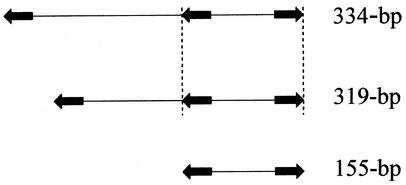
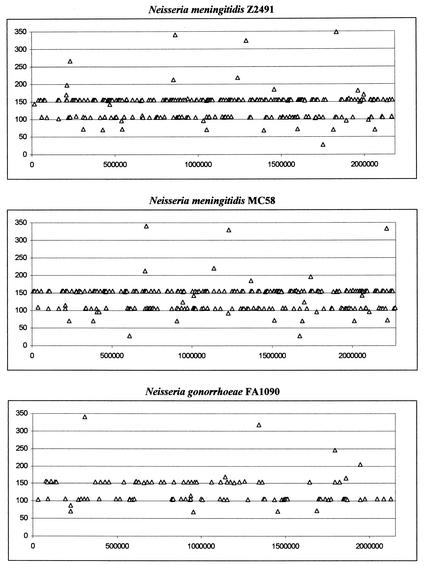
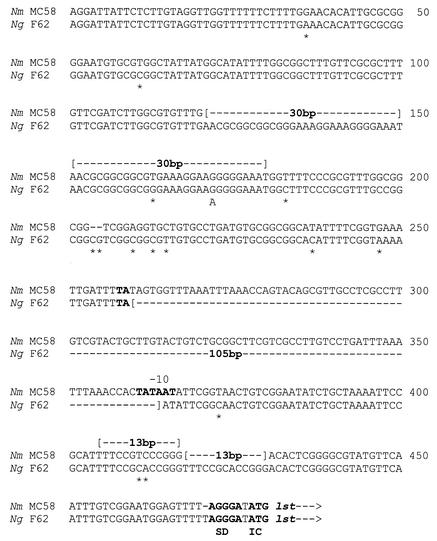
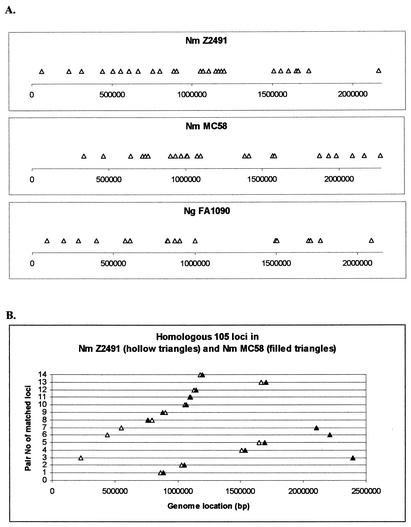
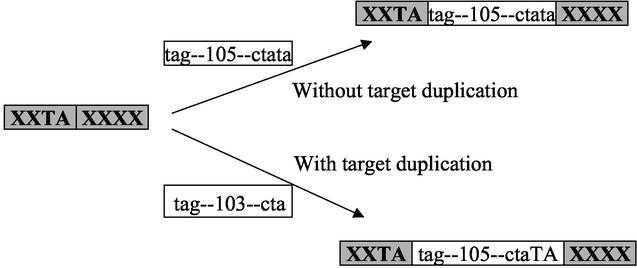
Whole genome sequences of Neisseria meningitidis strains Z2491 and MC58 and Neisseria gonorrhoeae FA1090 were analyzed for Correia repeats (CR) and CR-enclosed elements (CREE). A total of 533, 516, and 256 copies of CR and 270, 261, and 102 copies of CREE were found in these three genomes, respectively. The lengths of CREE range from 28 to 348 bp, and the lengths of multicopy CREE appear mainly in the ranges of 154 to 156 bp and 105 to 107 bp. The distribution of CREE lengths is similar between the two N. meningitidis genomes, with a greater number of 154- to 156-bp CREE (163 and 152 copies in N. meningitidis strain Z2491 and N. meningitidis strain MC58, respectively) than 105- to 107-bp CREE (72 and 77 copies). In the N. gonorrhoeae strain FA1090 genome there are relatively more 105- to 107-bp CREE (51 copies) than 154- to 156-bp CREE (36 copies). The genomic distribution of 107-bp CREE also shows similarity between the two N. meningitidis strains (15 copies share the same loci) and differences between N. meningitidis strains and N. gonorrhoeae FA1090 (only one copy is located in the same locus). Detailed sequence analysis showed that both the terminal inverted repeats and the core regions of CREE are composed of distinct basic sequence blocks. Direct TA dinucleotide repeats exist at the termini of all CREE. A survey of DNA sequence upstream of the sialyltransferase gene, lst, in several Neisseria isolates showed that 5 N. meningitidis strains contain a 107-bp CREE in this region but 25 N. gonorrhoeae strains show an exact absence of a 105-bp sequence block (i.e., the 107-bp CREE without a 5' TA dinucleotide) in the same region. Whole-genome sequence analysis confirmed that this 105-bp indel exists in many homologous 107-bp CREE loci. Thus, we postulate that all CREE are made of target TA with indels of various lengths. Analysis of 107-bp CREE revealed that they exist predominantly in intergenic regions and are often near virulence, metabolic, and transporter genes. The abundance of CREE in Neisseria genomes suggests that they may have played a role in genome organization, function, and evolution. Their differential distribution in different pathogenic Neisseria strains may contribute to the distinct behaviors of each Neisseria species.
Figures

References
Publication types
MeSH terms
Substances
Grants and funding
LinkOut - more resources
Full Text Sources
Molecular Biology Databases
