


Comparison of the expression of p53, p21, Bax and the induction of apoptosis between patients with basal cell carcinoma and normal controls in response to ultraviolet irradiation
- PMID: 12401820
- PMCID: PMC1769808
- DOI: 10.1136/jcp.55.11.829
Comparison of the expression of p53, p21, Bax and the induction of apoptosis between patients with basal cell carcinoma and normal controls in response to ultraviolet irradiation
Abstract
Aim: Ultraviolet light (UV) is known to cause DNA damage in the epidermis. The damaged DNA is repaired or deleted by apoptosis to prevent the generation of cancer. It has been suggested that a deficient apoptotic mechanism may predispose individuals to skin cancer. Therefore, the response of normal controls and patients with basal cell carcinoma (BCC) to UV irradiation was investigated.
Methods: The buttock skin from normal volunteers and patients with BCC was irradiated using solar simulated radiation (SSR). SSR mimics the effect of natural sunlight. Skin biopsies were excised and examined for p53, p21, and Bax protein expression and for the induction of apoptosis.
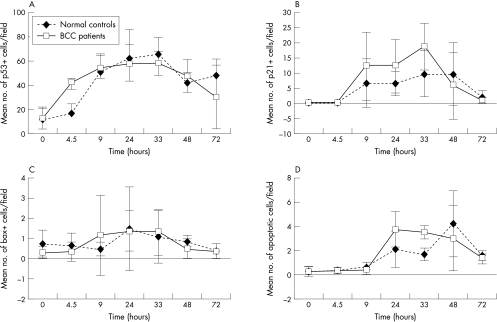
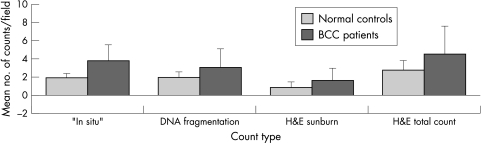
Results: At 33 hours after UV irradiation, the induction of apoptosis was significantly higher (p = 0.04) in patients with BCC than in normal volunteers (Mann Whitney test). A trend towards higher p21 expression was found at 33 hours in patients with BCC (mean, 18.69 positive cells/field) than in normal volunteers (mean, 9.89), although this difference was not significant (p = 0.05 positive cells/field).
Conclusion: These results may imply that patients with BCC have enhanced sensitivity to UV irradiation or that there is some defect in the cell arrest or repair pathways, which results in damaged cells been pushed into apoptosis rather than repair.
Figures
References
-
- Matsunaga T, Hieda K, Nikaido O. Wavelength dependent formation of thymine dimers and (6–4) photoproducts DNA by monochromatic ultraviolet light ranging from 150–365 nm. Photochem Photobiol 1991;54:403–10. - PubMed
-
- Yarosh DB. The role of DNA damage and UV induced cytokines in skin cancer. J Photochem Photobiol B 1992;16:91–4. - PubMed
-
- Young AR, Chadwick CA, Harrison GI, et al. The similarity of action spectra for thymine dimers in human epidermis and erythema suggests that DNA is the chromophore for erythema. J Invest Dermatol 1998;111:982–8. - PubMed
-
- Mukhtar H, Forbes MH, Ananthaswamy HN. Photocarcinogenesis models and mechanisms. Photodermatol Photoimmunol Photomed 1999;15:91–5. - PubMed
Publication types
MeSH terms
Substances
LinkOut - more resources
Full Text Sources
Medical
Research Materials
Miscellaneous
