. 2002 Nov-Dec;4(6):523-30.
doi: 10.1038/sj.neo.7900266.

MRI of transgene expression: correlation to therapeutic gene expression

Affiliations

MRI of transgene expression: correlation to therapeutic gene expression

Tomotsugu Ichikawa et al. Neoplasia. 2002 Nov-Dec.

Abstract

Magnetic resonance imaging (MRI) can provide high-resolution 3D maps of structural and functional information, yet its use of mapping in vivo gene expression has only recently been explored. A potential application for this technology is to noninvasively image transgene expression. The current study explores the latter using a nonregulatable internalizing engineered transferrin receptor (ETR) whose expression can be probed for with a superparamagnetic Tf-CLIO probe. Using an HSV-based amplicon vector system for transgene delivery, we demonstrate that: 1) ETR is a sensitive MR marker gene; 2) several transgenes can be efficiently expressed from a single amplicon; 3) expression of each transgene results in functional gene product; and 4) ETR gene expression correlates with expression of therapeutic genes when the latter are contained within the same amplicon. These data, taken together, suggest that MRI of ETR expression can serve as a surrogate for measuring therapeutic transgene expression.


Figures
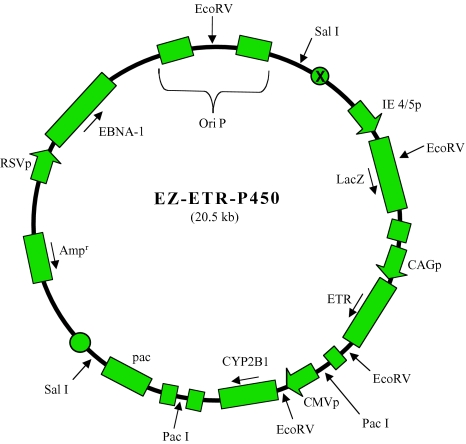
Figure 1
Figure 1
Schematic of EZ-ETR-P450 amplicon. Three transgene cDNA are contained within the amplicon: 1) the LacZ cDNA under control of an IE 4/5 promoter; 2) the ETR cDNA under control of the CAG promoter; and 3) the cDNA for rat cytochrome c P450 2B1 (CYP) under control of the CMV promoter. Sequences for EBNA-1, to allow for episomal maintenance in mammalian cells, and the pac signal, to allow for packaging into empty HSV virion capsids, are also included (see Materials and Methods).
Figure 2
Figure 2
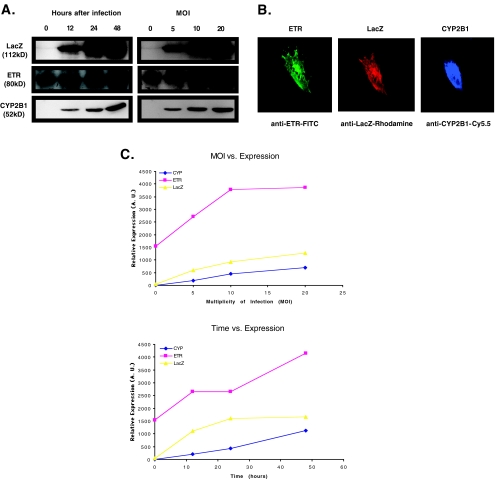
(A) Correlation of transgene expression in cells infected with EZ-ETR-P450 amplicon. Gli36∂EGFR cells were infected with amplicon containing three transgenes. At the indicated times or MOI, cells were harvested and lysates subjected to analysis by Western blot to confirm expression of transgenes. Blots were treated and signal-analyzed using NIH image as described in Materials and Methods. These data are plotted in (C). When protein expression was assessed at varying times after infection, a single MOI of 1 was used (representative data, n=3). (B) Expression of three cDNA after infection with EZ-ETR-P450 amplicon in each cell. Cells were fixed and analyzed using three different antibodies specific for each protein product. Complexes were then visualized using a second antibody conjugated to one of three different fluorochromes, each emitting at different wavelengths. All three gene products were expressed in all cells observed. Presented is a representative cell from an experiment (n=3). (C) Graphical analysis of Western blot from (A). The ECL signal from (A) was captured on to photographic film, scanned into the computer, and the resulting electronic figure analyzed using NIH Image.
Figure 3
Figure 3
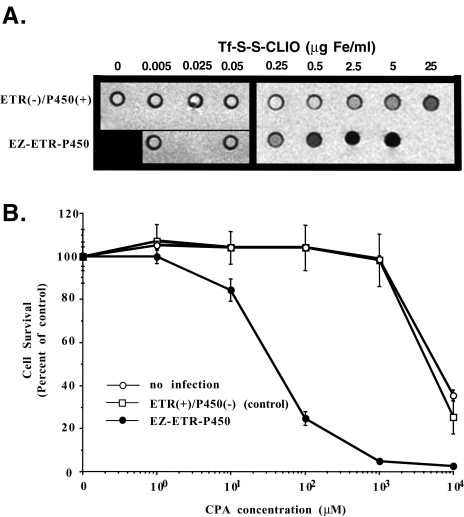
(A) Detection of increased cellular uptake of Tf iron oxide particles by cells infected with EZ-ETR-P450 amplicon. Twenty-four hours after infection, the cells were incubated for 1 hour with increasing concentrations of Tf-S-S-CLIO contrast agent, washed, pelleted into tissue culture tubes, and imaged in a clinical GE 1.5-T MRI. T2-weighted MRI of wells containing cell pellets treated with Tf-S-S-CLIO in culture shows that EZ-ETR-P450-infected cells show a significant signal decrease at 0.5 µg/ml iron compared to cells infected with the ETR-negative control vector, ETR(-)/P450(+). To conserve probe and other reagents, selective informative data points were measured for the EZ-ETR-P450-infected cells. The black square in the lower left corner is a place holder (n=2, representative experiment shown). (B) Infection of Gli36∂EGFR cells with EZ-ETR-P450 confers prodrug sensitivity. Gli36∂EGFR cells were infected with EZETR-P450 or control amplicon [ETR(+)/P450(-)] in tissue culture and cell survival 72 hours after CPA treatment was quantified by cell counting. EZ-ETRP450-infected cells have significantly increased drug sensitivity compared to uninfected and control infected cells (n=3).

References

    1. Rainov NG, Sena-Esteves M, Fraefel C, Dobberstein KU, Chiocca EA, Breakefield XO. A chimeric fusion protein of cytochrome CYP4B1 and green fluorescent protein for detection of pro-drug activating gene delivery and for gene therapy in malignant glioma. Adv Exp Med Biol. 1998;451:393–403. - PubMed
    1. Runnebaum IB. Basics of cancer gene therapy. Anticancer Res. 1997;17:2887–2890. - PubMed
    1. Zwacka RM, Dunlop MG. Gene therapy for colon cancer. Hematol Oncol Clin North Am. 1998;12:595–615. - PubMed
    1. Ikeda K, Ichikawa T, Wakimoto H, Silver J, Deisboeck T, Finkelstein D, Harsh GI, Louis D, Bartus R, Hochberg F, Chiocca E. Oncolytic virus therapy of multiple tumors in the brain requires suppression of innate and elicited antiviral responses. Nat Med. 1999;5:881–887. - PubMed
    1. Carter BS, Zervas NT, Chiocca EA. Neurogenetic surgery: current limitations and the promise of gene- and virus-based therapies. Clin Neurosurg. 1999;45:226–246. (in process citation) - PubMed

Publication types

MeSH terms