


doi: 10.1128/JCM.40.11.4289-4294.2002.
Dissemination of new methicillin-resistant Staphylococcus aureus clones in the community
Affiliations
- PMID: 12409412
- PMCID: PMC139674
- DOI: 10.1128/JCM.40.11.4289-4294.2002
Item in Clipboard
Dissemination of new methicillin-resistant Staphylococcus aureus clones in the community
J Clin Microbiol.
2002 Nov.
Abstract
Multiple methicillin-resistant Staphylococcus aureus (MRSA) clones carrying type IV staphylococcal cassette chromosome mec were identified in the community-acquired MRSA strains of both the United States and Australia. They multiplied much faster than health-care-associated MRSA and were resistant to fewer non-beta-lactam antibiotics. They seem to have been derived from more diverse S. aureus populations than health-care-associated MRSA strains.
Figures
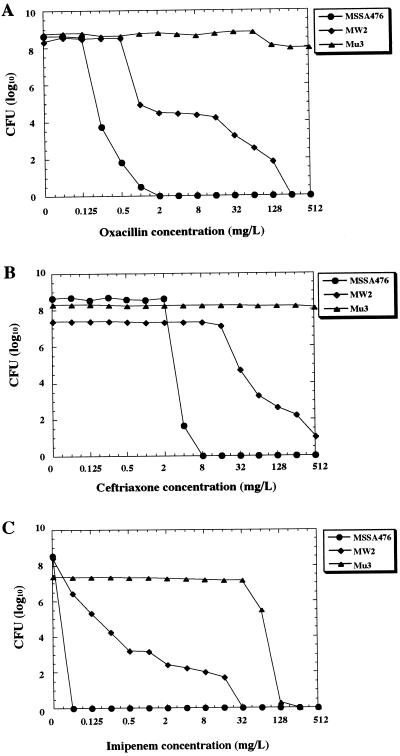
C-MRSA strain shows heterogeneous phenotypic expression of methicillin resistance. Analysis of resistant subpopulations of the C-MRSA strain MW2, the related MSSA strain 476, and strain Mu3, with heterogeneous resistance to vancomycin, was performed with oxacillin (A), ceftriaxone (B), and imipenem (C) as described previously (13). Ceftriaxone was the antibiotic used in vain to treat the patient infected with MW2 (3). MW2 is an American Midwest MRSA strain representing the major C-MRSA (see the text). Strain 476 is an MSSA strain sharing its MLST allotype with MW2 (see Table 1). Mu3 is a representative H-MRSA strain with heterogeneous resistance to vancomycin (13). It is noted that MW2 contains subpopulations resistant to each of the three beta-lactam antibiotics.

Illustrative representation of various types of SCCmec. SCCmec type is defined by the combination of the type of ccr gene complex and the class of mec gene complex. Type I SCCmec is defined by the combination of type 1 ccr and class B mec (IS1272-ΔmecR1-mecA); type II is defined by type 2 ccr and class A mec (mecI-mecR1-mecA); type III is defined by type 3 ccr and class A mec; and type IV is defined by type 2 ccr and class B mec. Type IV SCCmec is further classified into subtypes (type IVa and type IVb) based on the sequence difference in the J1 region of SCCmec (J stands for “junkyard”). Positions of primers used in this study to identify and type SCCmec are shown (see Table 2 for the nucleotide sequence of each primer). The allelic class of mec gene complex is determined by PCR detection of the presence or absence of IS1272, mecI, and mecR1 in two domains (PB, penicillin-binding domain; and MS, membrane-spanning domain), mecA, and IS431mec. PCR amplification was performed using 2.5 U of Ex Taq (Takara Shuzo Co., Ltd., Kyoto, Japan) in 50 μl of reaction mixture. Thermal cycling was set at 30 cycles (30 s for denaturation at 94°C, 1 min for annealing at 50°C, and 2 min for elongation at 72°C) using the Gene Amp PCR system 9600 (Perkin-Elmer, Wellesley, Mass.). For the detection of mecA-IS431mec, a long-range PCR method was used, set at 10 cycles (15 s for denaturation at 94°C, 30 s for annealing at 50°C, and 8 min for elongation at 68°C) followed by 20 cycles (15 s for denaturation at 94°C, 30 s for annealing at 50°C, and 12 min for elongation at 68°C). Note that this study identified a new type of SCCmec for three C-MRSA strains that carried the class C2 mec gene complex (21). The sequencing of the entire SCCmec is now ongoing.
References
-
- Alghaithy, A. A., N. E. Bilal, M. Gedebou, and A. H. Weily. 2000. Nasal carriage and antibiotic resistance of Staphylococcus aureus isolates from hospital and non-hospital personnel in Abha, Saudi Arabia. Trans. R. Soc. Trop. Med. Hyg. 94:504-507. - PubMed
-
- Baba, T., F. Takeuchi, M. Kuroda, H. Yuzawa, K. Aoki, A. Oguchi, Y. Nagai, N. Iwama, K. Asano, T. Naimi, H. Kuroda, L. Cui, K. Yamamoto, and K. Hiramatsu. 2002. Genome and virulence determinants of high virulence community-acquired MRSA. Lancet 359:1819-1827. - PubMed
-
- Centers for Disease Control and Prevention. 1999. Four pediatric deaths from community-acquired methicillin-resistant Staphylococcus aureus—Minnesota and North Dakota, 1997-1999. Morb. Mortal. Wkly. Rep. 48:707-710. - PubMed
-
- Centers for Disease Control and Prevention. 2001. Methicillin-resistant Staphylococcus aureus skin or soft tissue infections in a state prison—Mississippi, 2000. Morb. Mortal. Wkly. Rep. 50:919-922. - PubMed
Publication types
MeSH terms
Substances
LinkOut - more resources
Full Text Sources
Other Literature Sources
Medical
