Incidence of fires and related injuries after giving out free smoke alarms: cluster randomised controlled trial
- PMID: 12411355
- PMCID: PMC131023
- DOI: 10.1136/bmj.325.7371.995
Incidence of fires and related injuries after giving out free smoke alarms: cluster randomised controlled trial
Abstract
Objective: To measure the effect of giving out free smoke alarms on rates of fires and rates of fire related injury in a deprived multiethnic urban population.
Design: Cluster randomised controlled trial.
Setting: Forty electoral wards in two boroughs of inner London, United Kingdom.
Participants: Primarily households including elderly people or children and households that are in housing rented from the borough council.
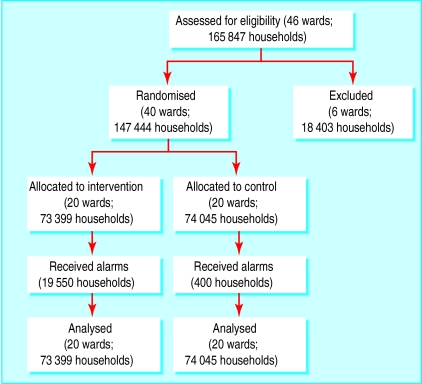
Intervention: 20 050 smoke alarms, fittings, and educational brochures distributed free and installed on request.
Main outcome measures: Rates of fires and related injuries during two years after the distribution; alarm ownership, installation, and function.
Results: Giving out free smoke alarms did not reduce injuries related to fire (rate ratio 1.3; 95% confidence interval 0.9 to 1.9), admissions to hospital and deaths (1.3; 0.7 to 2.3), or fires attended by the fire brigade (1.1; 0.96 to 1.3). Similar proportions of intervention and control households had installed alarms (36/119 (30%) v 35/109 (32%); odds ratio 0.9; 95% confidence interval 0.5 to 1.7) and working alarms (19/118 (16%) v 18/108 (17%); 0.9; 0.4 to 1.8).
Conclusions: Giving out free smoke alarms in a deprived, multiethnic, urban community did not reduce injuries related to fire, mostly because few alarms had been installed or were maintained.
Figures
Comment in
-
Smoke detectors and house fires.BMJ. 2002 Nov 2;325(7371):979-80. doi: 10.1136/bmj.325.7371.979. BMJ. 2002. PMID: 12411330 Free PMC article. No abstract available.
-
Free smoke alarms: a fire officer responds.BMJ. 2003 Jan 18;326(7381):165. doi: 10.1136/bmj.326.7381.165/c. BMJ. 2003. PMID: 12531861 Free PMC article. No abstract available.
-
Providing free smoke alarms did not reduce fire related injuries in a deprived multiethnic urban population.Evid Based Nurs. 2003 Oct;6(4):105. doi: 10.1136/ebn.6.4.105. Evid Based Nurs. 2003. PMID: 14577387 No abstract available.
References
-
- Watson L, Gamble J, Schofield R. Fire statistics: United Kingdom 1999. London: Government Statistical Service, November; 2000. . (Home Office Statistical Bulletin Issue 20/00.)
-
- Runyan CW, Bangdiwala SI, Linzer MA, Sacks JJ, Butts J. Risk factors for fatal residential fires. N Engl J Med. 1992;327:859–863. - PubMed
-
- Mallonee S, Istre GR, Rosenberg M, Reddish-Douglas M, Jordan F, Silverstein P, et al. Surveillance and prevention of residential-fire injuries. N Engl J Med. 1996;335:27–31. - PubMed
Publication types
MeSH terms
Substances
LinkOut - more resources
Full Text Sources
Medical