. 2002 Dec;76(23):12200-10.
doi: 10.1128/jvi.76.23.12200-12210.2002.

Characterization of the Golgi retention motif of Rift Valley fever virus G(N) glycoprotein

Affiliations

Characterization of the Golgi retention motif of Rift Valley fever virus G(N) glycoprotein

Sonja R Gerrard et al. J Virol. 2002 Dec.

Abstract

As Rift Valley fever (RVF) virus, and probably all members of the family Bunyaviridae, matures in the Golgi apparatus, the targeting of the virus glycoproteins to the Golgi apparatus plays a pivotal role in the virus replication cycle. No consensus Golgi localization motif appears to be shared among the glycoproteins of these viruses. The viruses of the family Bunyaviridae synthesize their glycoproteins, G(N) and G(C), as a polyprotein. The Golgi localization signal of RVF virus has been shown to reside within the G(N) protein by use of a plasmid-based transient expression system to synthesize individual G(N) and G(C) proteins. While the distribution of individually expressed G(N) significantly overlaps with cellular Golgi proteins such as beta-COP and GS-28, G(C) expressed in the absence of G(N) localizes to the endoplasmic reticulum. Further analysis of expressed G(N) truncated proteins and green fluorescent protein/G(N) chimeric proteins demonstrated that the RVF virus Golgi localization signal mapped to a 48-amino-acid region of G(N) encompassing the 20-amino-acid transmembrane domain and the adjacent 28 amino acids of the cytosolic tail.


Figures
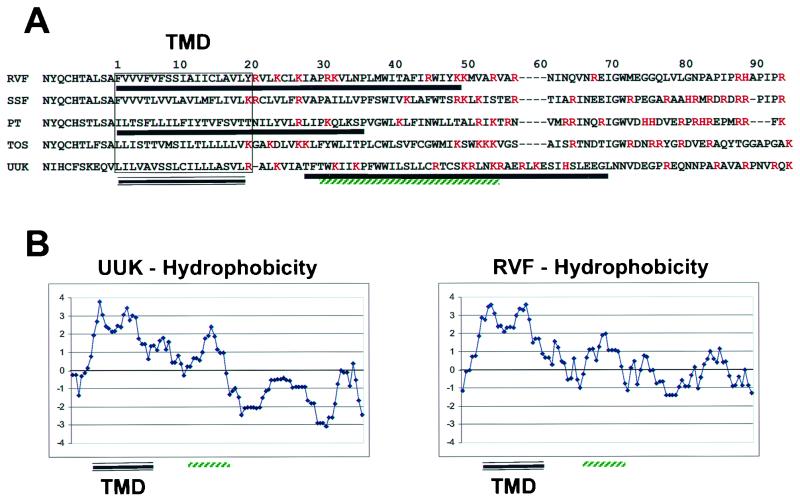
FIG. 1.
FIG. 1.
(A) ClustalW alignment of the carboxy-terminal region of the GN of viruses belonging to the genus Phlebovirus. The alignment begins 10 amino acids upstream of the transmembrane domain and concludes just prior to the signal sequence for GC. Abbreviations: SSF, Sicilian sandfly fever virus; PT, Punta Toro virus; TOS, Toscana virus; UUK, Uukuniemi virus. The transmembrane domain (TMD) is boxed and underlined, and the regions involved in Golgi localization of GN for RVF, PT and UUK are underlined with a single solid black line. The hydrophobic region of the UUK GN found sufficient for localization of a cytoplasmic protein chimera to the Golgi is underlined in green. Basic amino acids are in red. (B) Kyte-Doolittle hydrophobicity plots of the carboxy-terminal region of the GN for UUK and RVF. Positive scores indicate hydrophobic amino acid content, while negative numbers correspond to hydrophilic amino acid content. The TMD and second hydrophobic peak are indicated as in panel A.
FIG. 2.
FIG. 2.
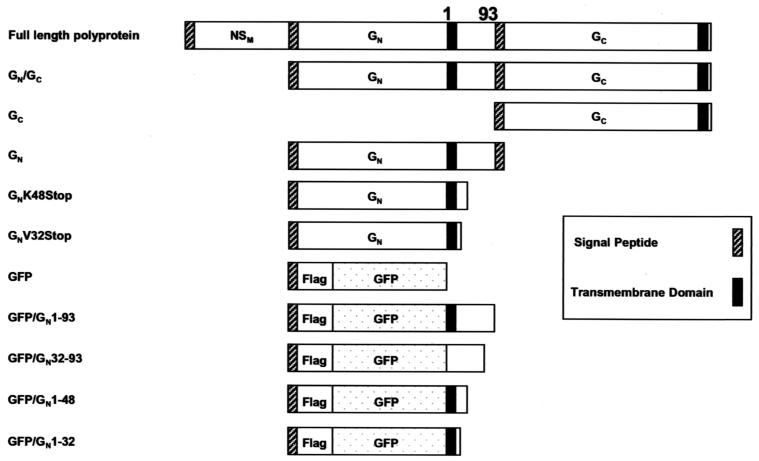
Names and diagrams of glycoprotein and chimeric expression constructs used in this study. The numbering of the amino acids in the carboxy-terminal tail of RVF virus GN is identical to that shown in Fig. 1.
FIG. 3.
FIG. 3.
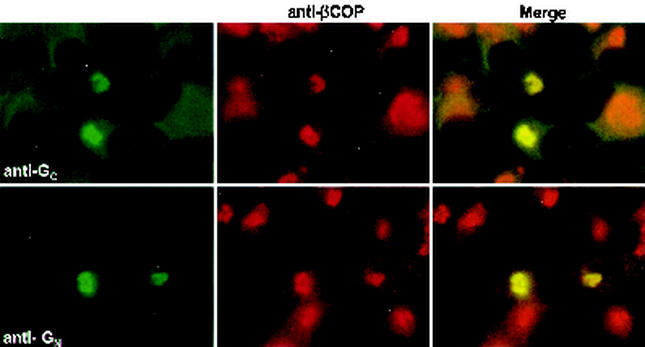
GC and GN localize to Golgi membranes. BHK-T7 cells expressing GN/GC were fixed and permeabilized as described in Materials and Methods. Cells were then incubated with rabbit anti-βCOP (red channel) and either mouse anti-GC or mouse anti-GN (green channel).
FIG. 4.
FIG. 4.
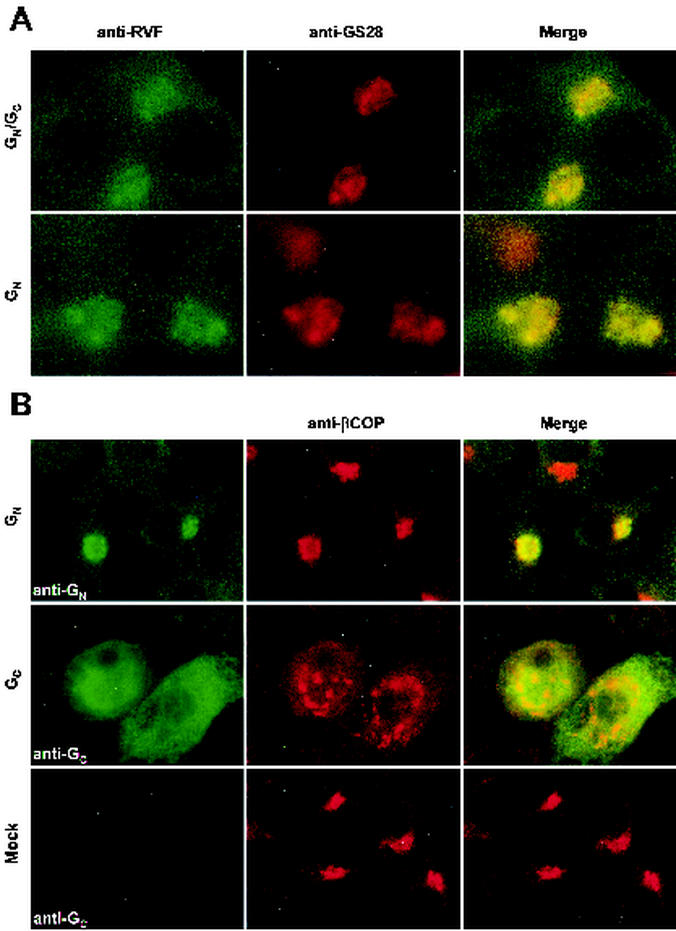
GN localizes to Golgi membranes in the absence of GC. (A) BHK-T7 cells expressing GN/GC or GN were fixed and permeabilized as described in Materials and Methods. Cells were then incubated with mouse anti-GS-28 (red channel) and human anti-RVF virus (green channel). (B) BHK-T7 cells transfected with GN, GC, or empty vector. Cells transfected with GC also received a plasmid that expresses additional T7 polymerase. Cells were incubated with rabbit anti-βCOP (red channel) and either mouse anti-GN or mouse anti-GC (green channel).
FIG. 5.
FIG. 5.
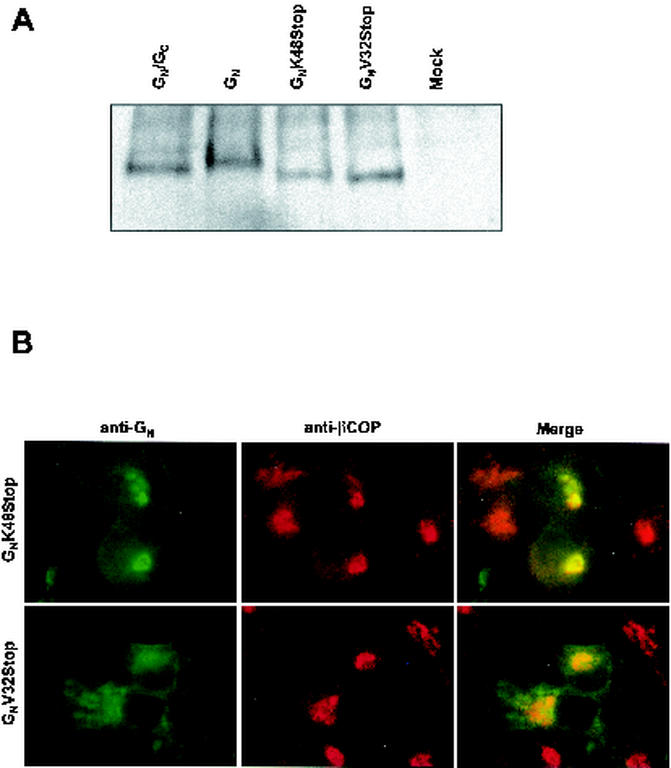
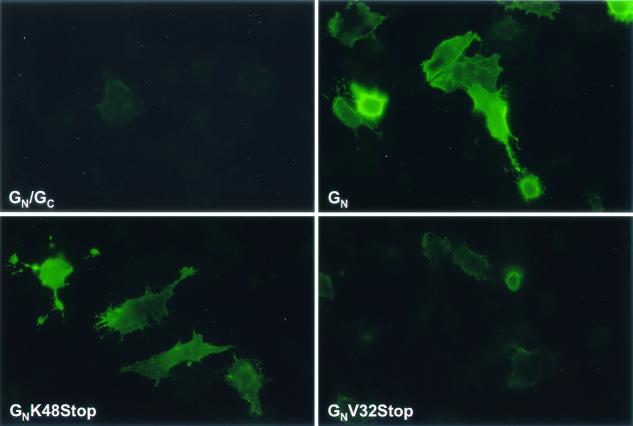
The basic carboxy terminus of GN is dispensable for Golgi localization. (A) Western blot comparing the relative sizes and expression levels of the various GN proteins. (B) Immunofluorescence staining pattern of GNK48Stop and GNV32Stop. Cells were incubated with mouse anti-GN (green channel) and rabbit anti-βCOP (red channel).
FIG. 6.
FIG. 6.
GN expression on the plasma membrane is increased when GN is expressed in the absence of GC. Cells were surface labeled with mouse anti-GN as described in Materials and Methods.
FIG. 7.
FIG. 7.
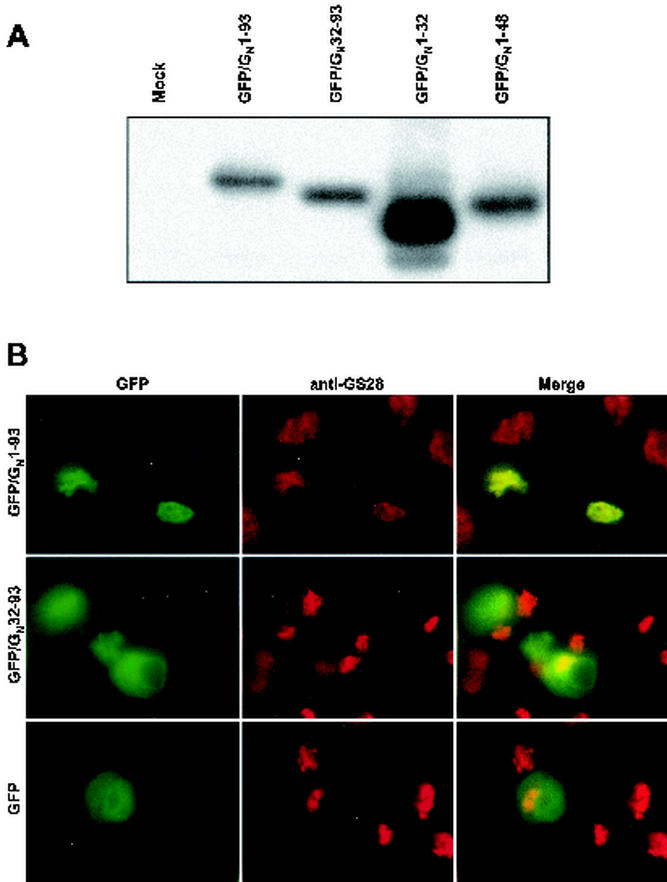
The transmembrane domain and cytosolic tail region of GN is sufficient to localize a GFP/GN chimera to the Golgi. (A) Western blot comparing the relative sizes and expression levels of the various GFP/GN proteins. (B) Fluorescence staining pattern of GFP/GN1-93 and GFP/GN32-93. Cells were fixed and permeabilized as described in Materials and Methods and were incubated with mouse anti-GS-28 (red channel).
FIG. 8.
FIG. 8.
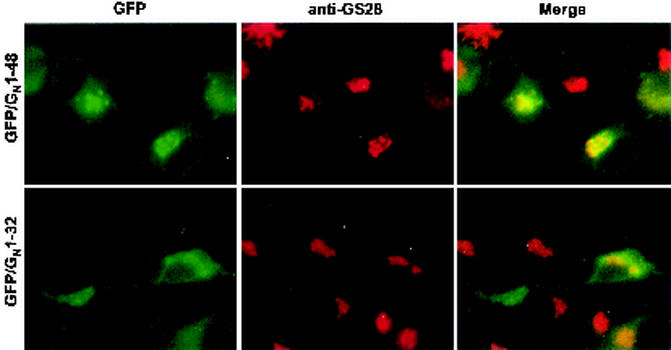
The transmembrane domain (20 amino acids) plus 28 amino acids of the cytosolic tail of GN is sufficient to localize a GFP/GN chimera to the Golgi. Cells were fixed and permeabilized as described in Materials and Methods and were incubated with mouse anti-GS-28 (red channel).
FIG. 9.
FIG. 9.
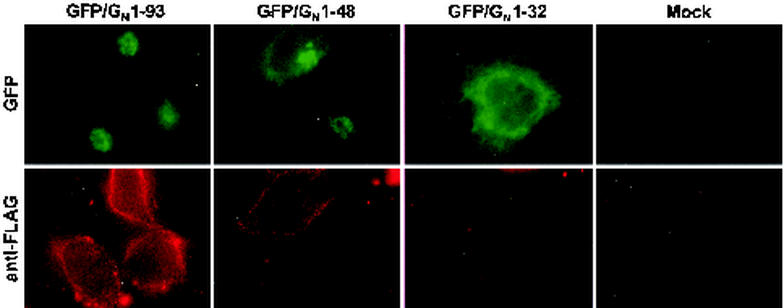
The GFP/GN chimeras behave similarly to the GN mutants with respect to Golgi localization and cell surface expression. Cells were surface labeled with mouse anti-FLAG (red channel) as described in Materials and Methods.

References

    1. Andersson, A. M., L. Melin, A. Bean, and R. F. Pettersson. 1997. A retention signal necessary and sufficient for Golgi localization maps to the cytoplasmic tail of a Bunyaviridae (Uukuniemi virus) membrane glycoprotein. J. Virol. 71:4717-4727. - PMC - PubMed
    1. Andersson, A. M., and R. F. Pettersson. 1998. Targeting of a short peptide derived from the cytoplasmic tail of the G1 membrane glycoprotein of Uukuniemi virus (Bunyaviridae) to the Golgi complex. J. Virol. 72:9585-9596. - PMC - PubMed
    1. Centers for Disease Control and Prevention. 1994. Rift Valley fever—Egypt, 1993. Morb. Mortal. Wkly. Rep. 43:693, 699-700. - PubMed
    1. Centers for Disease Control and Prevention. 2000. Outbreak of Rift Valley fever—Saudi Arabia, August-October 2000. Morb. Mortal. Wkly. Rep. 49:905-908. - PubMed
    1. Centers for Disease Control and Prevention. 2000. Outbreak of Rift Valley fever-Yemen, August-October 2000. Morb. Mortal. Wkly. Rep. 49:1065-1066. - PubMed

MeSH terms

LinkOut - more resources