. 2002 Dec;76(23):12381-7.
doi: 10.1128/jvi.76.23.12381-12387.2002.

RNA structure and packaging signals in the 5' leader region of the human immunodeficiency virus type 1 genome

Affiliations

RNA structure and packaging signals in the 5' leader region of the human immunodeficiency virus type 1 genome

Jared L Clever et al. J Virol. 2002 Dec.

Abstract

The leader region of the human immunodeficiency virus type 1 (HIV-1) genome has a highly folded structure, comprising at least two RNA stem-loops [the transactivation response (TAR) and poly(A) hairpins] near its 5' end and four others (SL1 to SL4) downstream. Each of these stem-loops contributes to the function of the HIV-1 packaging signal, which efficiently targets genomic RNA into nascent virions. The central 140-base region of the leader, which includes the U5 and primer binding site (PBS) sequences, is also believed to adopt a complex structure, but the nature of this structure and its possible role in RNA packaging have not been extensively explored. Here we report a mutational analysis identifying at least three separate loci within the U5-PBS region which, when mutated, impair both HIV-1 packaging specificity and infectivity in a single-round proviral assay. In common with those of all previously described packaging signals in the leader, the function of one of these loci appeared to depend on secondary structure rather than on sequence alone. By contrast, the activity of the other two loci did not correlate with any predicted conformations. Moreover, unlike SL1 to SL4, the TAR, poly(A), and U5-PBS hairpins were not bound with high affinity by the nucleocapsid portion of the HIV-1 Gag protein in vitro, implying that they contribute to packaging through a mechanism distinct from that of SL1 to SL4. Our findings confirm the existence and importance of secondary structure around the PBS and demonstrate that functional packaging signals are distributed across the entire HIV-1 leader.


Figures
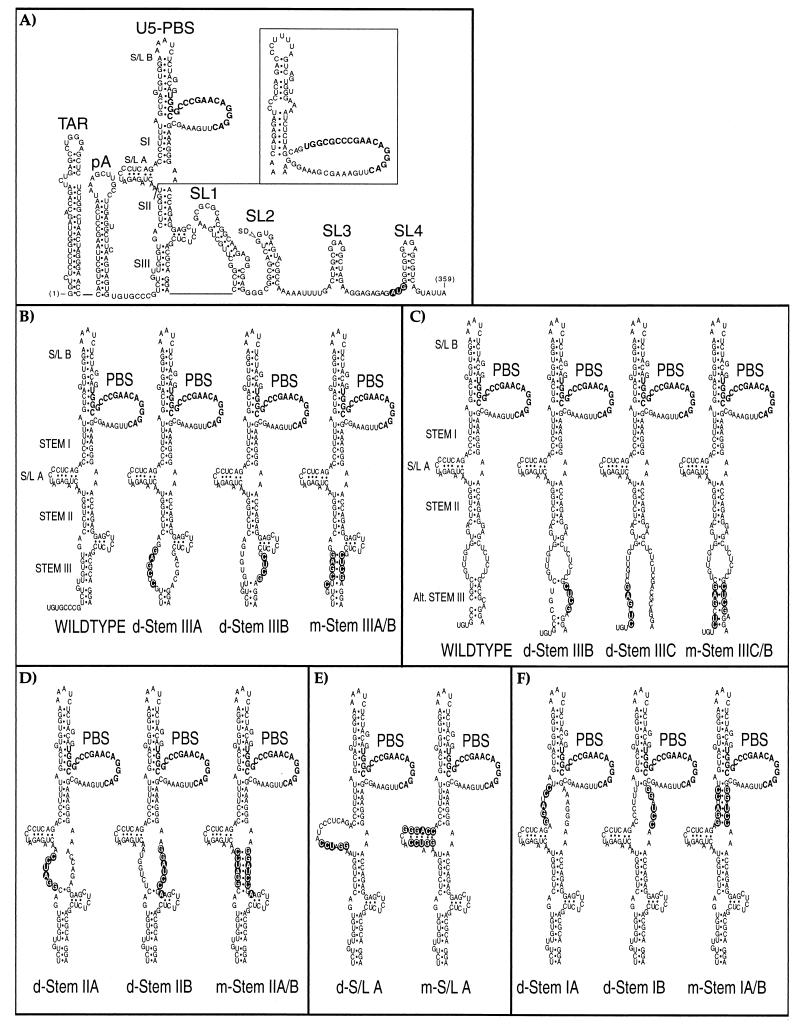
FIG.1.
FIG.1.
Mutant HIV-1 RNAs characterized in this study. (A) The 5′ leader region of wild-type HIV-1 RNA from strain HXB2, with the gag initiation codon shown with open lettering and the major 5′ splice donor (SD) indicated. The conformations shown for the TAR, poly(A) (pA), and SL1 to SL4 stem-loops were extensively validated by earlier genetic, functional, and structural data. The U5-PBS region, which is the focus of this study, is shown in two proposed conformations that are compatible with the results of published accessibility mapping studies (2, 15). The three major postulated stems (SI, SII, and SIII) are identified as described previously (2); two associated stem-loop elements are designated S/L A and S/L B in this study, and the 18 nucleotides (nt) of the PBS are shown in boldface type. An alternative conformation (15) for the distal sequences is shown as an insert. (B to F) The sequences and putative structural consequences of the 13 mutations tested in this study. Mutations predicted to disrupt base pairing are designated with the prefix “d-” whereas compensatory mutations designed to preserve potential base pairing have “m-” as the prefix. In most cases, compensatory mutations were constructed by combining a pair of disruptive mutations. The mutations shown in panels B and C were designed to test two alternative conformations of stem III. BspEI was used to linearize the plasmid DNA before the riboprobes used in the RNase protection assays were synthesized. An additional nucleotide outside stem II was altered in d-Stem IIB and m-Stem IIA/B to avoid creating a second BspEI restriction enzyme site; for the same reason, one nucleotide outside the stem of S/L A was altered in the m-S/L A mutant.
FIG. 2.
FIG. 2.
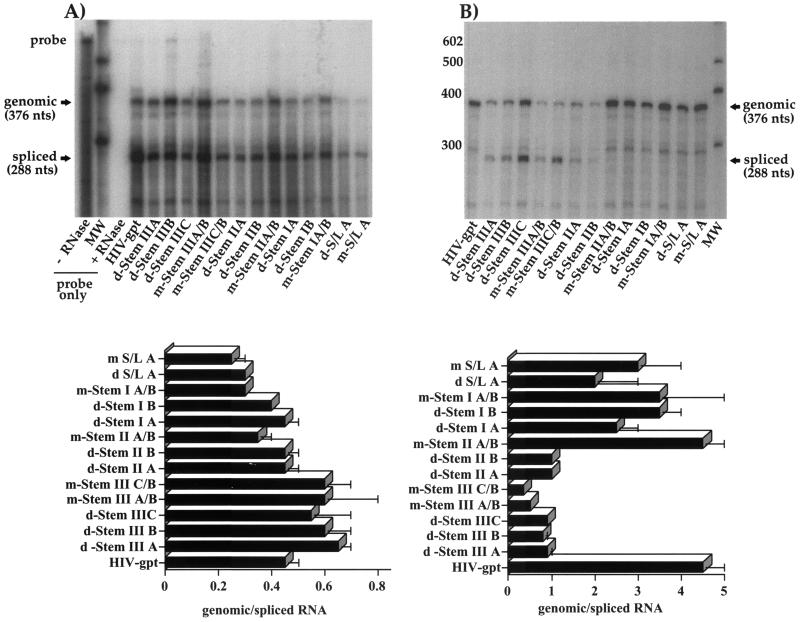
Quantitative RNase protection assays. Cytoplasmic (A) or virion-derived (B) RNAs were annealed to an excess of radiolabeled mutant-specific riboprobe and treated with single-strand-specific RNases, and the resulting protected fragments were separated on denaturing polyacrylamide gels. For each construct, the largest protected fragment (376 nt) corresponds to genomic RNA sequences whereas the second major fragment (288 nt) corresponds to spliced sequences. All riboprobes were also mixed with 2 μg of Escherichia coli tRNA and subjected to the assay with (+) or without (−) RNase treatment. Panel A includes an aliquot (1/20) of the wild-type probe without RNase treatment. MW, molecular weight markers (indicated in nucleotides). Each of the top panels shows an autoradiogram from one representative experiment; bottom panels depict composite data and standard errors from two independent RNase protection assays. Standard errors too small to depict graphically are not shown. Assays were performed exactly as previously described (10-12, 34) and were quantitated by phosphorimaging.
FIG. 3.
FIG. 3.
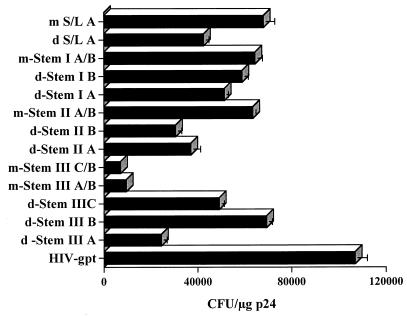
The infectivities of the various mutants were assayed in HOS cells and expressed as the number of Escherichia coli guanine phosphoribosyltransferase-positive (gpt+) CFU per microgram of viral p24 antigen. Assays of viral stocks from at least two transfection and infection assays yielded similar results. Standard errors too small to depict graphically are not shown. Colony formation assays were performed exactly as previously described (10-12, 34).
FIG. 4.
FIG. 4.
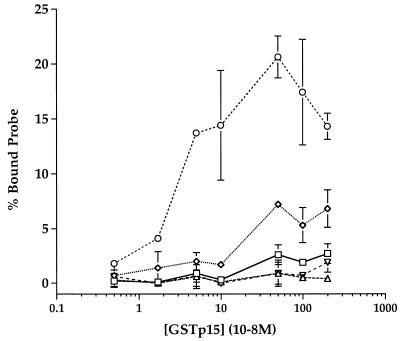
Filter-binding assay of glutathione S-transferase (GST)-p15 protein binding to radiolabeled HIV-1 leader-derived RNAs. The GST-p15 fusion protein was expressed and purified as described previously (9). Five radiolabeled RNAs were in vitro transcribed with T7 RNA polymerase from PCR-generated DNA products containing the T7 promoter positioned directly upstream from the desired nucleotide in the HIV-1 leader region. The TAR transcript (▵) extended from nucleotide positions +1 to 57 (57 nt), the poly(A) transcript (▿) extended from positions 58 to 104 (47 nt), the U5-PBS transcript (◊) extended from positions 104 to 242 (139 nt), and the SL1-to-SL4 transcript (○) extended from positions 241 to 354 (114 nt). An antisense RNA transcript which was the exact complement of the U5-PBS sequence, and hence extended from nt 242 to 104 (139 nt), was also synthesized (anti-U5-PBS) (□). Binding reactions were performed as described previously (9). Briefly, assays were performed in duplicate with a 30-μl reaction mixture containing the indicated amounts of GST-p15, 10 μg of E. coli tRNA, 5 U of RNase inhibitor, and 50,000 cpm (about 5 ng) of 32P-labeled transcript in 30 mM HEPES, 50 mM KCl, 10 μM ZnCl2, and 2 mM dithiothreitol, pH 7.5. After 15 min at 25°C, reaction mixtures were placed on prewetted nitrocellulose disks (0.45-μm pore size) and filtered through with 3 ml of the above-mentioned buffer before the filters were dried and quantitated by liquid scintillation counting. All data were corrected for background binding of the probe to filters in the absence of protein. Each data point and error bar indicates the mean ± standard error for duplicate determinations in a single representative experiment. All binding assays were repeated at least three times with similar results.
FIG. 5.
FIG. 5.
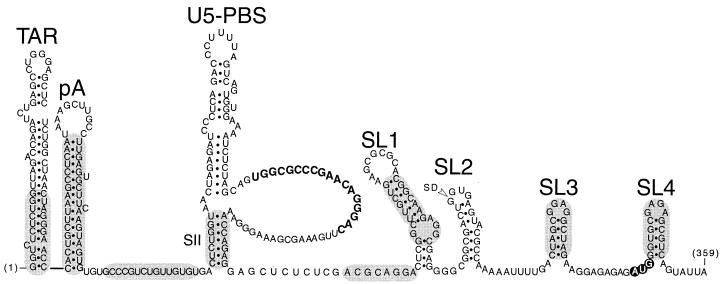
Working model of genetically verified RNA secondary structures and cis-acting packaging signals (shaded) within the first 359 nt of the HIV-1 genome. The shaded ovals represent those regions, identified here and in earlier studies (10-12), that have been shown genetically to be necessary for optimally efficient genomic RNA encapsidation.

References

    1. Aldovini, A., and R. A. Young. 1990. Mutations of RNA and protein sequences involved in human immunodeficiency virus type 1 packaging result in production of noninfectious virus. J. Virol. 64:1920-1926. - PMC - PubMed
    1. Beerens, N., F. Groot, and B. Berkhout. 2001. Initiation of HIV-1 reverse transcription is regulated by a primer activation signal. J. Biol. Chem. 276:31247-31256. - PubMed
    1. Berglund, J. A., B. Charpentier, and M. Rosbash. 1997. A high affinity binding site for the HIV-1 nucleocapsid protein. Nucleic Acids Res. 25:1042-1049. - PMC - PubMed
    1. Berkhout, B. 1996. Structure and function of the human immunodeficiency virus leader RNA. Prog. Nucleic Acid Res. Mol. Biol. 54:1-34. - PubMed
    1. Berkowitz, R., J. Fisher, and S. P. Goff. 1996. RNA packaging. Curr. Top. Microbiol. Immunol. 214:177-218. - PubMed

Publication types

LinkOut - more resources