


Evidence that 5-HT2A receptors in the hypothalamic paraventricular nucleus mediate neuroendocrine responses to (-)DOI
- PMID: 12417689
- PMCID: PMC6758011
- DOI: 10.1523/JNEUROSCI.22-21-09635.2002
Evidence that 5-HT2A receptors in the hypothalamic paraventricular nucleus mediate neuroendocrine responses to (-)DOI
Abstract
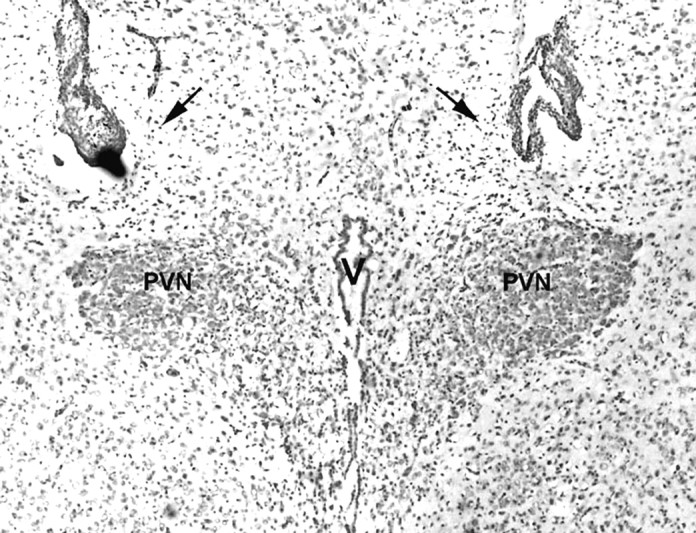
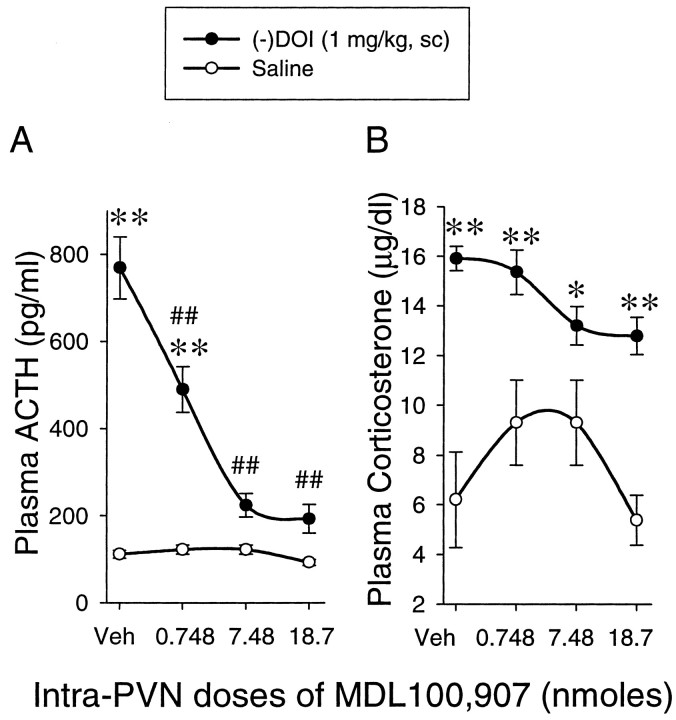
The present study determined whether the serotonin2A (5-HT2A) receptors in the hypothalamic paraventricular nucleus mediate the neuroendocrine responses to a peripheral injection of the 5-HT2A/2C receptor agonist (-)DOI [(-)1-(2,5-dimethoxy-4-iodophenyl)-2-aminopropane]. The 5-HT2A receptor antagonist MDL100,907 ((+/-)-alpha(2,3-dimethoxyphenyl)-1-[2-(4-fluorophenylethyl)]-4-piperidinemethanol), the 5-HT2C receptor antagonist SB-242084 (6-chloro-5-methyl-1-[[2-[(2-methyl-3-pyridyl)oxy]-5-pyridyl]carbamoyl]-indoline), or vehicle were microinjected bilaterally through a chronically implanted double-barreled cannula into the hypothalamic paraventricular nucleus 15 min before a peripheral injection of (-)DOI in conscious rats. (-)DOI significantly elevated plasma levels of oxytocin, prolactin, ACTH, corticosterone, and renin. Neither the 5-HT2A receptor antagonist nor the 5-HT2C receptor antagonist, injected alone, altered the basal levels of these hormones. MDL100,907 (0.748, 7.48, and 18.7 nmol) dose dependently inhibited the (-)DOI-induced increase in all of the hormones except corticosterone. In contrast, SB-242084 (10 nmol) did not inhibit (-)DOI-increased hormone levels. To confirm the presence of 5-HT2A receptors in the hypothalamic paraventricular nucleus, 5-HT2A receptors were mapped using immunohistochemistry. Densely labeled magnocellular neurons were observed throughout the anterior and posterior magnocellular subdivisions of the hypothalamic paraventricular nucleus. Moderately to densely labeled cells were also observed in parvicellular regions. Thus, it is likely that 5-HT2A receptors are present on neuroendocrine cells in the hypothalamic paraventricular nucleus. These data provide the first direct evidence that neuroendocrine responses to a peripheral injection of (-)DOI are predominantly mediated by activation of 5-HT2A receptors in the hypothalamic paraventricular nucleus.
Figures



References
-
- Aghajanian GK, Marek GJ. Serotonin model of schizophrenia: emerging role of glutamate mechanisms. Brain Res Rev. 2000;31:302–312. - PubMed
-
- Alper RH. Evidence for central and peripheral serotonergic control of corticosterone secretion in the conscious rat. Neuroendocrinology. 1990;51:255–260. - PubMed
-
- Appel NM, Mitchell WM, Garlick RK, Glennon RA, Teiteler M, de Souza EB. Autoradiographic characterization of (±)-1-(2, 5-dimethoxy-4-[125I]iodophenyl)-2-aminopropane ([125I]DOI) binding to 5-HT2 and 5-HT1c receptors in rat brain. J Pharmacol Exp Ther. 1990;255:843–857. - PubMed
-
- Bagdy G. Role of the hypothalamic paraventricular nucleus in 5-HT1A, 5-HT2A and 5-HT2C receptor-mediated oxytocin, prolactin and ACTH/corticosterone responses. Behav Brain Res. 1996;73:277–280. - PubMed
-
- Bagdy G, Makara GB. Hypothalamic paraventricular nucleus lesions differentially affect serotonin-1A (5-HT1A) and 5-HT2 receptor agonist-induced oxytocin, prolactin, and corticosterone responses. Endocrinology. 1994;134:1127–1131. - PubMed
Publication types
MeSH terms
Substances
Grants and funding
LinkOut - more resources
Full Text Sources
Other Literature Sources
