. 2002 Nov;14(11):2761-70.
doi: 10.1105/tpc.004911.

YABBY polarity genes mediate the repression of KNOX homeobox genes in Arabidopsis

Affiliations

YABBY polarity genes mediate the repression of KNOX homeobox genes in Arabidopsis

Mande K Kumaran et al. Plant Cell. 2002 Nov.

Abstract

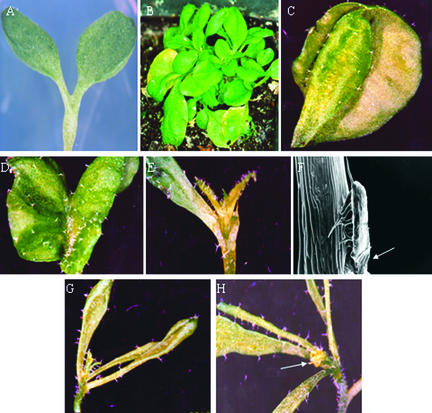
The YABBY (YAB) genes specify abaxial cell fate in lateral organs in Arabidopsis. Loss-of-function mutants in two early-expressing YAB genes, FILAMENTOUS FLOWER (FIL) and YAB3, do not exhibit vegetative phenotypes as a result of redundancy. Mutations in these genes result in the derepression of the KNOX homeobox genes SHOOTMERISTEMLESS (STM), BREVIPEDICELLUS, and KNAT2 in the leaves and in the partial rescue of stm mutants. Here, we show that fil yab3 double mutants exhibit ectopic meristem formation on the adaxial surfaces of cotyledons and leaf blades. We propose that in addition to abaxial specification, lateral organ development requires YAB function to downregulate KNOTTED homeobox genes so that meristem initiation and growth are restricted to the apex.


Figures
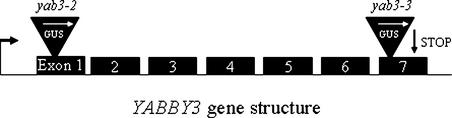
Figure 1.
Figure 1.
Different Alleles of YAB3 Generated by Ds Transposable Elements. The Ds gene-trap insertions in the yab3-2 and yab3-3 alleles are at nucleotide positions 191 and 755, respectively, with reference to the YAB3 mRNA sequence (ATG at 109).
Figure 2.
Figure 2.
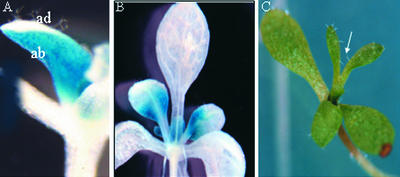
YAB3::GUS Expression in Heterozygotes, and Phenotype of fil-8 yab3-2 Plants. (A) YAB3::GUS in a leaf showing abaxial expression. ab, abaxial surface; ad, adaxial surface. (B) Strong YAB3::GUS expression at the leaf margins. (C) Bifurcated leaf of a fil-8 yab3-2 seedling (arrow).
Figure 3.
Figure 3.
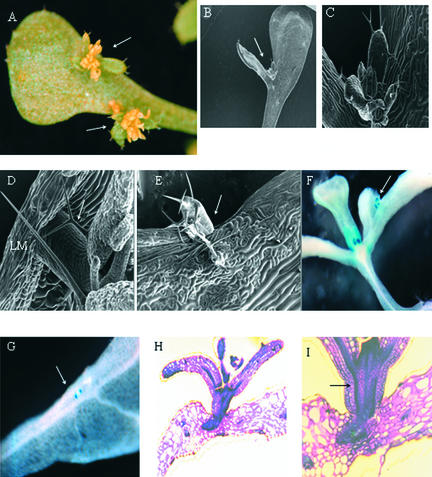
Induction of Ectopic Meristems on the Lateral Organs of fil-8 yab3-2 Plants. Arrows indicate the positions of ectopic meristems. (A) Ectopic inflorescence meristems on both sides of the leaf margin. (B) Ectopic meristem at the bifurcation point on a leaf. (C) Higher magnification of the meristem shown in (B). (D) Ectopic inflorescence meristem on a rosette leaf margin (LM). (E) Emergence of an ectopic meristem on the adaxial surface of a rosette leaf. (F) and (G) A YAB3::GUS marker was used to identify the emergence of ectopic meristems from cotyledon (F) and leaf (G). (H) Section of a leaf that has ectopic meristems reveals that they emerge from the vasculature tissues. (I) Differentiation of the procambium strand from the vein of a leaf producing ectopic meristems.
Figure 4.
Figure 4.
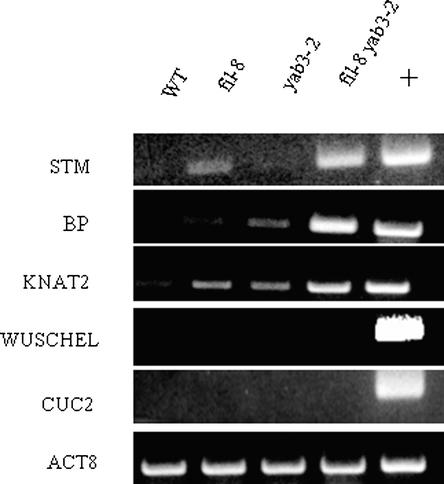
RT-PCR Analysis of Meristematic Genes in Mutant Leaves. RT-PCR analysis using gene-specific primers for STM, BP, KNAT2, WUS, and CUC2 on RNA from wild-type (WT), fil-8, yab3-2, and fil-8 yab3-2 leaves and control wild-type whole seedlings (+). ACTIN8 (ACT8) primers were used as an internal control.
Figure 5.
Figure 5.
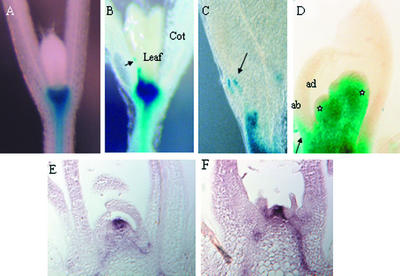
Misexpression of KNOX Genes in yab Mutants. (A) A wild-type seedling showing BP::GUS expression restricted to the meristematic regions and downregulated during lateral organ emergence. (B) BP::GUS expression persists in a fil-8 mutant in the leaf blades near the margins. The arrow indicates GUS expression in the leaf margin. (C) Enlarged view of the leaf shown in (B). (D) BP::GUS expression is observed in the abaxial tissues of leaves in a fil seedling. The arrow indicates GUS expression in the abaxial tissue layer of a fil-8 seedling leaf. The asterisks indicate younger leaves emerging from the SAM. ab, abaxial surface; ad, adaxial surface. (E) STM expression in wild-type plants is limited to the apical meristem and is excluded from leaf anlagen and primordia. (F) STM expression in fil-8 yab3-2 plants is not detected from leaf anlagen, as in the wild type.
Figure 6.
Figure 6.
Suppression of the stm-1 Phenotype in fil and fil yab3 Mutant Backgrounds. (A) The stm-1 mutant fails to initiate leaves. (B) stm-1 fil-8 double-mutant plants showing leaf proliferation but failure to produce flowers. (C) and (D) Lobed (C) and butterfly-shaped (D) leaves of stm-1 fil-8 double-mutant plants. (E) Proliferation of leaves from the apex of stm-1 fil-8 double-mutant plants. (F) Scanning electron microscopy analysis showing the emergence of a leaf (arrow) from the meristem in a fil-8 yab3-2 stm-1 triple-mutant seedling. (G) Formation of radialized leaves in fil yab3 stm triple mutants. (H) The arrow indicates the filamentous-like organs from the inflorescence apex of fil yab3 stm triple mutants.

References

    1. Barton, M.K., and Poethig, R.S. (1993). Formation of the shoot apical meristem in Arabidopsis thaliana: An analysis of development in the wild type and in shoot meristemless mutant. Development 119, 823–831.
    1. Bowman, J.L. (2000). The YABBY gene family and abaxial cell fate. Curr. Opin. Plant Biol. 3, 17–22. - PubMed
    1. Bowman, J.L., and Eshed, Y. (2000). Formation and maintenance of the shoot apical meristem. Trends Plant Sci. 5, 110–115. - PubMed
    1. Byrne, M.E., Ross, B., Mark, C., Arroya, J.M., Maitreya, D., Hudson, A., and Martienssen, R.A. (2000). asymmetric leaves1 mediates leaf patterning and stem cell function in Arabidopsis. Nature 408, 967–971. - PubMed
    1. Byrne, M.E., Simorwski, J., and Martienssen, R.A. (2002). ASYMMETRIC LEAVES1 reveals knox gene redundancy in Arabidopsis. Development 129, 1957–1965. - PubMed

Publication types