


East Asian genotypes of Helicobacter pylori strains in Amerindians provide evidence for its ancient human carriage
- PMID: 12417749
- PMCID: PMC137551
- DOI: 10.1073/pnas.242574599
East Asian genotypes of Helicobacter pylori strains in Amerindians provide evidence for its ancient human carriage
Abstract
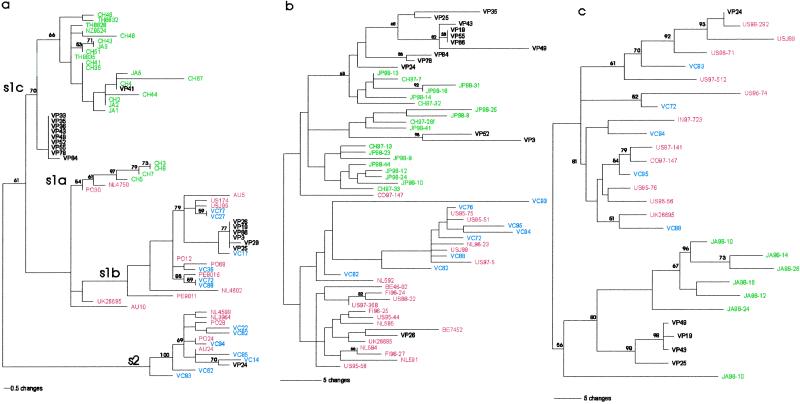
Phylogenies of indigenous microbes have been used as surrogates for the origins of the hosts that carry them. Conversely, polymorphisms may be used to date the spread of a microbial species when information about their host populations is available. Therefore, we examined polymorphisms in Helicobacter pylori, which persistently colonize the human stomach, to test the hypothesis that they have been ancient inhabitants of humans. Three H. pylori loci that previously have been shown to have phylogeographic affinity have been analyzed for two populations with different ethnic origins from Venezuela. In a group of Amerindian subjects from Amazonia, East Asian H. pylori genotypes were present for each of the loci examined but were absent in a mestizo population from Caracas. These findings provide evidence that H. pylori has been present in humans at least since ancestors of Amerindians migrated from Asia more than 11,000 years ago.
Figures
References
-
- Hoffecker J. F., Powers, W. R. & Goebel, T. (1993) Science 259, 46-53. - PubMed
-
- Di Rienzo A. & Wilson, A. C. (1991) Ann. Hum. Genet. 88, 1597-1601.
Publication types
MeSH terms
Associated data
- Actions
- Actions
- Actions
- Actions
- Actions
- Actions
- Actions
- Actions
- Actions
- Actions
- Actions
- Actions
- Actions
- Actions
- Actions
- Actions
- Actions
- Actions
- Actions
- Actions
- Actions
- Actions
- Actions
- Actions
- Actions
- Actions
- Actions
- Actions
- Actions
- Actions
- Actions
- Actions
- Actions
- Actions
- Actions
- Actions
- Actions
- Actions
- Actions
- Actions
- Actions
- Actions
- Actions
- Actions
- Actions
- Actions
- Actions
- Actions
- Actions
- Actions
- Actions
- Actions
- Actions
- Actions
- Actions
- Actions
- Actions
- Actions
- Actions
- Actions
- Actions
- Actions
- Actions
- Actions
- Actions
- Actions
- Actions
- Actions
- Actions
- Actions
- Actions
- Actions
- Actions
- Actions
- Actions
- Actions
- Actions
- Actions
- Actions
- Actions
- Actions
- Actions
- Actions
- Actions
- Actions
- Actions
- Actions
- Actions
- Actions
- Actions
- Actions
- Actions
- Actions
- Actions
- Actions
Grants and funding
LinkOut - more resources
Full Text Sources
