Influence of psychological coping on survival and recurrence in people with cancer: systematic review
- PMID: 12424165
- PMCID: PMC131179
- DOI: 10.1136/bmj.325.7372.1066
Influence of psychological coping on survival and recurrence in people with cancer: systematic review
Abstract
Objective: To summarise the evidence on the effect of psychological coping styles (including fighting spirit, helplessness/hopelessness, denial, and avoidance) on survival and recurrence in patients with cancer.
Design: Systematic review of published and unpublished prospective observational studies.
Main outcomes measures: Survival from or recurrence of cancer.
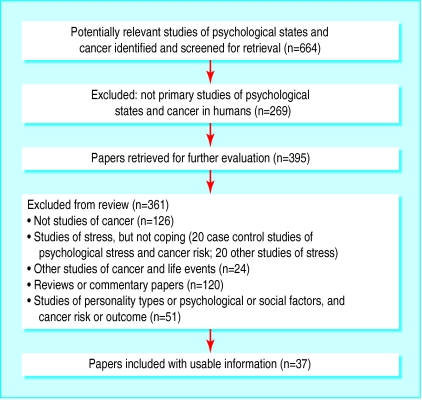
Results: 26 studies investigated the association between psychological coping styles and survival from cancer, and 11 studies investigated recurrence. Most of the studies that investigated fighting spirit (10 studies) or helplessness/hopelessness (12 studies) found no significant associations with survival or recurrence. The evidence that other coping styles play an important part was also weak. Positive findings tended to be confined to small or methodologically flawed studies; lack of adjustment for potential confounding variables was common. Positive conclusions seemed to be more commonly reported by smaller studies, indicating potential publication bias.
Conclusion: There is little consistent evidence that psychological coping styles play an important part in survival from or recurrence of cancer. People with cancer should not feel pressured into adopting particular coping styles to improve survival or reduce the risk of recurrence.
Figures
Comment in
-
Psychological coping and cancer. Study results should not have been dismissed.BMJ. 2003 Mar 15;326(7389):598; author reply 598. doi: 10.1136/bmj.326.7389.598/a. BMJ. 2003. PMID: 12637410 Free PMC article. No abstract available.
-
Psychological coping and cancer. Search strategy used is inadequate.BMJ. 2003 Mar 15;326(7389):598; author reply 598. BMJ. 2003. PMID: 12641073 No abstract available.
-
Review: limited evidence exists on the effect of psychological coping styles on cancer survival or recurrence.Evid Based Nurs. 2003 Jul;6(3):88. doi: 10.1136/ebn.6.3.88. Evid Based Nurs. 2003. PMID: 12882201 No abstract available.
References
-
- Reynolds P, Hurley S, Torres M, Jackson J, Boyd P, Chen V. Use of coping strategies and breast cancer survival: results from the Black/White cancer survival study. Am J Epidemiol. 2000;152:940–949. - PubMed
-
- Greer S, Morris T, Pettingale K. Psychological response to breast cancer: effect on outcome. Lancet. 1979;ii:785–787. - PubMed
-
- Pettingale K. Coping and cancer prognosis. J Psychosom Res. 1984;28:363–364. - PubMed
-
- Pettingale K, Morris T, Greer S, Haybittle J. Mental attitudes to cancer: an additional prognostic factor. Lancet. 1985;i:750. - PubMed
-
- Greer S, Morris T, Pettingale K, Haybittle J. Psychological response to breast cancer and 15-year outcome. Lancet. 1990;335:49–50. - PubMed
Publication types
MeSH terms
LinkOut - more resources
Full Text Sources
Other Literature Sources